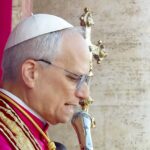

Wojciech Rogacin – Vatican
As Vatican News reports, the culmination will be a Mass presided over by the Pope on November 18, the anniversary of the consecration.
The basilica’s archpriest, Cardinal Mauro Gambetti, spoke in Rome about the celebrations marking 400 years since St. Peter’s Basilica’s consecration. He said they offered an opportunity to understand the basilica anew as an authentic event in human history. The archpriest added that Pope Julius II’s 1506 decision to demolish the old Constantinian basilica and build a new one in its place represented renewal in continuity. The tomb of the Apostle Peter remained untouched and formed the center of the new design, in keeping with Renaissance culture and theology.
The celebrations marking 400 years since the basilica was built combine spirituality, deeper knowledge, historical testimony and a modern approach that uses digital technology to engage pilgrims visiting the basilica.
New Stations of the Cross, meditations and Mass with the Pope
A new Stations of the Cross will be inaugurated in the basilica on February 20. It was created by Swiss artist Manuel Dürr, winner of the international public competition announced in 2023 by the Fabric of St. Peter.
Every Saturday at 3:30 p.m., prayer gatherings and polyphonic singing will take place at the Altar of the Chair, with Cappella Giulia.
Three Petrine Meditations are also planned at the Altar of the Chair, devoted to the Apostle Peter’s human journey and faith as read in the light of the Gospels and the Acts of the Apostles. The preacher of the Papal Household, Father Roberto Pasolini, will deliver them on three consecutive Tuesdays, November 3, 10 and 17, at 7 p.m.
The spiritual celebrations will culminate in a solemn Eucharistic celebration presided over by the Holy Father on November 18, the anniversary of the basilica’s consecration.

Spirituality, history and art
Three pastoral sessions will offer a better understanding of the church’s liturgical, pastoral and spiritual, historical and cultural dimensions. On March 24, lectures on the basilica’s history, architecture and mosaic decoration will be given by Dr. Barbara Jatta, Dr. Pietro Zander and Professor Vitale Zanchettin.
On May 26, Monsignor Corrado Maggioni, Professor Marco Guzzi and Professor Valentino Miserachs will discuss the liturgy, the development of music and singing in the basilica, and the vision of the Church from the seventeenth century to the present.
On October 13, Professor Caterina Bruno, Professor Vito Mignozzi and Father Andrea Lonardo will speak about the meaning of pilgrimage to the tomb of the Apostle Peter, the basilica’s universal role and its pastoral vocation.
Quo Vadis routes in the footsteps of the Apostles
The basilica’s jubilee will include Quo Vadis pilgrimage routes following Peter and Paul through Rome. A performance of Michele La Ginestra’s play Peter and Paul in Rome is also planned for the Solemnity of Saints Peter and Paul.
Pilgrims will gain access to spaces that are usually closed, including the octagonal rooms, which house such spaces as the sacristy, as well as the entire basilica terrace. Visitors will also be able to see the Gregorian and Clementine domes, among other features.
Permanent multimedia displays will explore the church’s construction and conservation. An exhibition will trace the design and building of the Vatican basilica, from architect Bramante’s earliest sketches to the completion of the work by Maderno.

An app and digital services
Other important services will be introduced. Visitors to the basilica will be able to use a smartphone app with readings, chants and simultaneous translation in 60 languages.
Worshippers will be able to follow the principal celebrations in their chosen language on their own smartphones. This will also be possible without the app, by scanning a QR code at the basilica entrance.
A whole new digital ecosystem will also be launched, including a new booking system with real-time reservations for entry to the basilica, Smart Pass. Integrated with the official platform www.basilicasanpietro.va, the service will let visitors check the availability of expedited access and make reservations, helping manage visitor flows in a more orderly way. An advanced presence-monitoring system will be introduced to analyze visitor movements, increase safety and improve the management of spaces.
A dedicated digital platform will also allow pilgrims and tourists to share their experience of visiting the basilica by writing a message on a social wall, leaving a prayer intention or publishing a photograph taken outside the basilica.
The Michelangelus font and a monitoring system
The basilica’s jubilee will also be marked by the release of a special font, Michelangelus. According to Cardinal Gambetti, it is inspired by Buonarroti’s handwriting and was developed by Studio Gusto. It will be included in Microsoft Office.
The Fabric of St. Peter will receive a new system for monitoring the church’s structures so that it can carry out all necessary conservation work on an ongoing basis.

An open gateway
As Cardinal Gambetti stated, the 400-year-old St. Peter’s Basilica is a living memory of our faith in Jesus Christ and an open gateway for everyone seeking God, as reflected in the scale of the building and Bernini’s great colonnade in St. Peter’s Square.

Read also: Trevi Fountain fees and the debate on Rome’s cultural heritage · St. Peter’s Basilica opening hours reported in June 2026.
Directory: Polish institutions and community organizations in the United States.