Eugenio Murrali – Vatican
These are themes that evoke the importance of the civic role of art, as emphasized in an interview with Vatican News by Marco Ramazzotti, a lecturer in Sustainable Tourism Sciences at La Sapienza University in Rome.
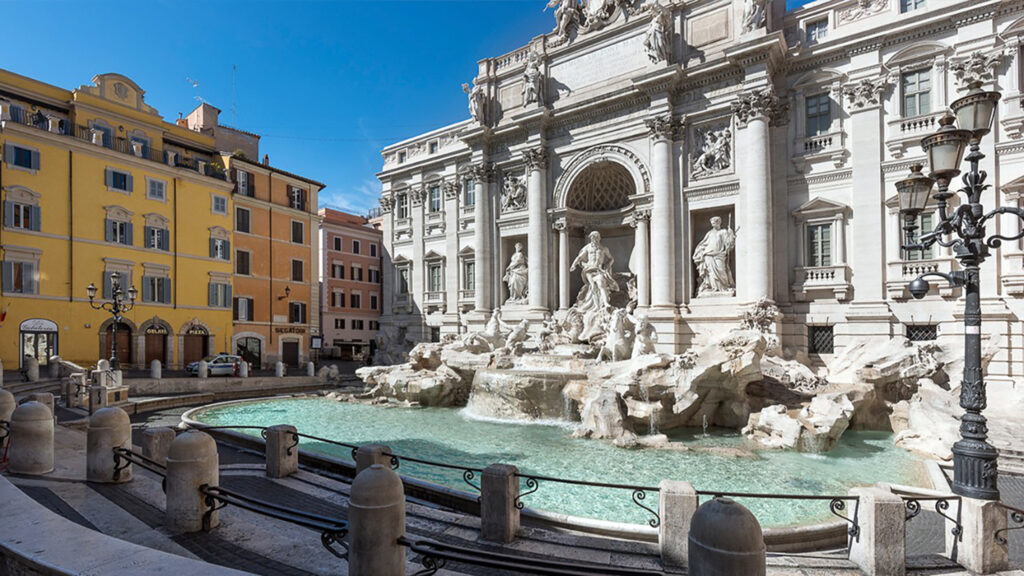
This is a story as old as water – more precisely, the Acqua Vergine – which began to flow in the center of Rome since the time of Emperor Augustus, and from the 18th century found its outlet in one of the most famous and beloved monuments in the world – the Trevi Fountain.
In 1731, Pope Clement XII announced a competition and chose Nicola Salvi to erect a magnificent marble scenography, intended to celebrate this life-giving element. Since then, the Trevi Fountain has pulsed with life in the heart of the city, announcing itself to Romans and visitors already on nearby streets with its murmur and imposing its monumentality on the eyes of those who approach.
Piranesi, Fellini, Renato Rascel, Totò – these are just some of the most famous artists who, in various ways, made it the protagonist of their works. From the beginning of this month, however, to see the famous basin up close, which, with the iconic coin toss, collects the dreams and hopes of visitors and the promise of returning to the Eternal City, a ticket will be required – payable for those outside Rome.
Other paid sites in Rome will include: the “Giovanni Barracco” Museum of Ancient Sculpture, the “Carlo Bilotti” Museum – Orangery in Villa Borghese, the “Pietro Canonica” Museum, the Napoleonic Museum, and the Villa di Massenzio.
Preserve and Disseminate
It will cost 2 euros to descend the steps to the fountain itself. Residents of Rome are exempt from the fee. The aim is to reduce crowding at the fountain and, at the same time, generate revenue needed for the maintenance of this and other monuments.
“Anyone who lives in Rome or anyone who has visited it remembers the Trevi Fountain as a more or less chaotic place, accessible to all, but free of charge,” notes Marco Ramazzotti, archaeologist and lecturer in Sustainable Tourism Sciences at La Sapienza University. “The introduction of a ticket will result, as data already seems to confirm, in more regulated and orderly visits, and above all, will help avoid excessive crowding.”
As he emphasizes, the revenue from the two-euro ticket will enable better protection and promotion of this and other sites in the Italian capital. “However,” he adds, “since the Trevi Fountain is a heritage of humanity, what is the point of distinguishing between paying non-residents and non-paying residents?”
Ramazzotti’s words concern not so much foreign tourists, who – in his opinion – will gladly buy a ticket, but primarily people coming from nearby Italian provinces, where there is an “urgent need for education in understanding, protecting, and valuing heritage,” a need for “educating for beauty.”
Will the “public of art” disappear?
An objective fact is the increase in tourism. 2025 was a record year in terms of arrivals. The Rome Tourism Department estimates that approximately 23 million tourists arrived from Italy and abroad, in addition to the pilgrims who came for the Jubilee Year – there were over 30 million of them, according to the Holy See.
Those who must manage a precious and fragile cultural history bear an objective responsibility. “When, in order to gain access to understanding, research, and use of tangible and intangible heritage, one has to pay – even a little – what Giulio Carlo Argan, in one of his essays, called the ‘public of art’ disappears, meaning the role of art in building civic values and respect for constitutional principles.”
Ramazzotti’s doubts also concern the risk of musealization of artistic sites and monuments, “whose significance stems from being part of the landscape, a dynamic and living context.”
Sustainable tourism
However, proponents of introducing fees have the argument of hyper-tourism. The problem of excessive tourism is an undeniable fact in Italy and elsewhere, and in some cases, even a crisis situation. It can be counteracted through a range of diverse solutions that reconcile the issue of democratic accessibility with the need for protection. One way is to cultivate a conscious citizen and a conscious visitor who will not fall into the trap of consumerist, hedonistic tourism.
“Because today people work too much, with relatively low wages, a strong need to escape, to use cultural goods on a ‘drop-in and drop-out’ basis, is created,” believes Ramazzotti. According to the archaeologist, this phenomenon of fast tourism is often fueled by international tourism corporations. This can lead to a lack of respect for societies, nature, and culture.
To avoid risky concentrations, it would be important to “rediscover and promote small towns, villages, encourage decentralization of traffic,” encouraging tourism in the peripheries, in the metropolitan area and further – in the provinces, also rich in treasures – suggests the scholar.
Youth and the risk of virtual art reception
Również wobec postawy młodych pokoleń wobec sztuki Marco Ramazzotti zachowuje wyważone spojrzenie. „Naszym nowym pokoleniom staramy się przekazywać umiejętność krytycznego myślenia i odporności, mając nadzieję, że pomoże im to odnosić się także – choć nie tylko – do dziedzictwa kulturowego” – zauważa.
He argues that the technological revolution and artificial intelligence – “which, as we know, has no ethics” – offer young people new opportunities but also pose new challenges, requiring intellectual tools capable of meeting them. Virtuality, “in a sense, a molecular representation of a historical and cultural object,” plays an increasingly important role in the recipient’s relationship with artistic heritage and often distracts us from the tactile and perceptual dimension, presenting an image that can be distorted by algorithms.
On the other hand, virtual landscapes, augmented reality, and digital tours often stand on solid and important research projects, and their contribution to understanding heritage – also in three dimensions and on a historical plane – should not be underestimated.
However, there is a real danger for young people: an additional temptation to solitude in these digital reconstructions of the past, which, however perfect, can lead to a detachment from the desire for direct, sensory experience of heritage, encounter, and true sharing of it.