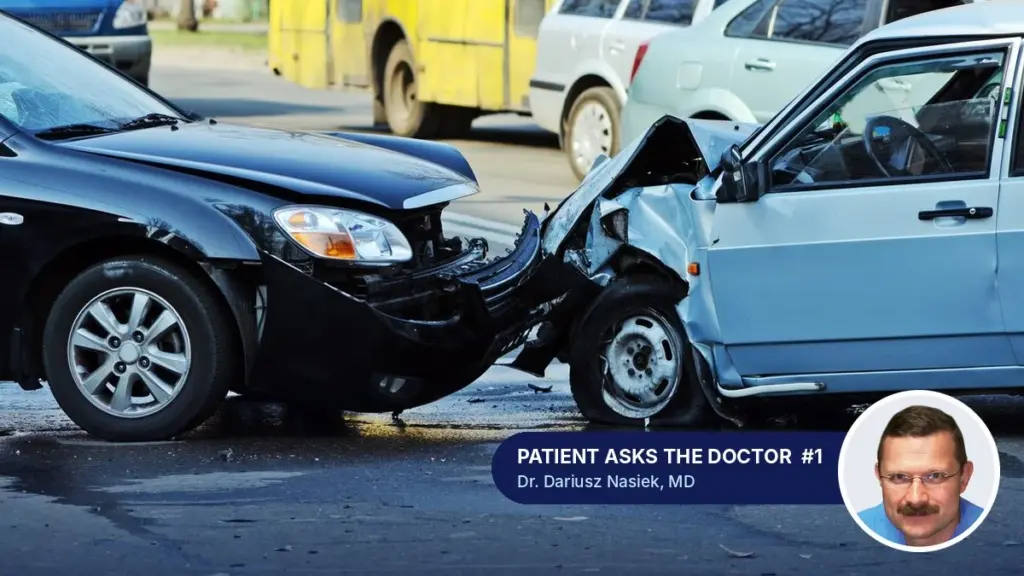
A fender bender, a repaired car, an insurance check and peace of mind. Then, months later, the family says: “You’ve changed.” Doctors in New Jersey and New York hear stories like this more often than you might think. Sudden irritability, forgetfulness and poor sleep can point to a brain injury no one recognized. We asked Dr. Dariusz Nasiek, a pain specialist who treats accident patients, how to catch it and whether a year later is too late.
This is the first installment of “A Patient Asks the Doctor,” a series in which Dr. Nasiek answers questions from people injured in accidents. This time the question came from a man whose car was hit hard from behind a year ago. The back of the car had to be replaced, he felt fine and he never saw a doctor. Now his family says he has changed beyond recognition.
The injury no one asked about
According to Dr. Nasiek, the most likely explanation is an unrecognized traumatic brain injury (TBI) and its aftermath, known as post-concussion syndrome. He stresses that this is not rare: research and clinical experience suggest it affects about 10–20 percent of people involved in motor vehicle accidents. The most common reason it goes undetected is simple: no one asked.
Three myths about concussion
- “I would have had to hit my head.” Not true. In a rear-end collision, the head snaps backward and forward and the brain moves inside the skull. A direct blow is not required.
- “But I never lost consciousness.” A concussion can happen without loss of consciousness.
- “My CT scan was normal.” A normal CT scan does not rule out a concussion.
Dr. Nasiek notes that even people who went to the emergency room after a crash often leave without this diagnosis. ER physicians rightly focus on ruling out life-threatening injuries. In a frequently cited study, 56 percent of patients who met the criteria for mild traumatic brain injury had no related diagnosis in their ER records.
Why the symptoms are so easy to dismiss
Brain injury symptoms masquerade as other problems. We blame headaches on whiplash, dizziness on a neck injury, irritability and poor sleep on stress, and memory and concentration problems on fatigue or medication. Often the first to notice a change are not the injured people themselves but those closest to them: someone becomes nervous, withdrawn or forgetful. For a doctor, that is an important signal.
A quick check: three questions after a crash
Dr. Nasiek suggests that anyone who has been in an accident answer three questions honestly:
- Did I feel dazed or confused after the accident?
- Do I have a memory gap around the moment of the crash or right after it?
- Do the people close to me say I’m “not the same”?
A single “yes,” or a recovery that isn’t going the way it should, is a reason to get evaluated.
A year later is not too late
The doctor’s reassurance: a brain injury can still be properly evaluated a year later, with a neurological examination, memory and concentration testing and, if needed, specialized imaging. A diagnosis opens the door to treatment that helps people get back to better health, to work and to their families. It also brings relief, because it explains what is going on: not a change in personality, but an injury that has a name and can be treated. Thorough medical documentation also matters for people whose injury claim is still pending.
Where to get evaluated, in English or Polish
Allied Neurology & Interventional Pain Practice, P.C., co-founded by Dr. Dariusz Nasiek, has been treating accident patients for 20 years. It performs brain injury evaluations at offices in Englewood, Garfield, East Orange and Elizabeth, New Jersey, and in Rego Park and Washington Heights, New York. Staff also speak Polish.
Dr. Dariusz Nasiek, MD, is a Board-Certified Anesthesiologist, Board-Certified in Pain Medicine and a Board-Certified Interventional Pain Physician. He is a co-author of “Brain Impact: Navigating Traumatic Brain Injury After Accidents,” a book about brain injuries after accidents. Read more in our earlier article on early detection of brain injuries after accidents.
Allied Neurology & Interventional Pain Practice, P.C.
Phone: 201-894-1313
Call or text in Polish: 973-773-7730
Dr. Nasiek’s profile in the Polish Pages directory »
This article is for general information and is not a substitute for medical advice. If you have worrying symptoms after an accident, contact a doctor.