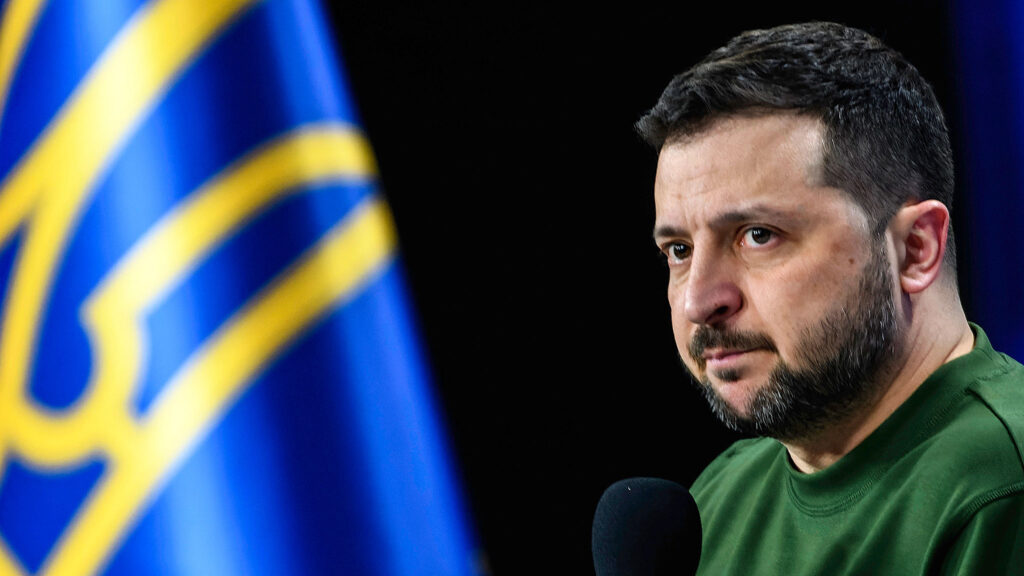
Therefore, the proposal by President Karol Nawrocki for the Order’s Chapter to consider stripping Ukrainian President Volodymyr Zelenskyy of this award is an almost unprecedented event. The Chapter meeting is scheduled for June 8. For the American Polonia, which has supported Ukraine financially, organizationally, and emotionally since the beginning of the Russian invasion, this is a difficult moment — because it forces them to confront a question that has been preferred to be postponed for three years of war: where does solidarity end and memory begin.
What happened
The spark was a decision made by Volodymyr Zelenskyy via a decree dated May 26, 2026, widely reported the next day. The President of Ukraine bestowed upon one of the units of the Ukrainian armed forces — the Separate Special Operations Center “North” — the honorary name “named after the Heroes of the UPA.” He justified this, as reported by the media, with the desire to “restore the historical traditions of the national army” and the exemplary performance of tasks in defending Ukraine’s territorial integrity. In the official Ukrainian historical narrative, the Ukrainian Insurgent Army is presented as part of the Ukrainian liberation movement, whose goal was to rebuild Ukrainian statehood. For Poland — and this is a fact that cannot be overlooked in the Polish debate — the UPA remains primarily a formation co-responsible for the Volhynian Massacre and the anti-Polish ethnic cleansing by OUN-UPA, in which, from the turn of 1942/1943 to 1945, according to cautious historical estimates, about one hundred thousand Poles died in Volhynia, Eastern Galicia, and parts of today’s Polish territories.
This tension is not new. It is one of the most difficult knots in the entire history of Polish-Ukrainian relations and returns regularly — usually when one of the parties makes a symbolically significant decision. This time, the decision came at a particular moment: during a war that Ukraine is fighting for survival, and which Poland — along with Polonia worldwide — supports like few other countries.
A reaction that divided the ruling party
The most interesting aspect of the whole matter is that the reaction to Nawrocki’s proposal did not run along the lines of “Poland versus Ukraine,” but rather across the Polish political scene. The President, who comes from the right-wing camp, reacted most strongly — announcing a motion to the Chapter. He emphasized that “Ukraine can shape its memory policy, but Poland also has the right to shape its own.” He received Zelenskyy’s decision, as he said, “with great sadness, because this is not how relations between nations are built.”
But Donald Tusk’s government — though equally critical of Zelenskyy’s decision itself — reacted differently to the idea of revoking the order. Prime Minister Tusk appealed to both presidents on social media for prudence, warning, in his characteristic style, “before it’s too late.” Deputy Prime Minister and Minister of Defense Władysław Kosiniak-Kamysz called Zelenskyy’s decision “unacceptable” and said it “reopens wounds of the past” — but at the same time noted that if he were in Nawrocki’s place, he would have reacted differently: he would have called Zelenskyy instead of resorting to a symbolic gesture. He described Nawrocki’s gesture as “symbolic, important.” This distinction — between evaluating Zelenskyy’s decision and evaluating Nawrocki’s reaction — is the essence of the Polish dispute currently unfolding.
Legal and customary aspects
Formally, the president has the right to such a move. According to Article 36 of the Act on Orders and Decorations, the head of state may strip an award from a person who has become “unworthy” of wearing it. As Bronisław Wildstein, a publicist and himself a Knight of the Order of the White Eagle and a member of the Chapter, notes, the president “is the host of the order” and has the right to introduce new issues for deliberation. Zelenskyy was awarded the Order on April 5, 2023, by then-President Andrzej Duda — the justification cited “distinguished merits in deepening friendly relations between Poland and Ukraine.” Less than three years later, the same order became the subject of the most serious symbolic dispute between Warsaw and Kyiv since the beginning of the war.
The decision to potentially strip Volodymyr Zelenskyy of the Order of the White Eagle can be made by the President of the Republic of Poland — after consulting the Order’s Chapter. The Chapter meeting scheduled for June 8 is therefore the beginning of the advisory procedure, not the final resolution itself. It is worth remembering that the president’s proposal is only the first step, not the finale — and that in the Polish public debate, voices appear both supporting this move and warning that during the ongoing war, it could weaken the position of both countries against Russia, whose propaganda has long tried to sow discord between Warsaw and Kyiv.
What this means for Polonia in the USA
For Polonia in the United States, this dispute is particularly uncomfortable because it touches upon two loyalties that have gone hand in hand for the past three years. On the one hand, many American Polonia communities actively supported Ukraine — from humanitarian collections in parishes to appeals to American politicians to maintain aid for Kyiv. On the other hand, the memory of the victims of the Volhynian crime is alive in many Polish-American families, passed down from generation to generation, often by the same grandparents who fled the war and built Polish America. The matter of the order forces these two loyalties to meet — and does not offer an easy answer.
Because the truth that must be confronted is uncomfortable for both sides. Poland has every right to demand remembrance for its victims — not as an act of hostility towards today’s Ukraine, but as a condition for honest neighborliness. And at the same time, Ukraine, fighting for survival, builds its national identity on heroes whom Poland mourns as executioners. These two truths cannot be reconciled with a single gesture — neither by naming a military unit nor by revoking an order. What this matter truly requires is a conversation, which — as even Minister Kosiniak-Kamysz, critical of Zelenskyy, noted — has so far been lacking. The Order of the White Eagle has survived over three hundred years precisely because it was almost never revoked. After the opinion issued by the Chapter on June 8, the final word will still belong to the president. The question is: is this one time worth it.
Kamil Brzozowski, editor of poland.us. For more political commentary by Kamil Brzozowski, please visit poland.us. Polish business, institution, and expert directory: PolishPages.com.
📱 Download the PolishPages app:
App Store (iPhone) | Google Play (Android)