Craftsmen, without whom the colony would not have survived
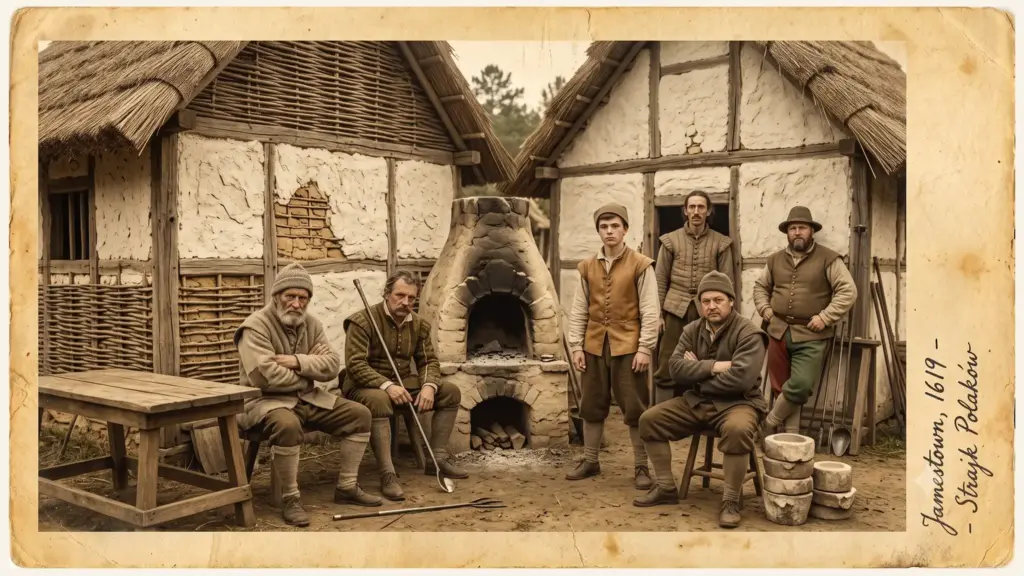
Polish specialists arrived in Jamestown as early as 1608, brought by Captain John Smith — the same one whose name is today mainly associated with the legend of Pocahontas. Among them were glassmakers, tar and potash producers, and carpenters. This was no accident — the colony needed something that could be sold back to Europe, and the products of Polish craftsmen — glass, tar, potash — became the first export goods from the New World.
The work was hard and thankless, but without these skills, the young colony would have had little chance of surviving its first, most difficult years. Poles were therefore not an addition to Jamestown’s history from the beginning, but an integral part of it — even though their names rarely appear in textbooks today.
1619 — and doors closed in their faces
When the first elections in history were held in the colony in 1619 (to the so-called House of Burgesses, the first elected legislative body in English America), it turned out that only settlers of English descent were entitled to vote. About fifty Polish craftsmen and their families were excluded from this — even though it was their work that kept the colony alive.
The reaction was immediate and, for those times, unprecedented. The Poles refused to continue working until they were granted the right to vote. This was an act of courage — in a colony where every pair of hands was worth its weight in gold, defying authority carried real risk. And yet the strike worked.
When skills proved stronger than origin
On July 21, 1619, the Virginia Company Council, which administered the colony, met to resolve the dispute. Under pressure from real economic losses — because without Polish specialists, the export of glass and tar would simply stop — the colonial authorities withdrew their decision to deny Poles the right to vote.
This was a moment when professional skills proved a stronger argument than ethnic origin — a precedent whose effects much later, albeit indirectly, would be felt throughout the entire American tradition of labor rights. Historians recognize the events in Jamestown as the first documented strike in North America, more than a century and a half before the United States itself was founded.
Why this story still matters
It’s easy to say today that this is just a curiosity from four centuries ago. But in the year the United States celebrates its 250th anniversary of independence, it’s worth remembering that the Polish presence on this continent began long before Kościuszko and Pułaski — and that the first mark Poles left in American history was a fight for simple justice, not grand politics.
This is a good punchline for today: sometimes the most important pages of history are written not by generals and politicians, but by craftsmen who simply refused to work for free without the right to vote — and won.
Ewelina Modrzejewska, Poland.US (Voice of Polonia in the USA). More from the “Invisible Polonia” series at poland.us.
📱 Download the PolishPages app:
App Store (iPhone) | Google Play (Android)