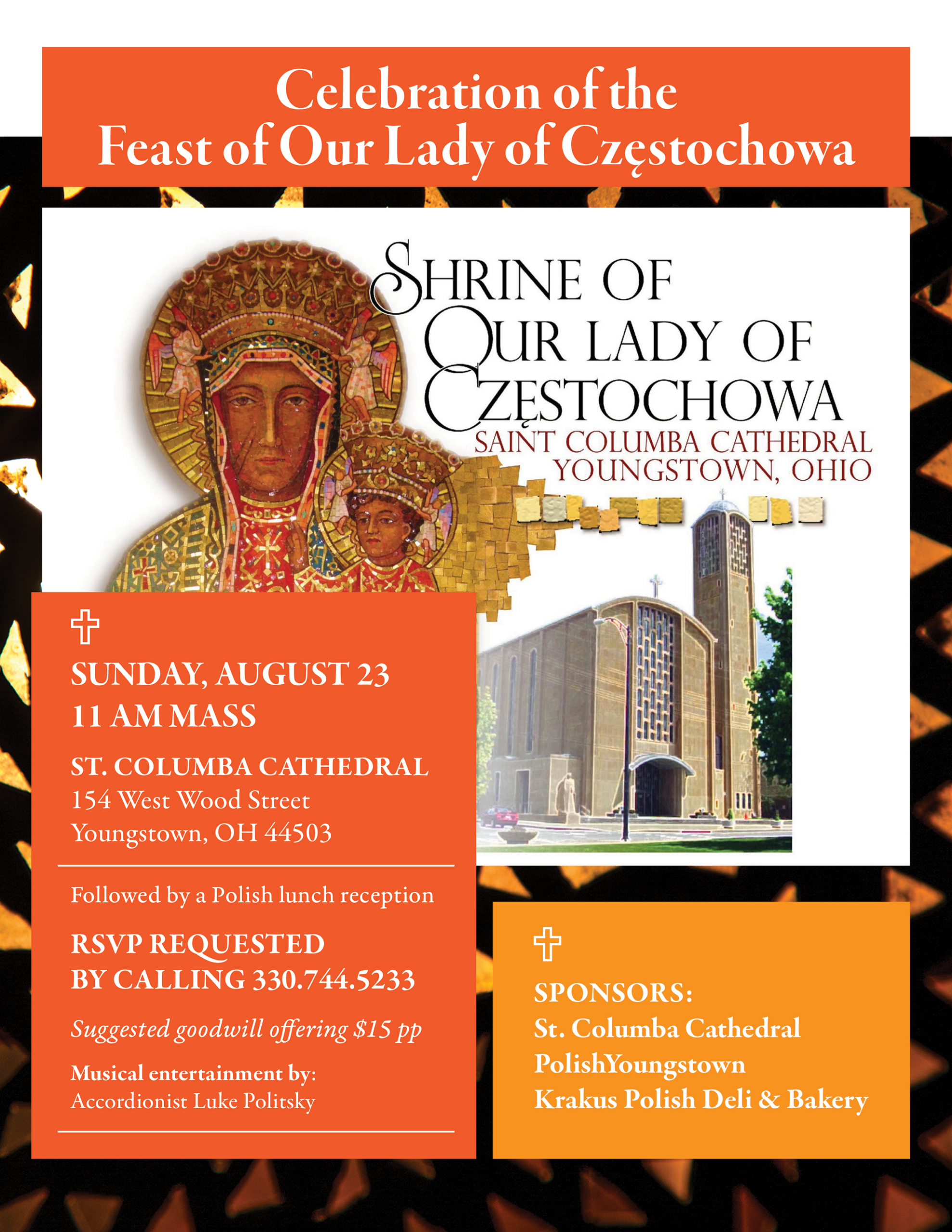
Mass in honor of Our Lady of Częstochowa will take place on Sunday, August 23, 2026, at 11:00 AM at St. Columba Cathedral at 154 W. Wood Street in Youngstown, Ohio. A Polish dinner will follow the Mass in the cathedral hall. Admission is free; suggested donation for dinner is $15.
On Sunday, August 23, St. Columba Cathedral in Youngstown will resonate with Polish hymns. The Mass in honor of Our Lady of Częstochowa—the Black Madonna—will begin at 11:00 AM, followed by a Polish dinner in the cathedral hall. Admission to the Mass is free and open to everyone.
The event is organized by PolishYoungstown and St. Columba Cathedral. The celebrant will be Msgr. Robert J. Siffrin, and other Slavic priests from the diocese have also been invited. The liturgy will feature traditional Polish hymns, and the faithful will join together to sing “Czarna Madonna” (The Black Madonna).
Dinner in the Cathedral Hall
Following the Mass, participants will gather in the cathedral hall for a Polish dinner sponsored by Krakus Polish Deli & Bakery. Accordionist Luke Politsky will perform.
The organizers kindly request that attendees RSVP for the dinner by phone so they know how many portions to prepare. The suggested donation is $15 per person, but it is a voluntary contribution, not a ticket price. Youngstown State University students attend free of charge with a valid student ID.
Shrine Featuring Mosaics from a Closed Church
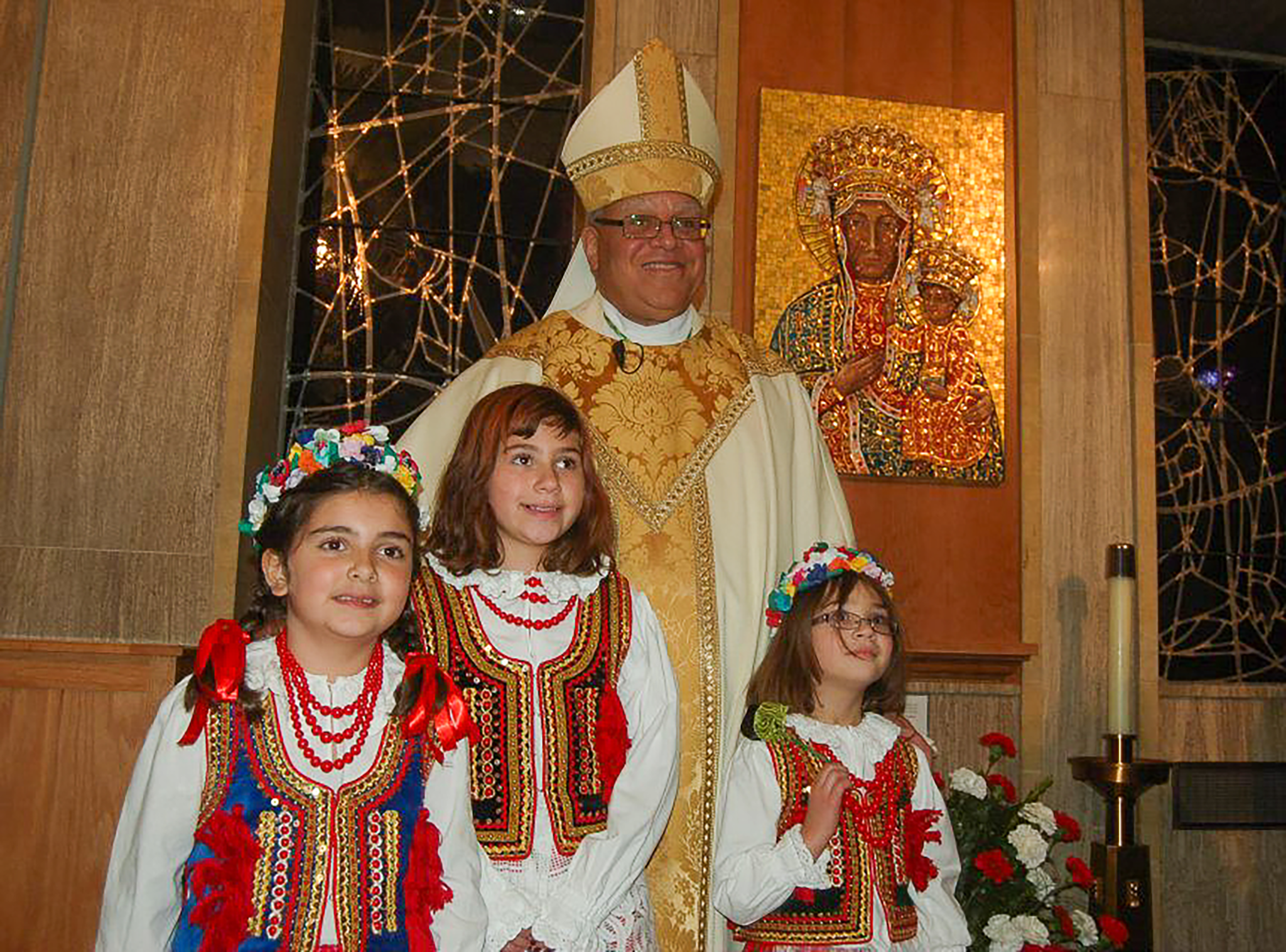
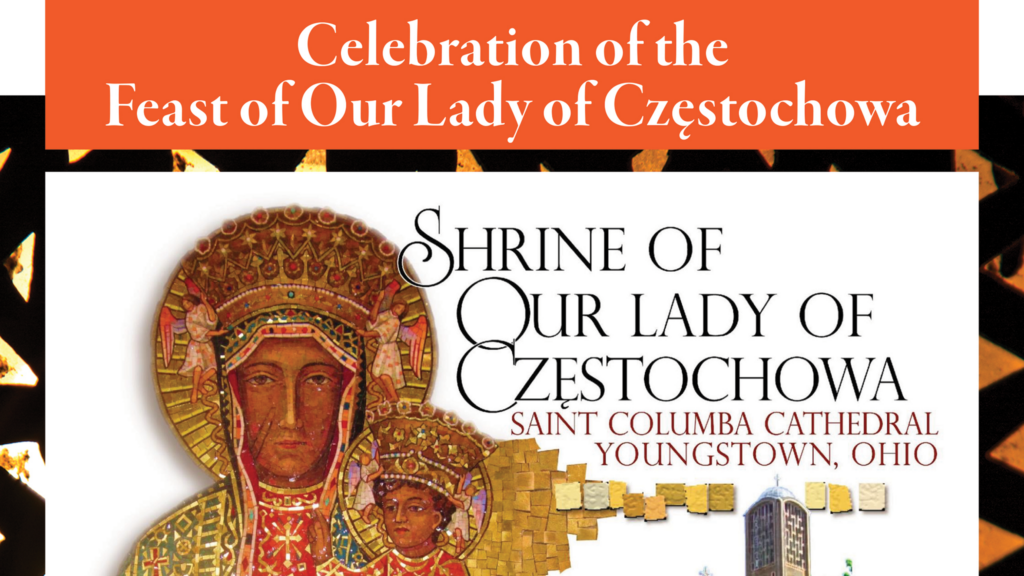
St. Columba Cathedral houses a shrine to Our Lady of Częstochowa—according to the organizers, the only consecrated site of its kind in the region. Its history says a lot about what happens to Polish parishes in America.
In 2010, the then-Bishop of Youngstown, Most Rev. George V. Murry, SJ, asked PolishYoungstown to help convert the cathedral’s baptistery into a shrine. The reason was specific: the reorganized parishes of St. Casimir and St. Stanislaus were closing, and their parishioners needed to be welcomed into the cathedral. The shrine was intended to be a place where they could feel at home.
Funds were raised jointly by PolishYoungstown, the St. Casimir Society, and cathedral parishioners. Meanwhile, parishioners of St. Stanislaus Kostka Church donated their mosaic icons, which became the heart of the new shrine. It was dedicated on October 30, 2012, and the ceremony concluded with a performance by the “Śląsk” Song and Dance Ensemble from Poland.
The shrine is open to all whenever the cathedral is open. Prayer cards and recordings are available there.
The Image with Scars
The image from Jasna Góra is recognized by two slash marks on the right cheek of the Mother of God. According to tradition, these were inflicted by Hussites who raided the monastery in 1430 and stole the painting. The wagons carrying the loot refused to move, so the robbers threw the image to the ground, and one of them struck it twice with a sword. During the third attempt, he reportedly fell to the ground and died in agony.
The dark complexion, which gave rise to the name “The Black Madonna,” is said to originate from the smoke of a fire from which—according to legend—the painting protected the church. Tradition holds that the icon itself was painted by St. Luke the Evangelist on a tabletop made by Jesus and brought to Poland in 1382 with troops fleeing the Tatars.
The most famous miracle attributed to the painting occurred in 1655, when Swedish forces approached Częstochowa. Polish soldiers prayed before the image for deliverance, and the enemy withdrew. A year later, King John II Casimir proclaimed Our Lady of Częstochowa the Queen of Poland and Częstochowa the spiritual capital of the country.
Subsequent centuries only cemented this status. During the Nazi occupation, Hitler banned pilgrimages to Jasna Góra, yet people went anyway, in secret. During the Cold War, the monastery served as a center of resistance against communism. Today, Jasna Góra is the third-largest Catholic pilgrimage site in the world.
Why August 23 and Not August 26
In Poland, the Feast of Our Lady of Częstochowa falls on August 26. This year, that date falls on a Wednesday, so Polish-American parishes are moving the celebration to the nearest Sunday. This slight shift in date says more about Polish-American religious life than many essays: tradition survived, but it had to bend to fit the American work calendar.
The organizers remind us that devotion to the Black Madonna has accompanied Poles for over six hundred years, and immigrants carried it with them across the ocean—hence home altars and countless churches, chapels, and shrines dedicated to her. Youngstown is one such place.
Practical Information
- When: Sunday, August 23, 2026, Mass at 11:00 AM
- Where: St. Columba Cathedral, 154 W. Wood Street, Youngstown, OH 44503
- Celebrant: Msgr. Robert J. Siffrin
- After Mass: Polish dinner in the cathedral hall, sponsored by Krakus Polish Deli & Bakery; featuring accordionist Luke Politsky
- Admission to Mass: Free
- Dinner: Suggested donation of $15 per person; YSU students free with ID
- Dinner Reservations: By phone at(330) 744-5233
- Parking: Free in all parking lots surrounding the cathedral
- Travel Advisory: The Panerathon charity run takes place on this day—organizers advise approaching from the north via 5th Avenue and Wick Avenue
Poland.us Editorial Team