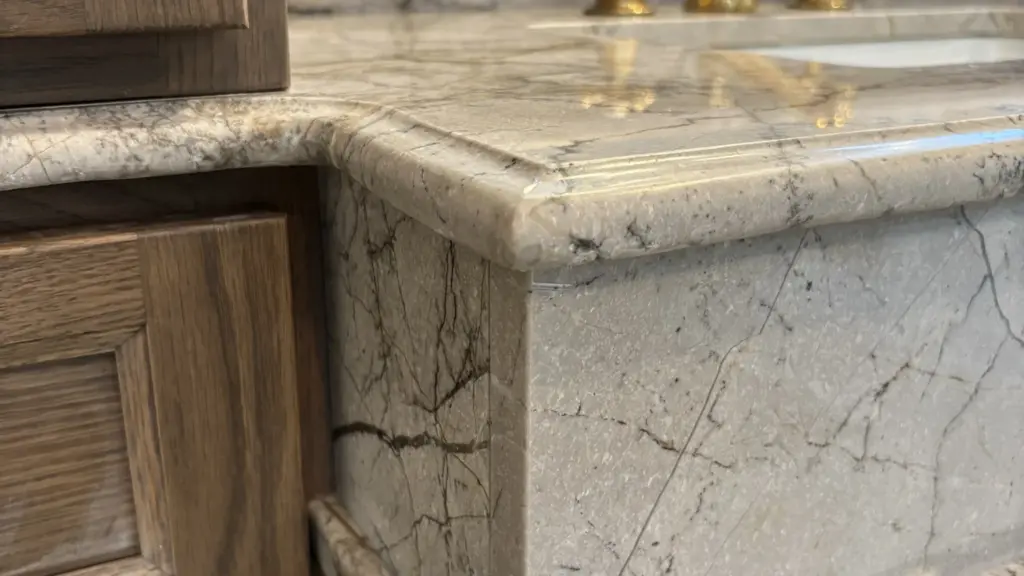
Granite, quartzite and engineered quartz work well in bathrooms because they handle water well. Marble, travertine and limestone can be used too, but they are more absorbent and sensitive to acids, so they need regular sealing, gentle cleaners and quick wiping of standing water.
For any finishing material, the bathroom is the toughest room in the house. Hot steam fills it several times a day, drops of water and soap linger on the counter, and next to the sink sit bottles of perfume, mouthwash and nail polish remover. Stone copes with these conditions well, as long as it is chosen carefully and properly protected.
The question comes up most often in older homes in Trenton, Hamilton and Bucks County, where bathrooms tend to be small and poorly ventilated, and in New York apartments with windowless bathrooms.
Why is bathroom moisture a test for stone?
Because natural stone has pores. Most are microscopic, but water, soap and dyes from cosmetics can seep into them if the surface is not sealed. The result may be darker spots near the faucet, dull streaks around the sink rim or discoloration where the tub deck meets the tub.
The overall humidity in the room matters as well. In its brief guide to mold, moisture and your home, the U.S. Environmental Protection Agency advises keeping indoor relative humidity below 60 percent, ideally between 30 and 50 percent, and running a fan or opening a window while showering. It also recommends drying water-damaged areas within 24 to 48 hours, which in most cases prevents mold from growing.
These rules apply mainly to walls, grout and caulk, but they protect the stone indirectly too. A drier bathroom means fewer deposits and streaks on the counter.
Which stones handle bathroom conditions best?
Granite and quartzite are hard and relatively water-resistant, which is why they often end up on vanity tops and tub decks. Engineered quartz has a non-porous, easy-care surface with consistent color, something many people appreciate in a modern bathroom.
Marble, including classic white Carrara, remains popular in traditional bathrooms. So do travertine and limestone, which give a room a warm, natural look. These stones are softer and more absorbent, however, and acidic toiletries can leave dull marks on them. Onyx is sometimes chosen for striking decorative pieces, but it calls for extra care.
None of this makes marble a bad idea in a bathroom. It simply means knowing what to expect and planning the upkeep from day one.
What does sealing do, and how often should it be repeated?
A sealer penetrates the pores of the stone and limits how much water and oil it absorbs. It does not make stone completely waterproof, but it buys you time to wipe up a spill before it leaves a stain. Engineered quartz needs no sealing because it has no open pores.
A simple home test shows when it is time to reseal. A few drops of water left on the stone for several minutes should stay beaded. If the surface underneath darkens, the sealer has worn off. How often to reseal depends on the type of stone, how heavily the bathroom is used and the product itself, so it is best to agree on a schedule with your installer.
Caulk is a separate matter: the bead where stone meets the tub, wall or shower enclosure. When it darkens, cracks or pulls away, replace it, because water can get under the tub deck through the gap.
What should you avoid when cleaning?
Many popular bathroom cleaners contain acids or chlorine compounds. They cut through hard-water scale on tile, but they can dull polished marble, travertine or limestone. For stone, use a mild pH-neutral cleaner or a product made for natural stone.
A few simple habits also help: wiping the counter after the morning routine, keeping toiletries on a tray and being careful with hair dye and nail polish remover. On a tub deck, avoid setting wet bottles directly on the stone.
More about stone in the home
A family-owned stone shop in Ewing
Euro 1 Countertops Granite & Marble, Inc. is a family-owned business in Ewing, Mercer County, with 20 years of experience in marble and granite. For bathrooms it custom-fabricates vanity tops, tub decks and stone bases, as well as thresholds, shower seats and niches. Its project gallery includes a bathroom in Doylestown, Pennsylvania. The company works with granite, marble, quartz, quartzite, travertine, limestone, onyx and semi-precious slabs for residential and commercial clients in New Jersey, Pennsylvania, Delaware, New York and Connecticut. Consultations and estimates are free, and the team speaks English, Polish, Russian and Ukrainian.
Learn more in Euro 1 Countertops Granite & Marble, Inc.’s listing in the PolishPages directory. To schedule an estimate, call 609-608-5750; the office is at 310 Dryden Avenue in Ewing, New Jersey.
The information in this article is general in nature; choosing and protecting stone for a specific bathroom is best discussed with a professional.