Granite, quartz and marble all suit a bar or dining table, each in its own role. Granite handles heavy daily use, quartz keeps a consistent look across many surfaces, and marble adds elegance but reacts more to acidic drinks. The choice depends on who uses it and how often.
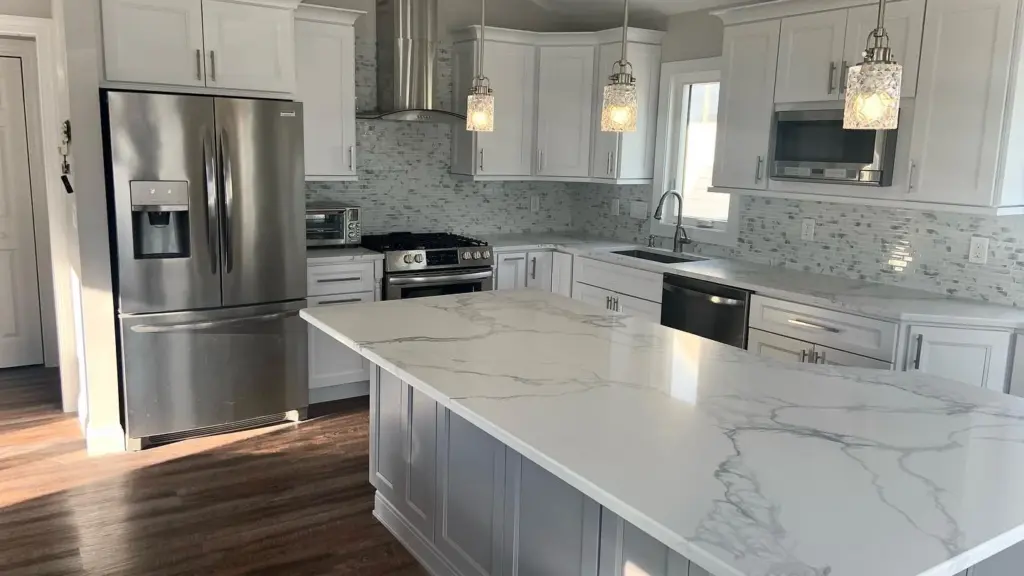
In many homes across Mercer County and Bucks County, Pennsylvania, the kitchen stopped being a separate room a long time ago. It opens onto the dining area, and an island lined with stools now does the job of the everyday table, from breakfast and homework to the Sunday spread when relatives visit.
Owners of cafés, bars and Polish delis with a few tables, from Trenton to New York City, face the same question on a bigger scale. Their counters serve a steady stream of guests and get wiped down several times per shift.
Why does stone end up in so many home bar areas?
Because the home bar is no longer an add-on. It is where people eat, talk and gather, so it has to put up with spilled drinks and plates sliding across it all day.
Stone answers those needs well. Granite tends to go where traffic is heaviest. Quartz, an engineered stone made from crushed mineral and a binder, comes in a range of colors and patterns that pair easily with cabinet fronts. Marble appears in homes where the bar area is meant, above all, to impress guests.
A few ideas keep returning in remodeled homes: an island with a raised bar section that separates cooking from seating, or a bar top in a different color from the main counter. Waterfall sides, where the stone runs straight down to the floor, are common too, as are home bars in finished basements, a familiar feature of single-family houses in New Jersey and Pennsylvania.
How is a restaurant bar top different from one at home?
Mostly in how hard it works. In a restaurant or bar, the stone is in contact with alcohol, citrus juice and cleaning products all day long, not just during the occasional family party.
Business owners therefore weigh ease of cleaning, stain resistance and whether the surface still looks the same after a few busy seasons. Granite suits counters where staff set down heavy glassware and trays. Quartz is a common choice when many tables need to look identical, because a manufactured material keeps a uniform pattern from slab to slab.
Marble is found mainly in cafés and wine bars where atmosphere comes first. As a carbonate stone it reacts more readily to acidic liquids, so it calls for quick wiping and the right cleaners. Some owners embrace the patina it develops as part of the room’s character.
A café also cannot stay closed for weeks, so measuring, fabrication and installation are scheduled to keep the closure short, with dates agreed before the old counter comes out.
Which stone works best for a dining table?
That depends on whether the table should be a quiet backdrop or the centerpiece of the room. A stone table top is seen up close and from every side, so the pattern of the stone matters more here than it does in the kitchen.
Fine-grained or boldly patterned granite holds up well to everyday meals with kids. Quartz gives an even, uniform surface that is easy to match to flooring and chairs. Marble with strong veining appeals to people who want a table for the long haul and are fine with routine upkeep.
Structure matters too. A stone slab is heavy, so the base must carry it safely, and large tops can be hard to get into Manhattan apartments or walk-ups without an elevator. Stone tops are also ordered for office conference tables.
How do you care for a stone surface that many people use?
Consistency is what counts: wipe spills quickly, use mild cleaners, and put coasters under glasses and trivets under hot dishes. These simple habits protect every type of stone.
Natural stone is often sealed to limit staining; how often depends on the material, so ask the fabricator at handover. Acidic and bleach-based cleaners are kept away from marble, and no stone should be used as a cutting board.
In restaurants, a single sheet of care rules by the sink prevents plenty of mix-ups when shifts change.
More about stone in the home
The bar area is only one of the places where stone works hard every day. On poland.us we also cover:
- stone kitchen countertops and choosing the right material
- stone in the bathroom: vanity tops and tub decks
- stone window sills during a window replacement
A family business in Ewing that serves customers in Polish
Euro 1 Countertops Granite & Marble, Inc. is a family-owned business in Ewing, Mercer County, with 20 years in the marble and granite trade; its president is Andriy Huz. The company makes custom bar tops and table tops in granite, quartz and marble, and also works with travertine, limestone, onyx and quartzite. It serves residential and commercial customers, with installations throughout New Jersey, Pennsylvania, Delaware, New York and Connecticut.
Consultations and estimates are free, and service is available in English, Polish, Russian and Ukrainian. Sample materials for bar areas are described on the company’s bar tops page.
Learn more in Euro 1 Countertops Granite & Marble, Inc.’s listing in the PolishPages directory. To schedule an estimate, call 609-608-5750; the office is at 310 Dryden Avenue in Ewing, New Jersey.
This article is for general information and does not replace an on-site visit. For a restaurant or bar, discuss the choice of stone with your fabricator and with whoever is responsible for your venue’s health code requirements.