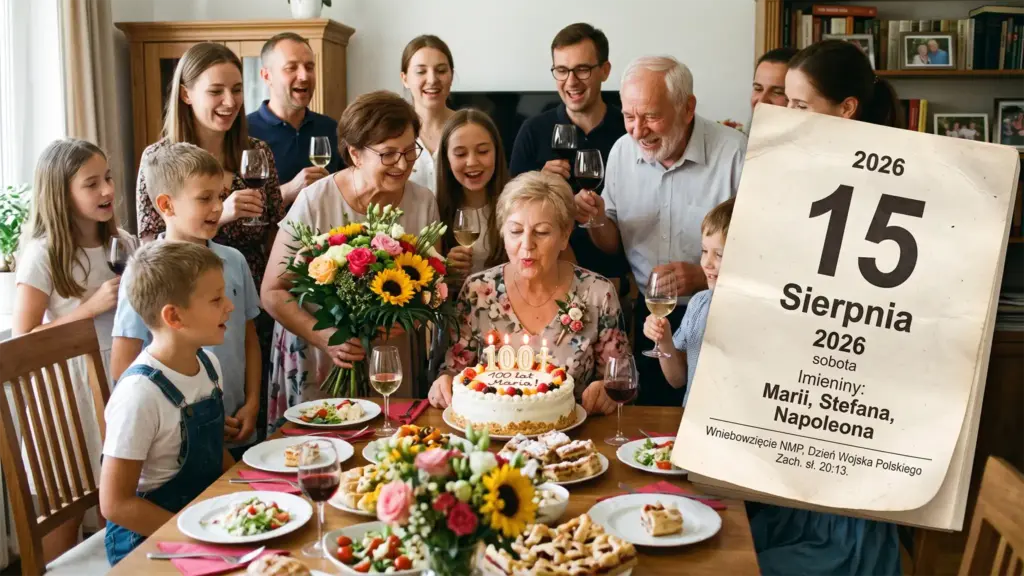
An American asked about a name day usually doesn’t understand the question. Not because they don’t know the custom — there is simply no natural word for it in English. Name day is a calque that needs to be explained. Meanwhile, in a Polish home in New Jersey, a grandma might get offended if no one calls on July 26th.
Where does this difference come from, and why did the custom survive for so long in Poland specifically?
Where name days came from
The tradition stems from the early Christian cult of saints and martyrs. A saint’s day of death was treated as the day of their birth into heaven, and this exact date was entered into the liturgical calendar. Every day of the year was thus assigned a patron.
A person bearing a given saint’s name celebrates their holiday on the day dedicated to that saint. Originally, it wasn’t about the person themselves, but about the patron under whose protection they were placed — a distinction that explains why the custom was so deeply rooted in Catholic culture.
This practice was organized by the Council of Trent in the 16th century, which unified the Catholic calendar and the rules of the cult of saints. From then on, the custom spread across Catholic Europe — taking deepest root where Catholicism was strongest: in Poland, the Czech Republic, Hungary, Italy, and Spain.
Why name days beat birthdays
Here lies the most interesting part of this story, and it is quite a practical one.
For centuries, birth dates were not commonly recorded or remembered — especially among common people. Vital records were kept irregularly, and the person in question was sometimes unsure of their own birth date.
Name days had an unbeatable advantage over this: the date was public. It hung in every calendar, in every kitchen. There was no need to remember anything or ask anyone — you just had to look at whose day it was today and offer wishes.
Added to this was the religious dimension. Birthdays were a private matter, while name days were connected to the patron and the church — giving them a status that secular birthdays lacked.
The effect was that in old Poland, name days were celebrated more solemnly than birthdays. An adult man might not know when he was born, but he knew perfectly well when his name day was.
What is left of this in America
In the States, the custom clashes with a culture that does not know this code. American calendars do not list patrons, school won’t mention name days, and no one at work will ask.
In practice, the custom is maintained in Polish families in the USA in two ways. The first generation usually remembers their own name day and those of their parents back in Poland — a phone call on that day is often a fixture of the year. The second and third generations are more likely to know only birthdays, unless someone at home consciously keeps the tradition alive.
The biggest practical obstacle is a mundane thing: where to check the date. In Poland, any calendar will do. In America, you have to search the internet — and no one searches for something they don’t remember exists.
That is why calendars with Polish name days still find their way into Polish-American homes and still hang in kitchens. Our pocket-sized edition of Mini Polish Pages contains a twelve-month calendar — with name days as well as Polish and American holidays all in one place.
How name days are celebrated
The custom is simpler than birthdays, and that is its charm. It requires no gifts or preparations — a phone call, flowers, or a small trinket is enough.
In Polish tradition, people sing Sto lat (One Hundred Years) to the person celebrating, just like on a birthday. Flowers are a classic name-day gift — more often than for birthdays, because the gesture itself matters more than the value of the gift.
If someone has a name that appears in the calendar multiple times a year — which is common — people usually adopt the date closest to their birthday or the one that has become established in the family. There is no rigid rule here.
In the reality of the Polish diaspora, the bare minimum is enough: to make a call. For the older generation in Poland, that phone call on July 26th or December 4th means more than it seems — because it shows that someone across the ocean still remembers how to count it.
Editors · August 2, 2026