Tomasz Zielenkiewicz
According to Statistics Poland (GUS) data, nearly 2 million Poles (5.3 percent of the population) live in extreme poverty. Another group balances on its edge: they have enough money for basic needs, but nothing more. “Caritas is the largest organization helping in many spheres of life,” says Agnieszka Sobocińska, emphasizing that the entire community should remember the vulnerable, because “the most important thing is how we care for our vulnerable.” She also points out that food aid is not limited to providing a meal, as it has a deeper meaning: thanks to it, for example, seniors can spend their modest benefits on the cinema or a trip.
Invisible Neighbors
The difficulty lies in the fact that the poor often remain in the shadows. “These people in need often do not reach out for help at all,” Sobocińska notes, pointing to shame and the feeling of being inferior. Therefore, she adds, “we are the ones to reach out to these people and we are the ones to look for them.” Lonely seniors are particularly vulnerable. In large cities, the problem is sometimes even less noticeable because “in the city you are totally anonymous,” and someone in need might live right next door.
Sobocińska appeals for opening our eyes to our neighbors. In Warsaw, Caritas delivers meals to people who do not leave their homes. As the Vatican News interviewee notes, “for these people, that meal is not the most important thing at all,” but rather the fact that someone comes, talks, and asks how they are feeling.
No One Chooses Homelessness
The coordinator of programs for excluded people at Caritas Poland appeals to break away from the belief that the poor are solely to blame for their situation. “No one decides as a child that in the future they will be homeless or live in poverty,” she points out. Homelessness crises are often driven by family problems, lack of support, and severed ties. Sometimes it really takes just one person to lend a helping hand.
People living in poverty often find it difficult to accept help. They are accompanied by shame and the belief that they are worse than others. Therefore, those who help must show patience and understanding. “Being a person in crisis, whether of homelessness or poverty, is extremely embarrassing. No one signed up for this,” Sobocińska says.
In her opinion, people must not be blamed for their difficult situation. “Each of us has the same hopes, the same desires, the same plans for life. It’s just that they don’t work out for everyone,” she points out.
The Caritas representative emphasizes that organizations like Caritas have the experience and capability to provide professional help, but they cannot replace ordinary human solidarity.
Special attention is required for young men in crisis, for whom Caritas runs the “We Can Do It!” program. Within its framework, they can receive support in escaping mental and actual homelessness, addictions, and life disorientation. Thanks to the program, several dozen young men have returned to life, finished school, started families, found jobs, and regained their freedom.
Not Just a Roof and Soup
Agnieszka Sobocińska emphasizes that help does not end with providing a roof over one’s head and a meal. She gave Poznań as an example. There, next to the Caritas shelter for homeless people on Krańcowa Street, an open cultural and integration space operates. It consists of the “Garden for Nurturing Relationships” social garden and a therapeutic container. As part of the project at the “Przystań” Charitable Home, mini-concerts, open-air cinema screenings, integration meetings, as well as art and culinary workshops are organized, among other things.
“This is a place where you can remind yourself what it was like when you enjoyed those other things and your goal wasn’t solely and exclusively survival,” Sobocińska says. This year, the play “Wings You Swing With,” staged by the Obsada Zmywaka Theater, was also produced, depicting the battle for a human soul between good and evil.
Everyday Solidarity
Agnieszka Sobocińska points out that Poles know how to mobilize in difficult times, such as after the outbreak of the war in Ukraine or after the attack in Kraków. “Poles deal fantastically with this solidarity,” she says, adding, however, that poverty is “all the time in the background.” When asked if the root cause of poverty is a lack of love, she replies briefly: “Lack of love and loneliness.”
Caritas Aid for the Poor
According to the latest Caritas Poland Report, in 2025 the organization provided assistance to over 760,000 people domestically, and counting international activities – to over 1.1 million people in need. Such a scale is possible thanks to the network structure: alongside Caritas Poland, there are 45 diocesan Caritas offices. Daily work is coordinated by over 12,000 employees supported by 70,000 volunteers. There are over 1,300 residential facilities and 1,200 food distribution points operating in Poland.
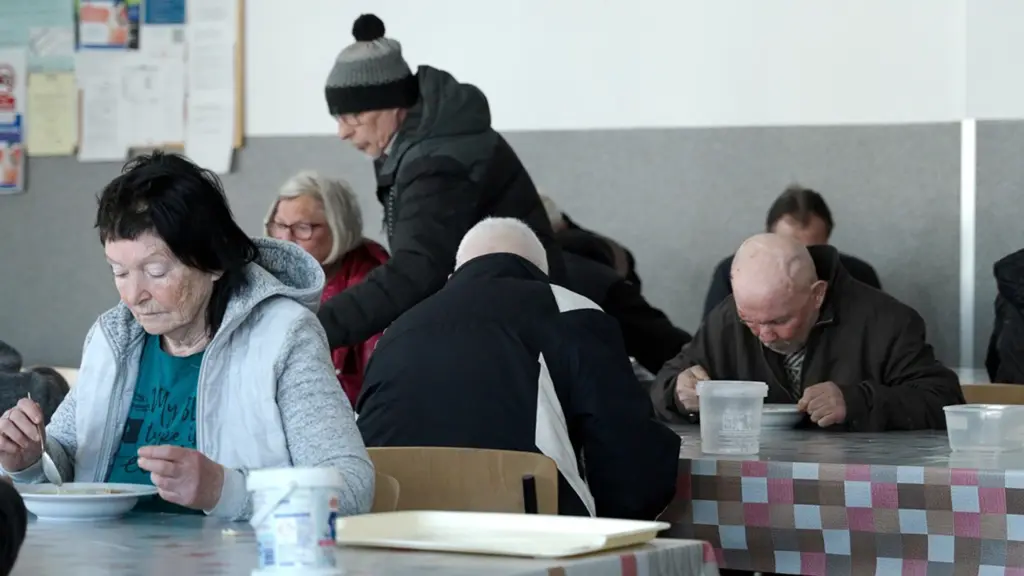
One of the main areas of activity is the fight against food poverty. As part of the “Caritas Pantry” project, over 6,000 tons of food were delivered to those in need, and over 400,000 people benefited from various forms of food aid. Under the FEPŻ program, over 1.2 million food parcels were distributed. Facilities for seniors, including 69 clubs and day-care centers, served nearly 119,000 elderly people. Over 11,000 seniors were covered by the “For Daily Shopping” program, under which they received prepaid cards with a total value of over PLN 25 million.
For people experiencing homelessness, Caritas offers assistance in 33 shelters, 14 night shelters, and 23 bathhouses. During the winter campaign “A Bit of Warmth for the Homeless” in Warsaw alone, 4.9 thousand liters of soup were distributed, among other things. In emergency assistance points, support was received by over 72,000 people.
The network also includes healthcare: Caritas runs 38 home hospices and 14 stationary ones, as well as 125 rehabilitation equipment rental shops.