Svitlana Dukhovych, Sr. Amata J. Nowaszewska CSFN
Audience with Leo XIV
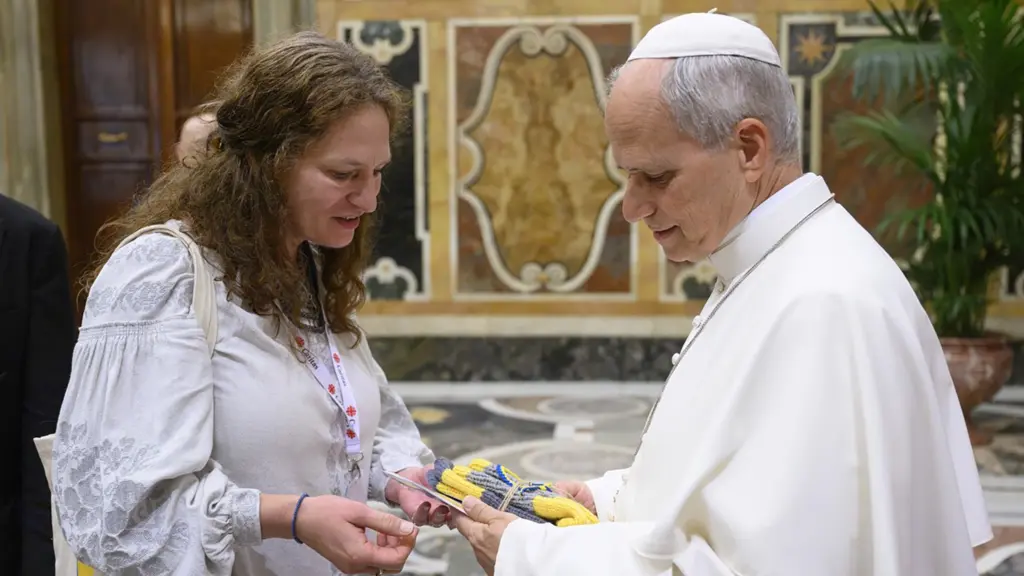
On November 19, Tetiana Stawnychy, together with representatives of Caritas Internationalis, participated in an audience with Leo XIV. “The Holy Father addressed words to us that are a great support for our mission and ministry,” she says.
The Pope thanked the representatives of Caritas for their work carried out “with love, compassion, and professionalism,” and recalled that through their ministry they are “the embodiment of Christ’s tenderness toward all people.”
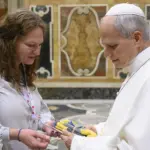
Stawnychy thanked Leo XIV for his support of the evacuation from Oleshky, showed him photographs of the evacuees, and presented him with a pair of socks knitted in Oleshky during the occupation by one of the city’s residents. “I had the great privilege of presenting Pope Leo with a pair of these socks as a gesture of gratitude,” she says.
At the end of October, a temporary ceasefire made possible the first organized evacuation from occupied Oleshky in the Kherson region. Hundreds of people, after years of isolation, were able to return to Ukrainian territory. Employees of Caritas Ukraine and other humanitarian organizations were waiting for them at the border.
Return to Ukraine
The President of Caritas Ukraine was at the border when the buses carrying the evacuees reached territory controlled by Ukraine. “It was truly a moving and emotional day. A day of encounters, smiles and tears, joy and laughter. A deeply human day,” she recalls.
Among the evacuees were people who had not seen their loved ones for years. Stawnychy particularly remembered the meeting of a brother and sister: a man came from Kyiv for his sister and waited by the bus door. When she got off, she “practically fell into his arms.”
She says that many evacuees felt a tremendous sense of relief that they decided to leave and were welcomed “with such great warmth, humanity, and kindness.”
They also brought their animals with them. “The convoy was accompanied by a huge truck filled with carriers containing dogs, cats, and even small birds,” Stawnychy says. She sees this as “a beautiful expression of what it means to be human in the fullest sense and to be a good caretaker of what God has entrusted to us.”
Assisting Evacuees and the Winter Challenge
Caritas continues to help evacuees reach their families, reissue documents, and find clothing or housing. People who do not have relatives able to take them in are in particular need of support.
At the same time, the organization is preparing for winter. “Last winter was probably the most difficult since the beginning of the war (…), primarily because of extremely severe frosts,” Stawnychy says. In addition to low temperatures, there were attacks on energy infrastructure.
“This year the same thing is happening. We are seeing an intensification of attacks on power plants, thermal power plants, water supply networks, and also bridges,” she emphasizes.
Caritas is preparing several action plans. Last winter, it distributed hot meals and sleeping bags and supported heating points where people could warm up and charge devices during power outages.
This year, evacuations of the most vulnerable may also be necessary. “Imagine an elderly person living on the fifteenth floor of a building without electricity and without a working elevator. If the heating also fails, the situation becomes truly dramatic,” Stawnychy says.
The Strength of Volunteers and Solidarity
Caritas Ukraine operates throughout the country. The network has about 2,500 employees, a similar number of active volunteers, and more than 12,000 additional people ready to join in the relief efforts.
After almost five years of war, fatigue is also affecting those who help. “We have moved from an immediate emergency situation to a protracted humanitarian crisis in a war that is still ongoing,” Stawnychy says, emphasizing the need for rest.
At the same time, she notes that in helping another person, “something divine happens.” “It is as if God’s power is present in that very gesture — and that, I believe, is what allows us to keep going.”
She also thanks everyone who supports Ukraine with help, prayer, and solidarity. “Perhaps you are not the ones who will deliver aid on the final stretch of the road (…), but you are part of this great chain.” As she summarizes, this awareness of community is “an anchor for today’s world.”