
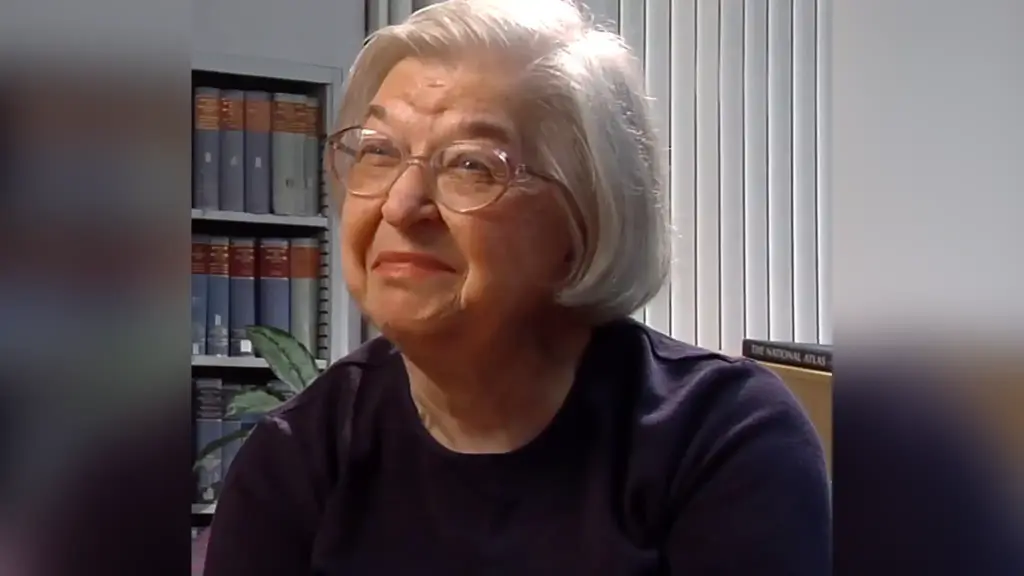
Yet it was she – Stephanie Kwolek (1923–2014), an American chemist of Polish descent – who discovered in 1965 the fiber known today as Kevlar, a material five times stronger than steel on a weight-for-weight basis. Her name does not appear in Polish history textbooks, though her invention protects thousands of people every day.
Who was Stephanie Kwolek?
She was born on July 31, 1923, in New Kensington, Pennsylvania, a small town near Pittsburgh, where Polish laborers settled, drawn by the steel mills and foundries. Her parents were Polish immigrants. Her father, John Kwolek, worked in a foundry and was a passionate nature lover in his free time – it was with him that young Stephanie spent hours wandering through forests and meadows, learning to observe the world carefully, with a researcher’s curiosity. Her mother, Nellie née Zajdel, was a seamstress. When Stephanie was just ten years old, her father died, and her mother raised her and her brother alone.
In this dual heritage – her father’s fascination with nature and her mother’s knack for fabrics – lies the entire later Kwolek. She herself admitted that she owed her interest in science to her father, and her sensitivity to materials and fibers to her mother. It’s hard to imagine a more beautiful picture of a Polish-American home, where from nothing, from passion and work, something is born that will change the world. In 1946, she graduated with a degree in chemistry from Margaret Morrison Carnegie College, part of today’s Carnegie Mellon University. At the time, she dreamed of medicine, treating her job as a chemist as a way to earn money for further studies.
How was Kevlar created?
The temporary position turned out to be a lifelong calling. Kwolek joined DuPont, where she worked for over forty years. In the mid-1960s, her team was looking for a light yet extremely strong fiber – at the time, they were thinking of car tires that would reduce fuel consumption. This task, seemingly industrial and prosaic, led her to a discovery that opened an entirely new chapter in polymer chemistry.
In 1965, Kwolek was working on long chains of polyamide molecules. One day, she obtained a solution that looked unlike anything she had known – cloudy, opalescent, with surprisingly low viscosity. According to laboratory routine, such a solution would usually be discarded as a failure. However, she decided to investigate it. She had to convince the spinneret operator, Charles Smullen, to even agree to pass her strange liquid through the machine. What she saw astonished her: the resulting fiber did not break where ordinary nylon would have long since snapped.
It turned out that the molecules aligned themselves in an ordered, liquid-crystalline manner in the solution, giving the fiber extraordinary stiffness and strength. Thus was born the material with the scientific name poly(p-phenylene terephthalamide), which DuPont introduced to the market in the early 1970s under the trade name Kevlar. The key was not so much fortunate serendipity as the researcher’s attitude – the persistence not to discard what looked like a mistake, but to ask the question: what if this is something new?
Why do so few people know she was Polish?
Kevlar entered our lives quietly, almost invisibly – just like its creator herself. Today, it protects officers in bulletproof vests, reinforces helmets and cut-resistant gloves, and is used in tires, boat hulls, sports equipment, fiber optic cables, and firefighter gear. It’s hard to name a field where this material hasn’t left its mark. Yet, when questions arise about its creator, few recognize the name – and even fewer know that a Polish woman is behind it.
In part, this stems from Kwolek’s own character. She was modest, dedicated to her work, not seeking publicity, and great corporate inventions rarely have a single face – it disappears behind the company logo and dry patent numbers (she had several dozen throughout her career). In part, it’s the fate of many women in science in the mid-20th century who broke through in a male-dominated world and only later received due recognition – in Kwolek’s case, this came, among other things, in the form of a place in the prestigious National Inventors Hall of Fame in 1995 and numerous industry awards.
However, there is a deeper reason, one closest to our series. Kwolek’s Polishness did not shout from the headlines because it was a second-generation Polishness – brought in the immigrants’ baggage, passed down at home, inscribed in a surname that to the American ear simply sounded like another difficult word. It is an invisible Polishness, the kind that was and is most prevalent in the United States: not in parades and banners, but in patient, daily work, in values brought from the family home, in the conviction that it is worth not giving up.
A Legacy We Carry
Stephanie Kwolek’s story is essentially a tale of generational continuity. A Polish foundry worker who, instead of leaving his daughter an inheritance, left her a curiosity about the world. A Polish seamstress who taught her to see fiber as a medium full of possibilities. And a daughter who, from this intangible legacy, wove something that literally stops bullets. In this chain – from a Polish village or town, across the ship to America, to the DuPont laboratory – lies the essence of the Polish-American experience: nothing is lost, everything is passed on, though not always under one’s own name.
That’s why it’s worth remembering her not only as a brilliant chemist but as one of us – from that large, dispersed family of Poles who built America quietly, without fanfare. Their contribution is rarely marked with a white-and-red flag, yet it is real, tangible, sometimes life-saving. Restoring these names to memory is not just a matter of pride. It is an act of justice towards people who gave more to others than they themselves took from the world. If you know such an invisible story in your family or neighborhood – a Polish engineer, doctor, artisan whose names no one remembers anymore – write to us. Invisible Polonia only becomes visible when we start telling its stories.
📱 Download the PolishPages app:
App Store (iPhone) | Google Play (Android)
Ewelina Modrzejewska, Poland.US (Voice of Polonia in the USA). “Invisible Polonia” series. More profiles and stories at poland.us