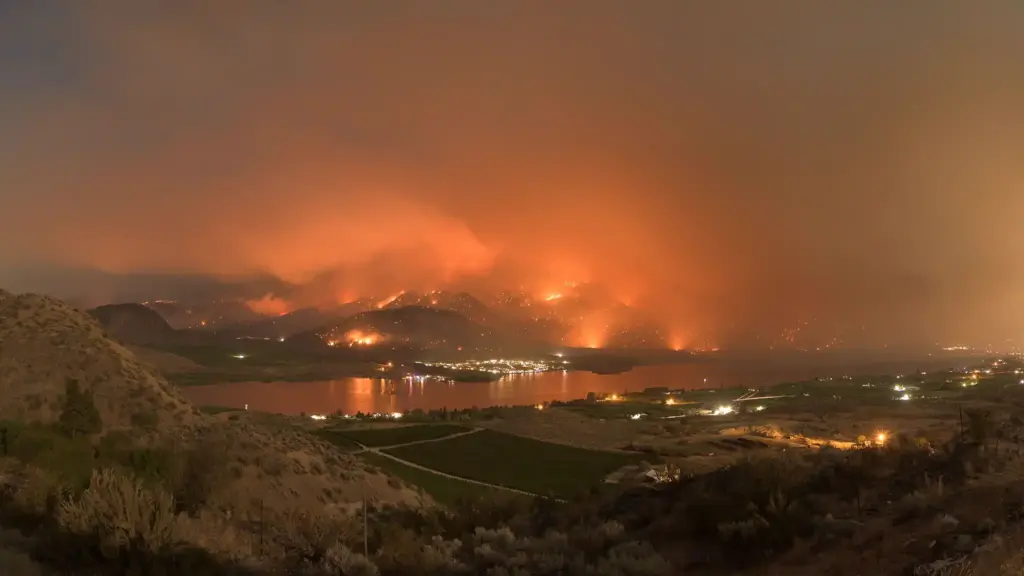
This is another, increasingly routine wave of smoke that has regularly reached large Polish communities in the USA during summer for several years — and it’s becoming harder to ignore, even if one lives hundreds of kilometers from the fires themselves.
Scale of the Fires and Why the Smoke Reaches Here
According to the Canadian Wildland Fire Information System, there are currently 858 active fires burning in Canada, including 29 new ones that erupted in the last 24 hours. Smoke from these fires, carried by winds from the Great Lakes, reached far south this week — to Minneapolis, Chicago, Detroit, and New York, creating a characteristic orange-gray haze over city skylines.
This is not an isolated weather episode, but a recurring pattern: smoke from Canadian wildfires has been drifting into the eastern and central US states for several years in a row, usually at the peak of summer when Canada’s fire season is most intense. For residents of Chicago and New York, this means checking the air quality forecast alongside the weather forecast has become a new summer habit.
Situation in Chicago and New York
In Chicago, the Illinois EPA announced a Red Forecast Air Pollution Action Day for Thursday, and the National Weather Service issued an air quality alert valid until midnight from Thursday to Friday. According to IQAir’s ranking, Chicago ranked third among cities with the worst air quality in the world on Thursday afternoon, with an AQI exceeding 300 — a “hazardous” level, the highest category on the US air quality scale. The city closed some beaches and pools.
In New York, Governor Kathy Hochul warned that smoke would be dense on Thursday and would cover additional parts of the state, including Long Island, the New York metropolitan area, and the Lower Hudson Valley — these regions are forecast to be at an “Unhealthy” level (unhealthy for all groups). The New York State Department of Environmental Conservation (NYSDEC) updated the statewide air quality health advisory. As early as Wednesday, an orange haze enveloped the Manhattan skyline, and residents reported a distinct smell of smoke on the streets.
What This Means for the Polish Community in Both Cities
Chicago and New York are the two largest concentrations of the Polish community in the USA — and smoke of such intensity affects all residents equally, regardless of the neighborhood. At AQI levels above 200-300, as recorded in both cities, US public health agencies consistently emphasize the same thing: this is no longer a matter of discomfort, but a real health risk — especially for children, seniors, and people with asthma or heart conditions. In practice, this means limiting time spent outdoors, keeping windows closed, and avoiding strenuous physical activity outside while the alert is in effect.
For families from Greenpoint, Maspeth, or Ridgewood in New York, or from Polish neighborhoods around Milwaukee Avenue in Chicago, such a day often means a change of plans — canceled outdoor sports activities, closed playgrounds, postponed walks. It is also worth remembering that surgical masks do not protect against fine particulate matter from smoke — an N95 or KN95 mask is needed if going outside is necessary.
When to Expect Improvement
According to forecasts cited by US media, rain expected on Friday over the upper Midwest and on Saturday over the northeastern states should help disperse some of the smoke. However, this is temporary relief — as long as the fires in Canada burn at their current scale, subsequent waves of smoke may reach Chicago and New York for the rest of the summer, as has happened in previous seasons.
Until conditions improve, the best source of current information remains local alerts from NYSDEC (in New York) and Illinois EPA (in Chicago), as well as the nationwide AirNow.gov map maintained by the US Environmental Protection Agency — there you can check the current AQI for your neighborhood in real time.
In Brief
- 858 active fires in Canada (Canadian Wildland Fire Information System data), including 29 new ones within 24 hours.
- Chicago: Red Forecast Air Pollution Action Day, AQI above 300 (“hazardous”), beaches and pools closed.
- New York: NYSDEC air quality alert, “Unhealthy” level for Long Island, NYC metro, and Lower Hudson Valley.
- Improvement expected with rainfall — Friday in the Midwest, Saturday in the Northeast.
- Recommendations: limit time outdoors, avoid physical exertion outdoors, N95/KN95 mask if going out is necessary.
Editorial Team, Poland.US (Voice of the Polish Community in the USA). This text is for informational purposes. Check the current air quality status at airnow.gov and on local state government websites. More Polish community news at poland.us.
📱 Download the PolishPages app:
App Store (iPhone) | Google Play (Android)