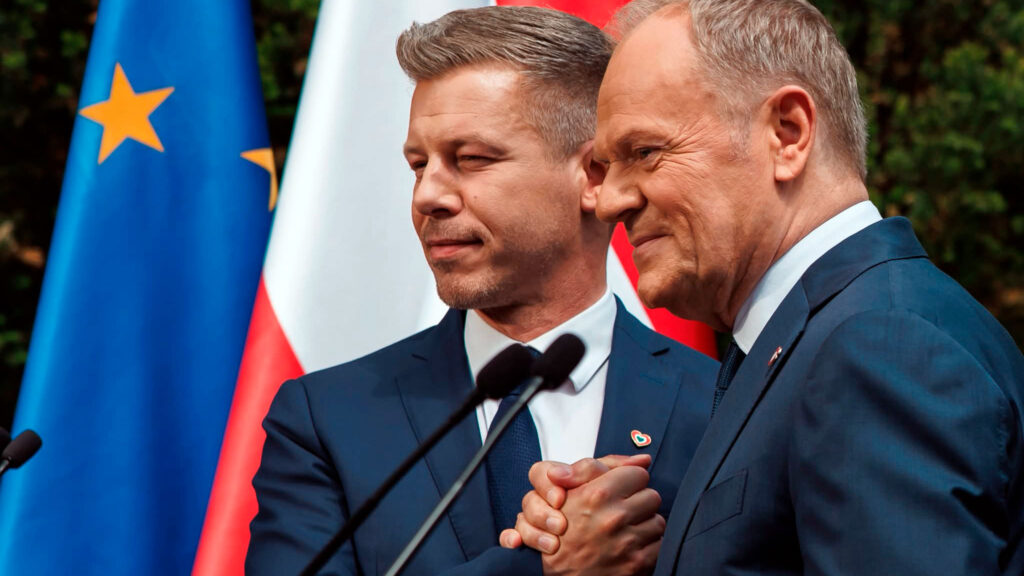
The new Hungarian Prime Minister, whose center-right Tisza party ended Viktor Orbán’s sixteen-year rule just a month ago, chose Poland for his first foreign visit. This is a gesture that cannot be overstated — and which both capitals interpret as the end of a several-year period of frost in Polish-Hungarian relations.
Return of hope
During a joint press conference, Tusk framed Magyár’s victory as part of a broader phenomenon he called the ‘return of hope’ in the West and Central Europe — after years in which, as he said, traditional democratic values came under pressure. The Polish Prime Minister emphasized that Polish-Hungarian relations were historically strong but ‘deteriorated’ during Orbán’s rule. He also noted an important point: it was not about tension between Poles and Hungarians as nations, but about differences in approach at the government level. This distinction carries weight — because it is precisely what allows for such a quick reset today.
Magyár, fresh from an election victory in which his Tisza party won 53 percent of the votes and a constitutional majority in parliament, arrived with an exceptionally large delegation: six ministers, including Foreign Minister Anita Orbán and the ministers of economy, defense, culture, transport, and agriculture. The size of the delegation itself is a message — Budapest treats relations with Warsaw as a strategic priority.
Kraków, train, Warsaw, Wałęsa
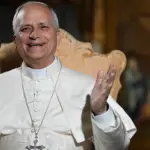
The visit began on Tuesday, May 19, in Kraków, where Magyár met with the local archbishop and representatives of civil society. From there, the Hungarian Prime Minister boarded a train to Warsaw — a mode of transport deliberately chosen to emphasize the importance of EU co-funded railway projects, including the high-speed Kraków–Warsaw line. This gesture is consistent with one of Magyár’s priorities: the modernization of the Hungarian railway network.
In Warsaw, in addition to talks with Tusk and a planned meeting with President Karol Nawrocki and the Speakers of both parliamentary chambers, a meeting took place that holds particular symbolic significance for Polish readers — Magyár met with Lech Wałęsa, the legend of Solidarity and the first democratically elected president of the Third Polish Republic. For a politician who has just overthrown a sixteen-year authoritarian rule, a conversation with the man who overthrew communism is a gesture with a clear message. The visit will conclude in Gdańsk — Wałęsa’s city, Solidarity’s city, the city on the Baltic Sea.
Reset after years of freezing
Relations between Warsaw and Budapest have been in a state of deep cooling for the past few years. Viktor Orbán’s government maintained close ties with Moscow during Russia’s full-scale invasion of Ukraine, repeatedly blocked EU aid for Kyiv, and harbored Polish politicians sought by the Polish justice system — in December 2024, Marcin Romanowski, former Deputy Minister of Justice, received political asylum in Hungary, and in January 2026, Zbigniew Ziobro obtained a similar status. It was then, when Budapest deemed the Polish European Arrest Warrant for Romanowski politically motivated, that bilateral dialogue practically ceased.
Significantly — the distance from Orbán was maintained not only by Tusk’s government. In November 2025, President Karol Nawrocki, a politician from the right-wing camp, canceled a planned meeting with Orbán after the Hungarian Prime Minister traveled to Moscow to discuss energy cooperation with Russia. This shows that the cooling of relations with Budapest transcended Polish party divisions — and that today’s reset with Magyár also has a chance to be cross-party.
Why Poland — and why now
The choice of Poland as Magyár’s first foreign visit destination is no accident. The Hungarian Prime Minister has repeatedly indicated that Donald Tusk’s model is his inspiration for rebuilding democratic institutions. The Polish Prime Minister, after taking office in December 2023 — in a situation comparable to today’s Tisza vs. Fidesz configuration — quickly moved to unblock EU funds frozen by the European Commission and to reform the judiciary and public media. Magyár now faces a very similar task, though from a stronger position: his constitutional majority gives him a freedom that Tusk, entering government as head of a coalition, did not have.
Andrzej Sadecki, an analyst at the Centre for Eastern Studies in Warsaw, however, pointed out the new prime minister’s biggest challenge in an interview with the Associated Press: “some key state institutions still remain in the hands of people nominated by Fidesz.” This is exactly the same problem that Tusk’s government faced — and still faces — in trying to regain control over institutions staffed by its predecessors.
The specific goals of the visit are practical. Budapest seeks Warsaw’s support in negotiations with the European Commission to unfreeze billions of euros in EU funds, blocked during Orbán’s time due to rule of law violations; a European Commission delegation is expected in Budapest later this week, and Magyár plans a visit to Brussels next week. The second topic is energy and the diversification of supplies that have been dependent on Moscow for years. The third is the revitalization of the Visegrad Group. “For V4 cooperation to become strong again, a very strong Polish-Hungarian axis is essential,” Magyár said before flying to Kraków. The Prime Minister also announced that he would meet with Ukrainian President Volodymyr Zelensky in Berehove, Transcarpathia, in early June — which would be another signal of breaking with Orbán’s pro-Russian course.
What this means for the Polish diaspora in the USA
For the American Polonia, Magyár’s visit signals that Central Europe is returning to a more predictable, pro-Western orientation. Poles in the USA, who for years observed with concern Orbán’s drift towards Moscow and his blocking of aid to Ukraine, can now witness the opening of a new chapter. Polish-Hungarian trade currently amounts to approximately 15 billion euros annually, and Anna Wiśniewska, head of the Polish-Hungarian Chamber of Commerce, announced a “significant revival” of business relations in an interview with AFP. The historical phrase “Pole and Hungarian, two good friends,” treated more as a relic of a school rhyme over the past eight years, may once again have practical significance today — in the context of NATO’s eastern flank, the Ukrainian issue, and the relations of both countries with the Donald Trump administration.
Key Facts
- What: First foreign visit of Hungarian Prime Minister Péter Magyár since taking office on May 9. Kraków (May 19) → Warsaw (May 20) → Gdańsk.
- Meetings: Prime Minister Donald Tusk and President Karol Nawrocki in Warsaw, as well as Lech Wałęsa; a planned meeting with Volodymyr Zelensky in early June.
- Sources: Associated Press, Daily News Hungary, Hungarian Conservative, The Journal, Euronews, Reuters.
We continue to follow the topic at poland.us. For a detailed directory of Polish-American businesses and institutions in the USA, please refer to PolishPages.com.
📱 Download the PolishPages app:
App Store (iPhone) | Google Play (Android)