Author: Vatican News
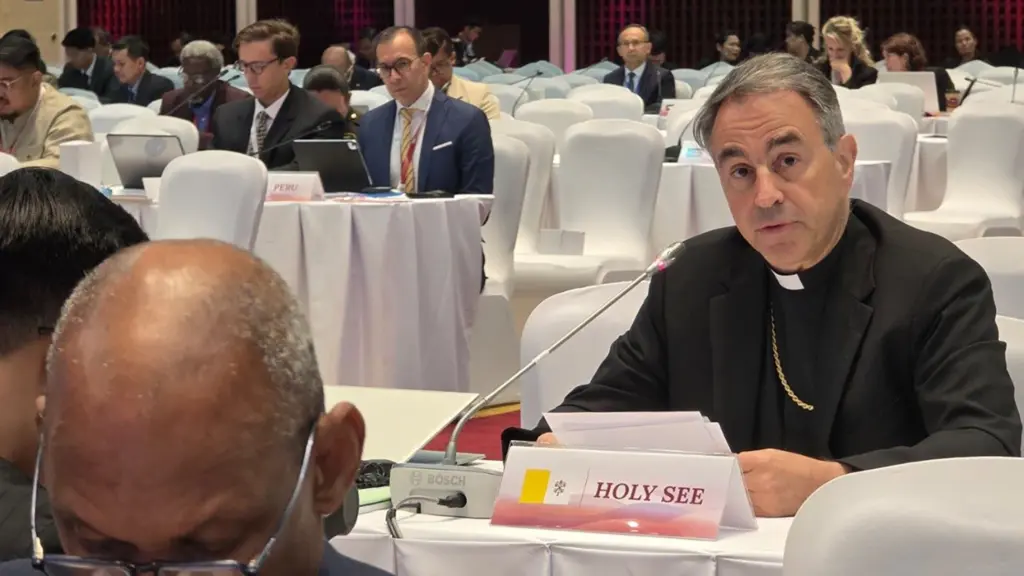
The Convention on Cluster Munitions has achieved “significant progress,” contributing to the saving of many lives, yet the deadly legacy of these weapons continues to affect innocent people, even long after hostilities have ended. This warning was issued on September 16 by Archbishop Ettore Balestrero, head of the Holy See’s delegation to the Third Review Conference of the Convention on Cluster Munitions, meeting in Vientiane, Laos.
Concern over continued use of cluster munitions
Speaking during a session dedicated to victim assistance, Archbishop Balestrero reiterated the Holy See’s “deep concern” regarding the ongoing use of cluster munitions and the growing number of civilians bearing the consequences.
“There is no time to waste,” the prelate stated, “precisely because every human life has inestimable value, whether it is the life of a soldier, a civilian, a woman, or a child, because it is a gift from God.”
The Archbishop emphasized that the Holy See stands in solidarity with those who have suffered and takes action to ensure they “do not feel alone” and that their suffering “does not go unnoticed or forgotten.” This commitment extends not only to those directly wounded by the use of cluster munitions, but also to their families and entire communities.
The Archbishop recalled that the Convention itself adopts a broad definition of victims and obligates States Parties to provide them with adequate assistance.
Putting the human person at the center of assistance
At the heart of the Holy See representative’s address was, above all, the need for an integral approach to assistance. “Protecting life at every stage and creating conditions for a life worthy of the human person constitute the essence of humanitarian aid.”
Therefore—the Archbishop explained—it is extremely important to continue putting the human person at the center of efforts directed toward communities affected by the consequences of conflicts.
The Holy See delegation therefore welcomed the increasing attention given to mental health and psychosocial support. These should also be accompanied by religious and spiritual help and care for the victims and their families—issues which, as Archbishop Balestrero noted, have often been overlooked in the past.
Assistance cannot, therefore, be limited merely to providing financial support. It should provide people with the tools necessary to become active participants in their own “integral human development.”
Listening to the voice of victims
Another key issue is the participation of the victims themselves. As the Archbishop recalled, the spirit of the Convention is based on cooperation and collaboration, which must, however, develop with respect for the values and cultures of the communities involved.
That is why it is so important for States Parties to the Convention to directly listen to the voices of victims and fully engage them in the implementation of undertaken commitments.
In conclusion, Archbishop Balestrero recalled the words of Pope Leo XIV from the document “Magnifica humanitas”: “Giving a place—in the transmission of information and in education—to the gaze and the voice of the victims helps us truly realize the abyss of evil contained in war and—generally speaking—in all violence.”
Listening to the victims—the Pope continued, in the excerpt quoted by the Vatican head of delegation—helps “not to accept the logic of conflict as something normal; not to look away when human dignity is violated; it helps to restore to the people affected by violence the dignity of being recognized and heard.”
As Archbishop Balestrero summarized, such a commitment is essential so that the needs of victims are met with an appropriate response and their rights are truly protected.