By S. Alina Petrauskaite and Svitlana Dukhovych – Vatican City
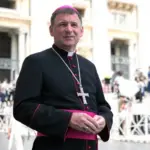
Thirty-five years after gaining independence, which brought the Ukrainian nation true and genuinely experienced religious freedom, the country continues to face the dramatic trial of war. In an interview with Vatican media, Bishop Vitaliy Skomarovych, Bishop of Lutsk and President of the Conference of Roman Catholic Bishops of Ukraine, describes the dramatic reality and the enormous price people must pay in defense of their country. Echoing the warning of St. John Paul II, who described war as a great plague, the prelate simultaneously emphasizes the extraordinary and enduring chain of solidarity and material and spiritual support flowing from every corner of the world.
Your Excellency, is 35 years of independence a lot or a little?
From a historical perspective, 35 years is not much. But for us, here in Ukraine, if we look back at everything we have experienced during this period, it is an extremely long and eventful span of time. We lived through the severe economic crisis of the 1990s and the subsequent efforts toward reconstruction. And now, since 2014, we have effectively been in a state of war, which then escalated into full-scale aggression in 2022. Therefore, although from the perspective of a millennial history it is a short fragment, for us it encompasses an immense journey.
What significance did regaining independence have for the spiritual life of Ukrainians?
Today we live in an independent state and enjoy real freedom of conscience, not just freedom written on paper. Every person has the opportunity to practice their faith and bear witness to it. Of course, as in any country, bureaucratic issues may arise, but freedom of conscience is guaranteed by the Ukrainian constitution and is a reality experienced on a daily basis. For us, this gift is something extraordinary and unique, especially if we look at the past.
The Soviet Union formally recognized the right to freedom of conscience in its constitution, but for ideological reasons, the Church and religion were systematically persecuted. During some periods, the persecutions were bloody; in others, they were more covert. The faithful were imprisoned, some gave their lives for their faith, while others were simply stripped of all opportunities for professional development: they could not teach, work as doctors, or hold public office. It was a time of true trial.
Also in earlier tsarist times, the Catholic Church – and indeed all Churches – was subject to severe restrictions. Even the Orthodox Church, which at that time was the state Church in tsarist Russia, suffered from a suffocating state “embrace” that prevented it from freely fulfilling its spiritual mission.
Therefore, these 35 years of independence and religious freedom represent an absolutely unique experience for our country. Of course, the Church must face new challenges and previously unknown problems today, but every time we celebrate Independence Day, we thank the Lord for the priceless gift of freedom enjoyed by our community.
Your Excellency, you often share in the suffering of families and participate in the funeral ceremonies of men and women who pay the highest price for freedom by offering the greatest good, which is life. Can meaning be given to this immense sacrifice, and how can one pastorally face this trial?
We find ourselves in a situation where Ukraine is forced to defend itself because we have been attacked. I do not know how many of those who choose to defend the homeland do so with the explicit thought: “we are giving our lives.” In reality, they want to live, they hope to survive. However, as military personnel, they perform a job that involves mortal danger.
Unfortunately, it happens that defenders die, struck by enemy bullets and shrapnel. The citizens of Ukraine must take up the fight to defend themselves because there is no one else who could do it for us.
Our people are forced to go to the front to protect their country: it is a value so great that it is difficult for us to fully grasp it. We call it the homeland – it is our common home, our shared place of residence.
When an enemy enters, smashing windows and breaking down doors, everyone would defend their family and loved ones. Here, it is about our common home, about the bond that unites all of us, Ukrainians. Therefore, Ukrainians have risen in defense of their land.
The price that must be paid is truly immense, but equally great is the threat that lies in wait for us. The enemy did not simply come to impose a different political system or dictate new electoral rules: they came to kill, to destroy. And therefore, in response to this aggression, Ukraine is forced to defend itself.
What has this time of war in Ukraine “revealed” to Your Excellency personally?
Certainly, this is a completely new experience, entirely different from my previous notions of war, which I formed by reading books, watching movies, or following news about wars in other parts of the world. This reality is completely different. I could never have imagined that war looks precisely like this.
I would like to say that all of this has led me to fully agree with St. John Paul II: war is a great plague, and if there is even the slightest possibility of avoiding it, everything must be done to prevent it.
Peace is a tremendous gift, while war is an unimaginable evil for everyone who gets entangled in it. I deeply understood that prayer for peace has priceless value, because peace is an extremely precious good. Probably, we realize this value above all when peace is lacking, when war continues, and when everyone is threatened: children, the elderly, the weak and the strong – no one is excluded.
Then you understand how much peace, the absence of war, is a priceless gift for a nation and a state.
Another great experience is solidarity – the extraordinary closeness shown to the Ukrainian nation by so many people from every corner of the earth. And this solidarity, along with material and spiritual support, is enduring: people do not tire of praying for us and bringing us help. This is a tremendous gift. Such solidarity is not born of a mandate, but flows directly from the heart; it is the voice of the human heart.
And all of this gives us a lot of strength and hope. We continue to pray that this war will end as soon as possible.