


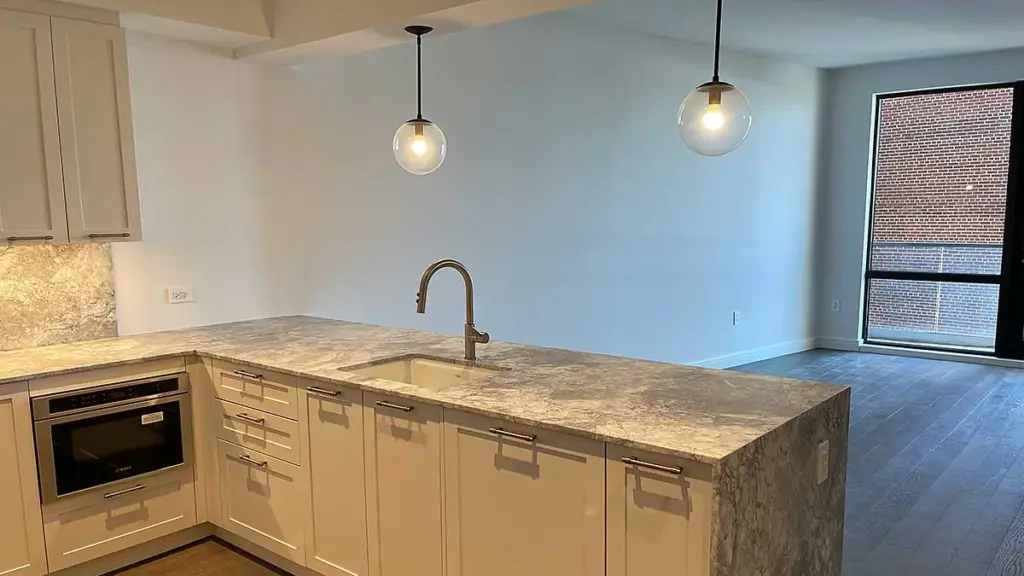
An apartment renovation in New York starts with three questions: does the work need a Department of Buildings (DOB) permit, what are the co-op or condo board’s rules, and was the building constructed before 1978? The answers shape the paperwork, the schedule and the requirements for your contractor.
Many Polish families in Ridgewood, Maspeth and Greenpoint live in older buildings: walk-ups with narrow staircases, brownstones, or prewar co-ops in Manhattan. Renovating in a place like that is about more than tile and paint colors. There are neighbors on the other side of the wall, a building board with its own house rules, and city regulations that separate minor work from projects that need a permit.
A well-run renovation therefore starts with paperwork and a plan, not with demolition. Below are the steps that help avoid stop-work situations and friction with the board.
Does an apartment renovation need a DOB permit?
It depends on the scope. According to the Department of Buildings, most construction in New York City requires approval and permits, but some minor alterations can be done without one.
The Department’s “Do I Need a Permit?” page gives painting, plastering, installing cabinets, replacing plumbing fixtures, resurfacing floors and non-structural roof repair as examples of work that does not require a permit. Even then, the city sets rules for who does the job: plumbing fixture replacement must be performed by a Licensed Master Plumber.
Anything beyond that list, such as changing the layout or touching the structure, has to be checked case by case. The Department suggests asking a Professional Engineer (PE), a Registered Architect (RA) or the DOB borough office to explain the exceptions.
What needs to be cleared with a co-op or condo board?
The board has its own rules and, for a larger renovation, usually wants to approve it before a crew walks in.
In co-ops and condominiums, boards often ask for a description of the work and, for bigger projects, drawings from an architect and proof of the contractor’s insurance. House rules can also be detailed about everyday matters: working hours, use of the freight elevator and how debris leaves the building. You need to know these terms before signing a contract, because they affect both the schedule and the price.
Owners of walk-ups and brownstones in historic districts have one more party to deal with: the Landmarks Preservation Commission. According to the Commission, its permit is required for, among other things, any interior work that requires a DOB permit and any interior work that affects the exterior of the building, such as HVAC louvers and vents.
Why does Lead-Safe certification matter in pre-1978 buildings?
Because work that disturbs old paint can expose residents to lead, which is why the U.S. Environmental Protection Agency (EPA) has set rules for these renovations.
Under the EPA Renovation, Repair and Painting (RRP) Program, firms paid to do work that disturbs painted surfaces in homes, childcare facilities and preschools built before 1978 must be lead-safe certified. That includes sole proprietorships. Workers are trained in lead-safe work practices that minimize occupants’ exposure to lead hazards.
The EPA recommends that homeowners hire a lead-safe certified contractor. In general, the rule does not apply to homeowners working on their own pre-1978 homes, but it does cover landlords and rental properties. In an old New York walk-up, it makes sense to ask about certification at the very first estimate.
In what order should work proceed in an occupied building?
From protection and demolition, through the systems hidden in the walls, to the finishes, so that nothing already closed up has to be opened again.
- Board approval, any permits, protection of hallways and the path to the unit.
- Demolition and an assessment of walls, floors and existing systems.
- Systems: plumbing, electrical, heating and air conditioning.
- Drywall for walls and ceilings, fire-rated or acoustic where needed.
- Kitchen, bathroom, flooring, built-ins and painting.
In a building where neighbors go about their daily lives, logistics matter too: keeping dust and noise down, leaving common areas clean, giving the board notice of deliveries. Plumbing and electrical risers are often shared by several units, so any change to them requires talking to building management first.
Systems and windows: related guides
We cover the systems worth planning alongside a renovation in separate articles: electrical work and interior carpentry and installing and repairing heating and air conditioning. If the project also includes new windows, see our guide to energy-efficient windows.
A Polish construction company from Ridgewood
PDP Contracting, Inc. has been in business since 1997, has its office in Ridgewood, Queens, and is led by Peter Praszkowicz. The company handles interior renovations, including kitchens, bathrooms, basement finishing, drywall, flooring and painting, and also takes care of permits and manages projects from planning to final sign-off. The company is a BBB Accredited Business and an EPA Lead-Safe Certified Firm.
It works with homeowners, developers, architects and building managers across New York, New Jersey and Connecticut. Client reviews mention full gut renovations of apartments, including in Greenwich Village, and repairs after water damage. Consultations and estimates are free, and service is available in Polish and English. The full scope of services is listed on the company’s website.
Learn more in PDP Contracting’s listing in the PolishPages directory. To schedule an estimate, call 718-456-3150; the office is at 2137 Butler Avenue in Ridgewood.
This article is for informational purposes only. Regulations and requirements may change; before starting work, check the current rules with the Department of Buildings, your building management and your contractor.
BBB is a trademark of the International Association of Better Business Bureaus. All trademarks belong to their respective owners. Polish Pages is not affiliated with or endorsed by these companies.












1 comment
Sylvia
Hello! I found you through Polish Business Directory. My mother is looking for someone to do some minor bathroom tile repair. She’s had a hard time finding anyone to commit to the work. She lives in Rego Park, Queens. I hope to find a reliable source here.