Limited or Unlimited Tax Liability
Whether we have to declare our income in Poland depends on what kind of tax liability we have there.
In Poland
Since January 1, 2007 – under Poland’s personal income tax act – unlimited tax liability in Poland applies to people who had Polish tax residency in the given tax year. A person has tax residency if he or she meets one of the following criteria:
- stays in Poland for more than 183 days in the given tax year, or
- has his or her center of vital interests in Poland, made up of the center of personal interests (family, friends, etc.) and the center of economic interests (work, business, property owned).
A tax resident has unlimited tax liability, which means he or she must declare worldwide income. A tax nonresident pays taxes only on income earned in Poland.
It follows that U.S. citizens and green card holders living in the United States are not Polish tax residents (even if they have permanent registered residence in Poland), so they do not have to declare their American income there. If, however, they have some income in Poland, they pay taxes on it in Poland.
In the United States
U.S. citizens and green card holders are always U.S. tax residents as far as the Internal Revenue Service (IRS) is concerned, regardless of where they live. As for foreigners, in short, they become tax residents if they stay in the U.S. for more than 183 days a year.
The detailed calculation of residency is somewhat complicated; you can find it at: www.irs.gov
Taxation Examples
Let’s say a tax resident earned $20,000 from work in New York, and the interest on his account in a Polish bank came to $1,000 after converting to dollars. This person has unlimited tax liability in the United States, so he must report $21,000 of income on his return. The taxes withheld from the $1,000 in Poland can be claimed as a foreign tax credit in the United States under the treaty on the avoidance of double taxation.
A non-resident alien for tax purposes who earned $20,000 in the United States and $1,000 in interest in Poland has limited tax liability in the United States and reports only $20,000 on his return. This person then files Form 1040-NR and cannot take the standard deduction. He can, however, claim itemized deductions.
More information: IRS Publication 519, www.irs.gov
A ZUS or KRUS Pension
Does a retiree who receives ZUS (Poland’s Social Insurance Institution) benefits but lives in the United States have to file taxes in Poland?
ZUS and KRUS (Poland’s Agricultural Social Insurance Fund) are required – as the payers of benefits – to withhold tax from the retirement and disability pensions they pay. Since 2022, Poland has had a new tax scale: 12%, and 32% on income above PLN 120,000, with a tax-free amount of PLN 30,000 a year. The amount withheld also depends on whether the retiree is a Polish tax resident and on the provisions of the treaty on the avoidance of double taxation – ZUS will explain the details (www.zus.pl).
In addition, ZUS and KRUS calculate and withhold from the retirement and disability benefits they pay a health insurance contribution of 9% of the contribution base.
People who have no other income in Poland do not have to file tax returns.
Interest in a Polish Bank
If you have some money in a bank in Poland, the bank itself withholds tax on it and pays it over to the urząd skarbowy (tax office). That is the end of it. The same goes for dividends – the brokerage firm withholds the tax and pays it to the tax authorities.
This is a good place to mention the Foreign Account Tax Compliance Act (FATCA), the law on disclosing foreign accounts for tax purposes. It affects many Poles living in the United States who have accounts in Poland covered by the law. These regulations have been in force for years: foreign financial institutions report on accounts held by U.S. taxpayers, and the taxpayers themselves must – depending on the value – report their foreign accounts and assets to the IRS. We should know about this in order to comply with the law, to legally keep the nosy taxman at bay, and to prevent trouble in the future. I explain the details in my book “Jak chować pieniądze przed fiskusem” (“How to Hide Money from the Taxman”).
Profits from the Polish Stock Exchange
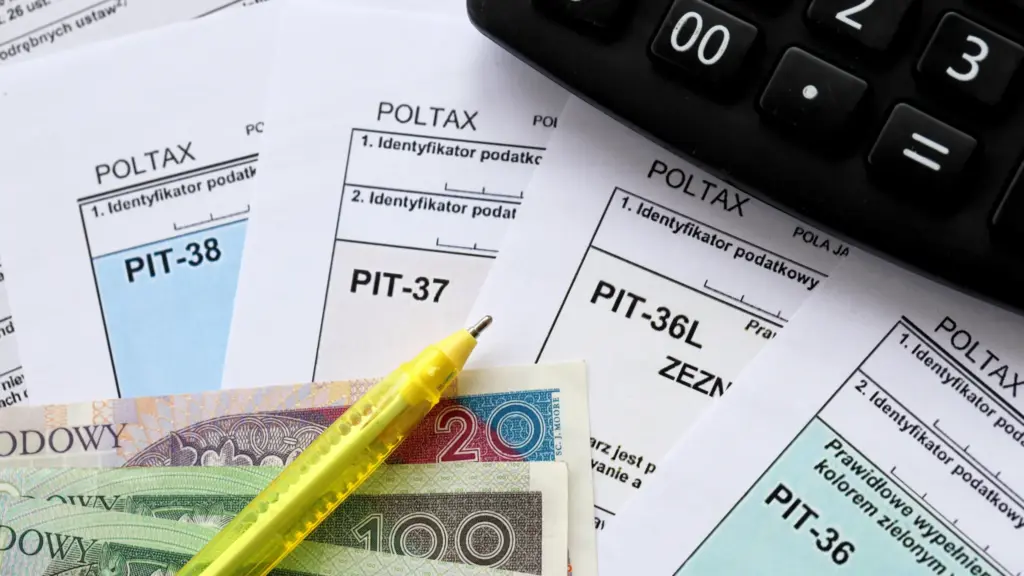
Income from the sale of securities is subject to a 19 percent flat tax. No estimated tax payments are made during the year on stock market income. The tax is paid in full only after the end of the year, when you settle up with the tax authorities by filing form PIT-38 (Polish capital gains tax return).
Tax on Apartment Rentals
Since January 1, 2010, an amendment to Poland’s tenant protection act has been in force, introducing the so-called occasional lease (najem okazjonalny). These rules make it easier for landlords who rent out apartments to evict unreliable tenants without lengthy eviction proceedings. Income from private rentals is taxed with a flat-rate tax on recorded revenue (ryczałt) – the current rates are posted by the Ministry of Finance at www.podatki.gov.pl.
You will find more information in the article “Łatwiejszy wynajem mieszkań w Polsce” (“Renting Out Apartments in Poland Made Easier”) and at: www.PoradnikSukces.com (type “wynajem” in the “search” box).
How to File Taxes in Poland
If the only income you receive in Poland is a pension or bank interest, the payers withhold the tax due themselves, and you do not have to file a tax return, regardless of whether you live in the United States or in Poland.
If you have other income in Poland and you are a Polish tax resident required to file in Poland under the treaty on the avoidance of double taxation, you should file a PIT-36 (Polish annual tax return) together with a PIT/ZG (schedule of foreign income) in Poland and report your U.S. income on them. You calculate the so-called abolition relief (ulga abolicyjna) on form PIT/O (schedule of deductions).
You send the tax return by April 30 to the tax office that has jurisdiction over your place of residence for tax purposes in Poland.
You can read more about filing Polish taxes at: www.podatki.gov.pl
How to File Taxes in the United States
When you have unlimited tax liability in the United States, you are required to report bank interest and stock market gains (as well as all foreign income) on your U.S. tax return, and you partially offset the taxes paid in Poland against your U.S. taxes thanks to the foreign tax credit.
Details in the book “Jak oszczędzać na podatkach” (“How to Save on Taxes”).
When You Send Money to Poland
The mere fact of sending money to your own account in Poland does not create any tax obligations. We pay taxes on income after the year in which it was earned. With properly taxed money we can do whatever we want. Of course, there are rules for international transfers, but they have nothing to do with income taxes.
If we send money to someone in Poland as a gift, we do not have to report up to $19,000 per recipient per year (the limit for 2026) to the IRS, but larger amounts must be reported on IRS Form 709. Recipients in Poland should report the gifts to the Polish tax office and, if applicable, pay gift tax depending on their tax group (degree of kinship) and the size of the gift. The details are discussed in the book “Powrót do Polski” (“Returning to Poland”).
Elżbieta Baumgartner
Elżbieta Baumgartner is the author of many advice books, including “Powrót do Polski” (“Returning to Poland”), “Emerytura reemigranta w Polsce, podręcznik seniora wracającego do kraju” (“A Returning Emigrant’s Pension in Poland: A Handbook for Seniors Returning Home”), “Ubezpieczenie społeczne Social Security” (“Social Security”), and “Obywatelstwo z przeszkodami” (“Citizenship with Obstacles”). They are available in Polish-American bookstores and directly from the publisher: Poradnik Sukces, 255 Park Lane, Douglaston, NY 11363, tel. 1-718-224-3492.
A list of these and many other guides is available online at: www.poradniksukces.com
Updated October 2026.