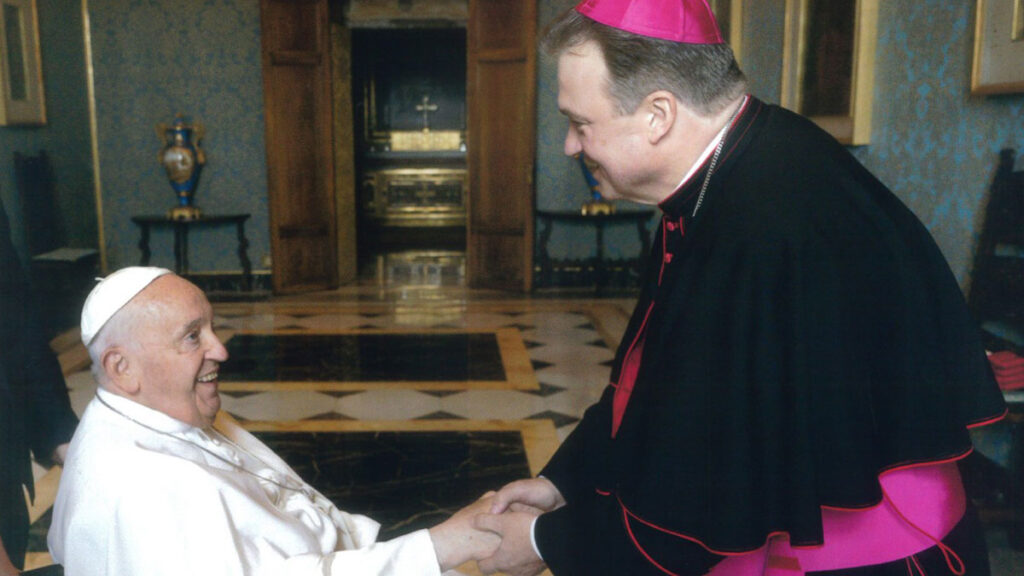
Conversation with Bishop Krzysztof Nykiel, Regent of the Apostolic Penitentiary.
If Your Excellency, as Regent of the Tribunal of Mercy and a close collaborator of Pope Francis, were to point to one message of the papal pontificate, what would Your Excellency choose?
The theme of Divine Mercy has been of great importance in the teaching and life of Pope Francis. It was very important to the Holy Father that the tenderness and merciful love of God could become the experience of everyone, especially those most in need. Therefore, as Christians, we must be people of the Beatitudes, who perform works of mercy for the soul and for the body. Many times during my private audiences or those related to my office, this concern was very concretely visible. Meetings with the Holy Father, and there were really many of them, were always very cordial, and one could feel that the mission of reconciliation, leading people along the paths of conversion, forgiveness, and mercy, was close to the Holy Father’s heart.
There are truly many speeches, homilies, heartfelt gestures, and actions with which the Holy Father Francis captivated the hearts of the faithful, dedicating much attention precisely to the theme of Divine Mercy, and this from the very first days of his pontificate. God is mercy! He never stops forgiving us! Let us trust Him! Pope Francis skillfully pointed out and always repeated that Divine Mercy is the beating heart of the Gospel, and even the very essence of God.
And if “the celebration of mercy takes place in a very special way in the sacrament of reconciliation (…), when we feel the embrace of God’s heart, in which we feel the embrace of the Father who comes to meet us to restore us to the grace of being His children” (Misericordia et misera, 8), every confessor cannot forget that in the exercise of his ministry he is a visible image of the invisible mercy of God, «a channel of joy for the faithful», who after «receiving forgiveness no longer feel oppressed by their sins, but can taste the work of God who has freed them» (Audience for participants in the Course on the Internal Forum, March 4, 2016).
God loves us, He never tires of us, He never tires of forgiving! This truth, so often reminded to us with conviction by the Holy Father, has helped so many brothers and sisters around the world to rise from spiritual poverty and confidently return to the path of faith, as we have been able to see in our daily ministry in the Tribunal of Mercy.
I think that one of the greatest gifts that Pope Francis has given us during his pontificate is precisely this appeal, which he addresses to each of us: God never stops forgiving you; with His forgiveness, it will always be possible to start anew, because God is a Father who raises His fallen children
and, embracing them, restores their dignity. And we should make this divine style of life our own, so that our lives may have a merciful style, because only those who show mercy will receive mercy.
This is the heart of the Gospel. It is up to us, therefore, to cultivate this joy and share it with the brothers and sisters we meet on our way.
Your Excellency, can one still obtain indulgences after the Pope’s death?
The answer is absolutely positive.
As is known, during the period of sede vacante, the spiritual goods of the Church (comprising the so-called Treasury of the Church), gained by the Most Precious Blood of the Savior and the merits of the Blessed Virgin Mary and all the saints, do not cease to flow to the faithful who are properly disposed to receive them.
Among the providential ways of benefiting from these spiritual goods is the gaining of an indulgence.
In view of the above, indulgences retain their validity even when the Apostolic See is vacant, because they are issued in the form of general laws, and these by their nature are unchangeable. Only the currently serving Pope can change them or abolish a particular indulgence.
One of the conditions for obtaining a plenary indulgence for oneself or a soul suffering in purgatory is prayer for the intentions of the Pope. These “intentions of the Pope” also retain their objective content during the period of sede vacante. The Tribunal of the Apostolic Penitentiary, called the Tribunal of Mercy, therefore maintains its continuity, even during the vacancy of the Apostolic See.