Taras Kotsur – Vatican
He cites data for July 2026: the “bloodiest month” of four and a half years of a war that has already claimed an unimaginable number of human lives and brought massive destruction. He condemns the cruelty of the war and its ethical consequences resulting from technology in which a drone’s eye, clearly seeing who it is about to attack, makes the concept of “accidental” civilian casualties both unacceptable and tragic.
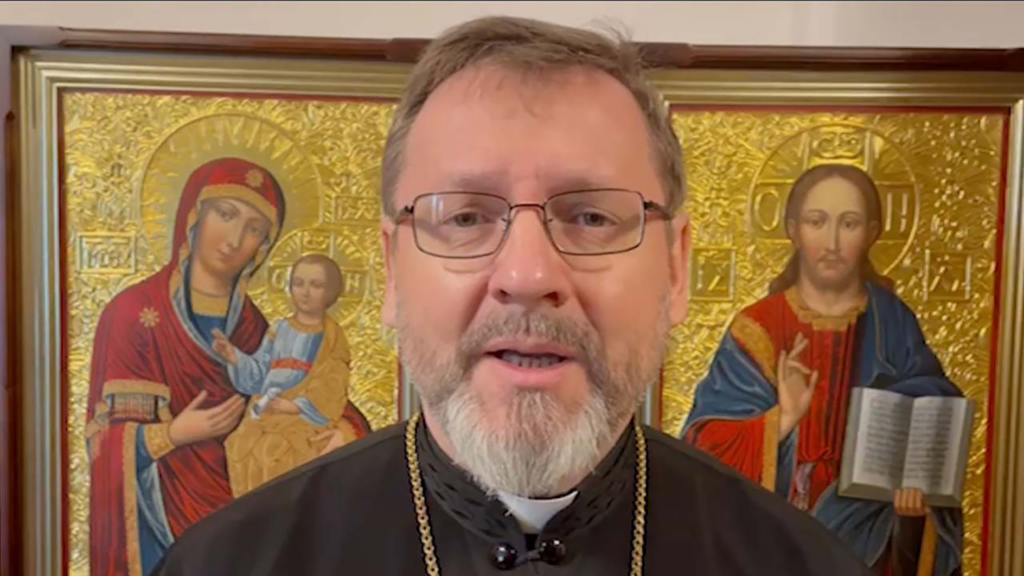
In the heart of the head of the Ukrainian Greek Catholic Church, His Beatitude Sviatoslav Shevchuk, the emotions evoked by the conflict are intertwined with those related to the 35th anniversary of Ukraine’s independence from Soviet totalitarianism. Both events—he tells Vatican media—prompt deep reflection on the priceless value of freedom.
Your Beatitude, it is a great joy to speak with Your Grace again, especially in this context, when every day we hear about continuous and heavy attacks on the capital of Ukraine, which also affect the part of the city where your cathedral and your residence are located. How are you experiencing this current situation?
We all spent this night [August 22 – Ed.] in an air-raid shelter, just like previous nights, because unfortunately the number of drones and missiles launched over our heads is increasing. Recently, every month has been bloodier than the previous one. For example, according to the United Nations Human Rights Monitoring Mission in Ukraine, July was the bloodiest month since March 2022, which had the highest number of casualties during these four and a half years of war. Official statistics state that this July 437 civilians were killed and 2,610 were wounded; since April 2022, the largest number of wounded and killed children has also been recorded.
All experts trying to understand what is happening say that this war is increasingly becoming a war of advanced technology and very sophisticated weapons. Some speak of a war of cities. Why? Because practically the ability to advance on the combat line has been halted. The advance of the Russian army along the front line is becoming increasingly impossible and very costly. Therefore, they are trying to attack the civilian population, increasing the suffering of people living primarily in large cities. For this reason, the capital of Ukraine has become target number one. When trying to find some analogy in the past, many say that the scenario unfolding in Ukraine is very similar to the Iran-Iraq war of the 1980s, which was indeed a war of two nations incapable of winning on the front line and trying to increase the suffering of the civilian population.
The second very serious feature from a moral and ethical point of view is that developing technology uses not only artificial intelligence to guide drones toward a target, but currently these deadly missiles and increasingly advanced drones used to attack the civilian population have been equipped with cameras. Thus, the operator directing this missile or drone in real-time sees the people they are killing. To say that civilian casualties are accidental victims whose direct killing was not intended is no longer possible. For example, a few days ago a bus was hit in the city of Kherson. Not only the people traveling on that bus were killed, but also those who were around it. It is obvious that the operator of this drone saw the people they were killing. This is truly a very serious moral problem. It is said that Russia is now trying to use the suffering of the civilian population, as well as fear, as a weapon. What they were unable to achieve on the combat front, they are trying to obtain through this terror directed at major cities.
This war also seeks to transform fatigue, suffering, and even the spiritual suffering of people into an instrument of political pressure. Of course, this changes the face of this war, which is always a sacrilegious war. Every act of this kind is a crime both against international humanitarian law and against the moral law applicable in the context of armed conflict. Such is the situation, especially in the capital, that we have been experiencing in recent months and days.
What does celebrating the 35th anniversary of independence mean in this situation, falling exactly four and a half years since the beginning of this terrible aggression?
For us, celebrating Ukraine’s Independence Day means first of all thanking the Lord for the gift of freedom, guaranteed by an independent Ukrainian state. For Christians, love for the homeland cannot turn into the idolatry of the state. The rule of law is an important tool for protecting human dignity, freedom, the common good, and the nation’s right to live. Love for one’s homeland is not hatred for others, but the will to take responsibility for one’s nation and to serve it. Therefore, for us, this day of commemorating Ukraine’s independence is a day of prayer and reflection on how we should today not only defend our freedom, but also positively build our future.
In these days we also always speak of national unity, because it is unity around certain fundamental values. The state is a tool serving the common good, the dignity of the human person, ensuring survival, living in freedom, and building our society in peace. Of course, on this day we will all pray for the end of the war. We know that not only is Ukraine’s independence a gift from God, but peace is also a gift from God. We will all be united in prayer, but also in our service to the common good, in our service to save human lives, especially in the context of the war we are experiencing today.
Your Grace mentioned the gift of freedom. In this context, I would like to ask something personal. You were born during a period of totalitarianism. Your priestly formation began in underground seminaries. What does these 35 years of freedom personally mean to Your Grace, also in the perspective of today’s youth, who were already born into the second generation of independence?
I happened to live at a time when the totalitarian communist state, which wanted to control even people’s minds and wills, fell apart. Then we understood that freedom does not mean merely the ability to be free in an external sense; we understood that freedom is a spiritual and moral category. I remember that even in the Soviet Union, we Christian Catholics who lived underground were freer than the communist leaders, because we carried this freedom of the children of God in our hearts. And it was precisely thanks to this capacity to be free, to have the courage to think differently than the state communist ideology dictated, thanks to the freedom of deciding, of making decisions freely, but always in accordance with the criteria of Christian discernment, that for us in Soviet times this became a spiritual school of freedom.
Then, when that totalitarian state collapsed, we were able to transmit this inner freedom that we carried within us into the context of Ukrainian civil society. Therefore, we truly became the leaven of a new society, and our Church became a true agent of the transformation of Ukrainian society from a post-communist and post-Soviet colonial country into a democratic state. Of course, this path will never be a path traveled once and for all. Every day we must demonstrate this Christian freedom and continue our journey.
Here, however, I understood something very deep that belongs to the Byzantine spiritual and theological tradition: that freedom is something greater than mere free will. Freedom is the fruit of a good choice and a choice based on truth. If I make the right choice, if I choose fundamental values, if I choose the good, then my free will, which is the potentiality of freedom, is transformed into the experience of freedom. Therefore, helping people make the right choices is the path toward authentic freedom. Not license, not anarchy, but freedom that is always connected with responsibility and the common good.
It is obvious that this concept of freedom is in high demand in Ukraine today. Interestingly, many of our boys who were prisoners of war, who experienced terrible torture in Russian captivity and were subsequently released, said that they felt freer even with their hands tied than those who tortured them. Why? Because those Russian officers were truly prisoners of their own thought patterns. They were afraid of their superiors. They were afraid that they themselves would end up in prison if they did not blindly follow the orders received. And our soldiers in those moments felt freer even with their hands tied. Why? Because they had made their choice. The right choice. A choice that is always based on truth and the defense of human life.
This is our experience from the times of the Soviet Union. Our experience as a society rebuilding itself after the fall of state totalitarianism. It is precisely this freedom that the Ukrainian people are trying to defend today and increasingly build in their free and independent country.
What could be the message of the Ukrainian people to today’s world, where we can observe a certain crisis of democracy along with the growth of authoritarian tendencies in various parts of the world, even where we would least expect it?
Do not grow tired of being free! In my opinion, this crisis of democratic values is linked to a certain crisis of responsibility for one’s own country. Everyone wants to shift their responsibility onto the shoulders of others. Sometimes people look for a scapegoat—a politician or an autocrat who could take over the personal duties that every human being has toward their homeland and their country. Sometimes some people want to be relieved of the necessity of thinking and discerning. They want someone else to think, discern, and decide for them. This is a kind of infantilism, because that is how children behave when they think that others should always build a better future for them. The flight from responsibility is, in my opinion, a great plague of modern democracies today.
Therefore, it surprises me that today the Church is increasingly becoming the guarantor and defender of democratic values, because the Church affirms the dignity of every human person. It is the Church that protects man in contemporary culture against dehumanization, at all levels, starting from today’s challenge which is artificial intelligence. It is the Church that says no one should have the right to steal other people’s dreams and hopes regarding their future. On the contrary, we ourselves are the builders of our lives and our future.
Do not be afraid to be free. This is the fundamental message that Ukraine can address to the entire world today. Even if this freedom has to be defended. Because freedom is never given once and for all. Those who do not take the risk of accepting this freedom and living as free men and free women are not worthy of this gift of freedom.
As a pastor of a portion of the People of God found in Ukraine, as well as in other parts of the world, what appeal would Your Grace like to address to the universal Church on the occasion of this independence anniversary?
The highest expression of freedom is man’s ability to love. To love God and neighbor. Today in Ukraine we see that the national concord that led us to national independence can only be defended through mercy. Through the ability to empathize with those who suffer, the ability to show mercy to those who make mistakes, but also through our ability to do good to our neighbor. Therefore, we must not forget that we experience the greatest experience of freedom when we love God and neighbor.
I wish to thank everyone who, on Ukraine’s Independence Day, August 24, will join us in prayer. I want to recall that the All-Ukrainian Council of Churches has appealed to the World Council of Churches, and has also written a letter to Pope Leo and to all people of good will, to experience August 24 as a day of prayer for peace in Ukraine. All of us in Ukraine on that day will be united in prayer. We, the heads of Churches and religious organizations, will gather in the oldest cathedral of Eastern Europe, the Cathedral of St. Sophia in Kyiv. There is an 11th-century mosaic of the Mother of God Orans there. Before this mosaic of the Mother of God Orans of Kyiv, we will pray for peace. We ask you for solidarity and unity in prayer, but also in humanitarian actions, which are today an excellent way for us to show our love for God and neighbor.