Why donate your car?
If you want to do yourself a favor while doing a good deed for others, donate your old car to a charity. This is how many Americans get rid of their old cars (as well as boats, recreational vehicles and motorcycles), and evidently it pays off for them.
Many people are disappointed with the price offered for their old car by the dealer selling them a new one (trade-in prices). The reason is that dealers are making less and less on new cars, so they make up for it on the old ones. On the other hand, if you want to sell your old clunker yourself, you may find that there are no buyers at all. Nobody will want a real wreck from you, not even for free.
Whom to donate to
To get a tax deduction, you must donate to a nonprofit organization that has official charitable status granted by the IRS – so-called 501(c)(3) status. You can check whether an organization can accept tax-deductible donations with the IRS Tax Exempt Organization Search tool, available at www.irs.gov/charities-non-profits/tax-exempt-organization-search (data from the former Publication 78 – “Pub 78 Data”). You can also check an organization’s status by calling the IRS at 877-829-5500. Just remember that churches, synagogues and mosques do not have to apply to the IRS for tax-exempt status and may not appear in the search tool.
Many charities, both local and national, accept cars. The formalities (picking up the car, selling it at auction) are often handled on their behalf by specialized intermediary companies.
Of course, you can donate your car directly to a charity. The National Kidney Foundation runs one of the best-known programs of this kind – Kidney Cars (www.kidney.org). Cars are also accepted by, among others, regional affiliates of Volunteers of America.
Note: Many organizations that collect cars for charities do not themselves have charitable status. If you sign the title over to them, you will not be entitled to a tax deduction.
The paperwork
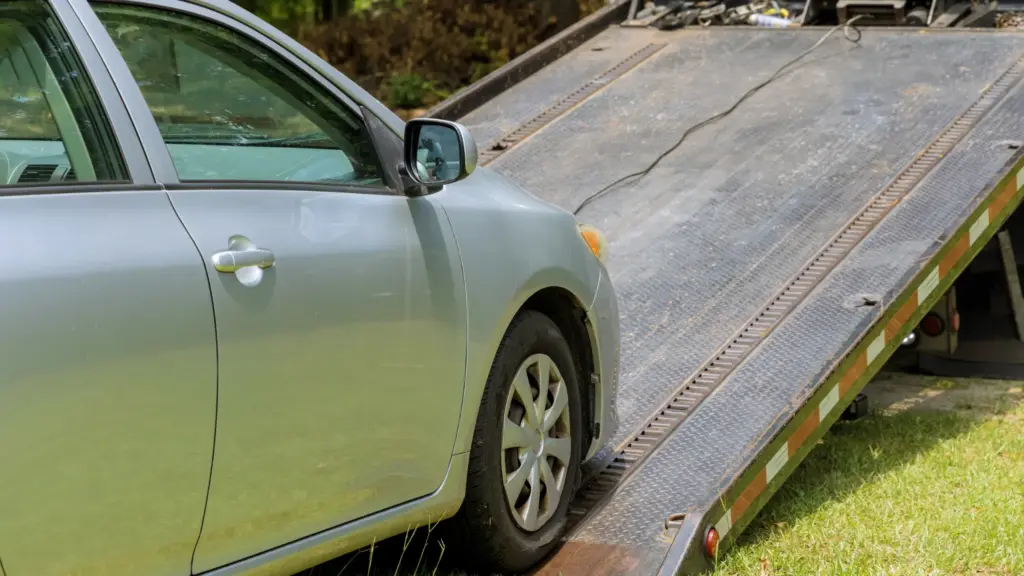
Once you choose a charity, you can contact it by phone or by filling out a form online. It is better to call and talk, because the organization may not operate in your area or may not accept the car if it is too old. Usually your car does not even have to run. You make an appointment with the organization, and its representative will come to you, tow the car away and leave a receipt.
In theory, you, not the organization, should determine the value of the car. In practice, however, organizations will do it for you (see below). Many organizations will tell you over the phone what your car is worth and what deduction you can expect.
You must give the organization’s representative the keys and the Title of Ownership, signed over to that organization (you enter its name on the back). If you cannot find the title, you must get a duplicate from your state Department of Motor Vehicles. In New York you can order a duplicate title online at dmv.ny.gov or on Form MV-902 (fee: $20), and residents of other states will find information on their state DMV’s website.
Cancel the car’s registration so that you are not held liable if the new owner causes an accident.
What is your car worth?
For years, owners could deduct the market value of a donated car. That changed on January 1, 2005. Donors can now deduct the amount for which the charity managed to sell the car. Since vehicles are often disposed of at auction, the sale price is often below market value.
In a few situations there is an exception to this rule, and you can deduct the vehicle’s market value. This applies when the charity gives you a written certification that the organization:
- will use the car for its own needs,
- intends to make repairs or improvements, or
- intends to give or sell the car below market price to a needy person who requires transportation.
If the donated car was sold for $500 or less, you can deduct the smaller of the two: $500 or the market value.
You can estimate your vehicle’s value without leaving your computer. Popular used-car pricing guides such as Kelley Blue Book or Edmunds will help, where you can find the price of your passenger car, SUV, van or truck by make, model year, mileage and where you live.
The charity is required to send you a written acknowledgment (e.g., Form 1098-C) within 30 days of the date the car was sold, or within 30 days of the date of the donation if the exception described above applies.
Do you qualify for a tax deduction?
The deduction is claimed on Schedule A: Itemized Deductions, which is also used to itemize other tax breaks, such as state and local taxes, mortgage interest, casualty losses, medical expenses and so on.
The problem: if all your deductions do not exceed the standard deduction – for tax year 2026 it is $16,100 for a single person and $32,200 for a married couple filing jointly – you will not be able to deduct your charitable gift, because the standard deduction will be larger.
Many people who have donated cars cannot deduct the donation. The reason is that a person who rents an apartment, works for a wage and keeps money in the bank rarely has deductions exceeding the standard deduction. As a rule, only homeowners, who are allowed to deduct mortgage interest and property taxes, clear that threshold. If we do not own a home, donating a car probably will not give us a deduction. Still, we will have the satisfaction of having done a good deed.
The tax deduction
Do not think that you can deduct from your income the highest price you have seen for your car model in perfect condition. It is also wrong to deduct the price that a careless charity worker wrote on the receipt if he simply pulled it out of thin air. The IRS requires you to use “fair market value”. That is why, when pricing your car, you should enter accurate information about its condition.
If your deduction for the car exceeds $500, you should fill out Form 8283, Noncash Charitable Contributions, and attach it to Form 1040. You settle your taxes by the tax filing deadline, usually April 15 of the following year.
Remember: Keep the papers documenting the donation: the organization’s receipt and the car valuation. Do not count on always being able to print it out from your computer. The IRS usually calls taxpayers in after 3 years, and by then your car’s model year will be much cheaper. Reconstructing what the car was worth 3 years earlier will not be easy.
You can get more information in the IRS brochure A Donor’s Guide to Vehicle Donation (www.irs.gov/pub/irs-pdf/p4303.pdf).
Elżbieta Baumgartner
Elżbieta Baumgartner is the author of many financial and consumer advice books, including “Otwieram biznes” (“Starting a Business”) and “Praca w Ameryce” (“Working in America”), 255 Park Lane, Douglaston, NY 11363, tel. 718-224-3492, www.PoradnikSukces.com.
Updated October 2026.