
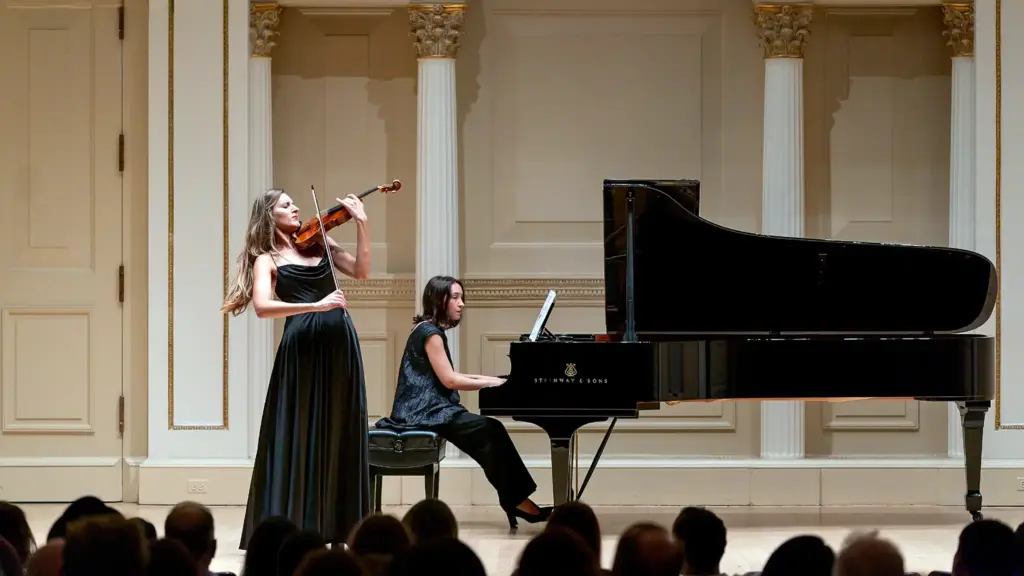
Polish violinist Yuliya Kazimirovich performed at Carnegie Hall’s Weill Recital Hall on July 21, 2026, in the American Virtuoso International Music Competition winners’ recital. Born in Belarus and trained in Gdańsk, she played miniatures by Wieniawski, Tchaikovsky and Kreisler. Her next stop is the Osaka final in October.
A hundred and fifty years ago, a Polish violinist crossed the Atlantic and played 215 concerts in eight months. He never performed at Carnegie Hall. The building did not exist yet.
On July 21, 2026, Henryk Wieniawski’s music arrived there anyway – carried by a violinist from Gdańsk.
The recital
Yuliya Kazimirovich performed at Weill Recital Hall at Carnegie Hall, in the winners’ recital of the American Virtuoso International Music Competition, presented by the American Society of Musical Excellence. She shared the evening with some twenty other laureates, playing with piano accompaniment on the smallest and most intimate of Carnegie Hall’s three stages – roughly 270 seats, the room where debuts happen.
Her program was built from miniatures: Henryk Wieniawski, Pyotr Tchaikovsky, Fritz Kreisler. Short pieces, and a deliberate choice. Miniatures leave a violinist nowhere to hide. There is no long symphonic arc to carry a weak passage; every phrase is exposed.
“The program was meant to show different sides of my personality and of the path I have taken so far,” Kazimirovich said.
A Polish violinist born in Belarus
Kazimirovich describes herself as a Polish violinist. She was born in Belarus, and her musical life has been Polish since her student years.
She earned both a bachelor’s degree with honors and a master’s degree at the Stanisław Moniuszko Academy of Music in Gdańsk, studying in the violin class of Dr. hab. Karolina Piątkowska-Nowicka and Dr. hab. Anna Wandtke-Wypych. She is now completing her studies at the University of Music and Performing Arts in Vienna, in the class of Prof. Stefan Kamilarov and Alexandra Soumm.
Her competition record started early. First prize at the London International Music Competition and second prize at the “Música Callada” international competition in Ávila, Spain, both in 2018. First prize at the international Glière competition in Moscow the following year.
Vienna, on the inside
Most young soloists arrive in Vienna to study. Kazimirovich has been working there.
From 2023 to 2025 she was a member of the first violin section of the Wiener Symphoniker – the orchestra of the city of Vienna, the one that plays the Konzerthaus and the summer night concert at Schönbrunn. She is now a member of the first violins of the Tonkünstler-Orchester, based at the Musikverein and in Sankt Pölten.
This matters more than a line in a biography. A soloist’s career is built on competitions and recitals; an orchestral seat in Vienna is a different discipline, learned from inside the section – matching a bow stroke to fifteen other players, keeping a phrase alive at the third desk when nobody is listening for you specifically. Musicians who have done both tend to be recognizable. They listen better.
She has also performed at concerts and festivals in the United States, Mexico, Morocco and a number of other countries.
Wieniawski’s America
The connection between the program and the place is not incidental.
Henryk Wieniawski left Russia in 1872 and sailed for America with the pianist Anton Rubinstein. Between September 1872 and May 1873 the two men gave 215 concerts in 59 cities – New York, Boston, Chicago, Philadelphia and dozens of towns whose halls are long gone. Eight months. Roughly a concert every day.
When Rubinstein went home, Wieniawski stayed. He played on through California, reached San Francisco, and did not return to Europe until early 1874. The tour made money and wrecked his health; he never fully recovered, and died in 1880 at forty-four.
Carnegie Hall opened eleven years after his death, in 1891. Wieniawski built the American reputation of the Polish violin school in rooms that have since been demolished, in a country that had not yet built the hall every musician now wants to play.
That is the quiet symmetry of this July evening. The composer never reached the stage. The music did.
Osaka, next month
The Carnegie Hall recital was not the end of the season for Kazimirovich.
She qualified for the final of the OSAKA International Music Competition by winning the European semifinal with the highest score in her category – advancing directly, without an intermediate round. The final takes place in Osaka, Japan, October 10–12, 2026.
It is a little over a month away.
Ewelina Modrzejewska