Vatican News / Artur Hanula
Future uncertain, but there are numerous benefits
Leo XIV noted that while on the one hand the full impact of technological development on the future “remains uncertain,” on the other hand “these tools give us reason to hope for a better future for humanity.” The Holy Father listed such benefits as: technology assisting in breakthrough scientific discoveries, fostering technological innovations that will contribute to the development of medicine through higher levels of diagnostics and treatment of diseases, strengthening food and energy systems, and deepening the understanding of the universe and the natural world. Technology can open “new opportunities for human creativity and cooperation.”
Remembering the risks
However, the Pope warned against forgetting the risks associated with technological development. “Artificial intelligence can be used for surveillance, manipulation, and discrimination,” the Holy Father said. “Advanced cyber capabilities and autonomous weapons can – if developed or deployed without appropriate safeguards and human oversight – pose new threats to international security and peace.” Furthermore, artificial intelligence systems require significant energy and water resources, impacting carbon emissions.
The need for discernment
As the Holy Father emphasized, “the greater our power to transform the world, the greater must be our capacity to discern what truly serves human dignity given by God, to exercise power wisely, and to care for those who may bear the greatest consequences of our choices.”
Alarming climate change
The Pope then drew attention to alarming natural disasters that “occur more and more frequently and with ever-greater intensity.” Their effects hit poor people the hardest. “The climate issue is not merely an environmental challenge, but fundamentally concerns justice, human dignity, and solidarity between nations and generations. We cannot respond to these challenges only after a disaster has occurred. We must move from crisis response to prevention, from vulnerability to preparedness, and from short-term measures to a wise and far-sighted vision for humanity,” Leo XIV appealed.
He encouraged a responsible and prudent approach to science, committed “to discovery while at the very beginning taking into account the consequences that scientific and technological choices may have for humanity and for the integrity of creation entrusted to us by God.”
The necessity of cooperation
The Holy Father pointed out the necessity of cooperation among scientists, engineers, economists, doctors, and sociologists, as well as local communities and decision-makers. He recalled that climate challenges transcend all boundaries between disciplines, institutions, and nations.
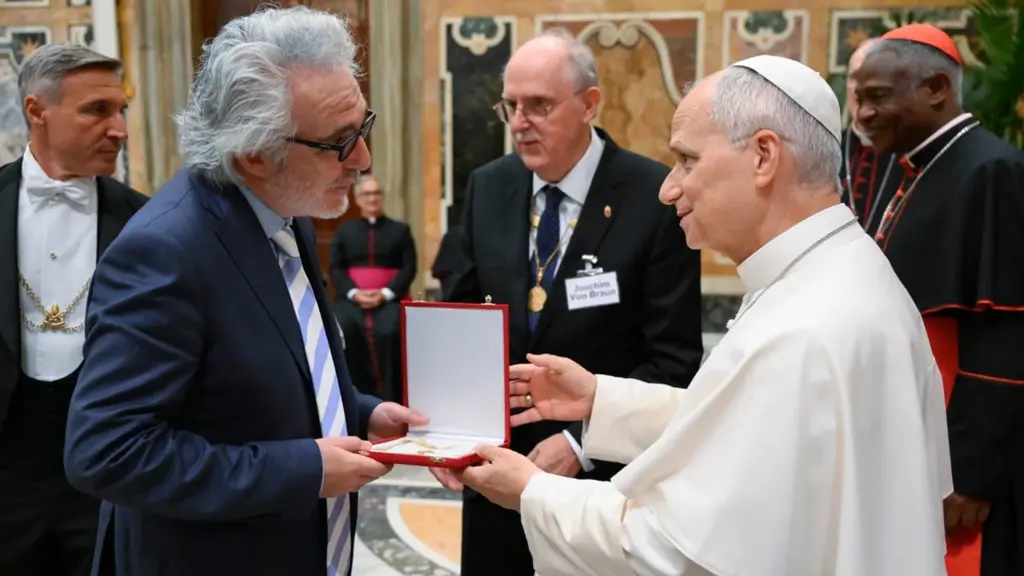
In this context, the Pope spoke with appreciation of the initiatives undertaken by the Pontifical Academy of Sciences, which bring together not only scientists, but also youth, public authorities, representatives of civil society, and followers of various religious traditions.
“Such meetings create spaces where knowledge can be shared across borders, drawing on successful experiences and adapting them to one’s own needs, as well as translating scientific knowledge into concrete action,” the Pope said, encouraging the continuation of this path.
In conclusion, the Pope encouraged the audience participants to cultivate a scientific culture that “will be ambitious yet humble; rigorous yet open to dialog; innovative yet responsible; based on global cooperation yet mindful of those who are most vulnerable and most in need.”
According to Leo XIV, thanks to this, scientific cooperation will serve peace and the protection of God-given human dignity, the promotion of the common good, and the care of creation.
The Holy Father expressed his joy at the presence of young people among the audience participants, which “reminds us of the future!”; “And that is very, very important,” the Pope added.