
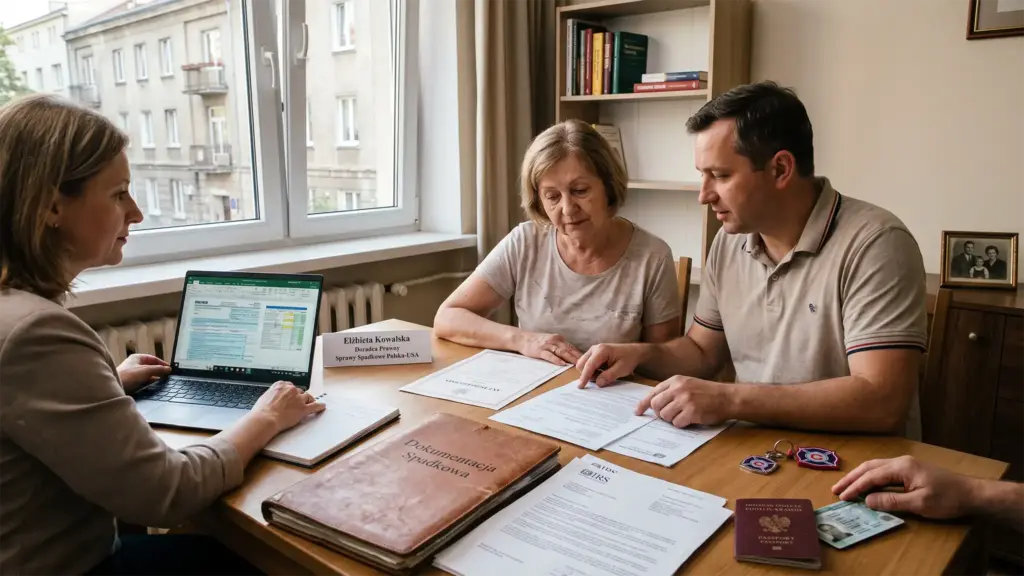
The reason is simple, though few know about it until it becomes a problem: there is no double taxation treaty between Poland and the United States regarding inheritances and gifts. This means that the same assets can be taxed twice — once in the country where they are located, and once in the country where the heir resides.
For comparison: Poland has such agreements with only three countries — Austria, Hungary, and the Czech Republic. The USA is not among them, even though it is home to one of the largest Polish diaspora communities in the world. In short — if you are expecting an inheritance from Poland or plan to leave assets to loved ones in the USA, it’s worth understanding the mechanics of this system before the tax office does it for you.
How inheritance tax works in Poland
Polish inheritance and gift tax divides heirs into three tax groups, depending on their degree of kinship with the deceased. Group I includes immediate family: spouse, children, grandchildren, parents, grandparents, siblings, stepchildren, stepparents, as well as sons-in-law, daughters-in-law, and parents-in-law. Group II consists of more distant relatives — for example, parents’ siblings or siblings’ spouses. Group III includes unrelated individuals, such as partners or friends.
In 2026, the tax-exempt amounts are: PLN 36,120 for Group I, PLN 27,090 for Group II, and PLN 5,733 for Group III. Above these thresholds, rates increase progressively — from 3 to 7 percent in Group I, from 7 to 12 percent in Group II, and from 12 to 20 percent in Group III, depending on the amount exceeding the tax-exempt threshold.
The most important relief applies to the so-called Group Zero — i.e., spouse, descendants (children, grandchildren), ascendants (parents, grandparents), siblings, stepparents, and stepchildren. These individuals can be completely exempt from tax, under one condition: reporting the acquisition of the inheritance or gift to the tax office within 6 months. For gifts, the deadline is usually counted from the date of receipt, while for inheritances — from the date the court’s decision on the acquisition of inheritance becomes final or the registration of the certificate of inheritance by a notary, not from the date of the deceased’s death itself. Missing this deadline is one of the most common mistakes that cause families to lose their right to exemption — even if they formally qualified for a zero rate.
How it looks on the American side
The system in the USA works completely differently and, for individuals without American citizenship or permanent residency, can be much stricter. The American estate tax is levied on the deceased’s assets before they reach the heirs — not from the perspective of the person inheriting, as in Poland.
For US citizens and residents (green card, domicile in the States), the tax-exempt amount is very high — as of January 1, 2026, it is $15 million per person, which in practice eliminates federal tax for the vast majority of families. However, it is completely different for a so-called nonresident alien — an individual who is neither a citizen nor a tax resident of the USA. For such a person, the tax-exempt amount for US estate tax is calculated solely on assets located within the United States and is only $60,000 — a threshold that has not changed since 1976 and is not indexed for inflation. Assets above this amount can be taxed at a rate of up to 40 percent.
This distinction has enormous practical significance. A Pole living in Poland who inherits from a relative living in the USA may — depending on the asset structure and their tax status — be subject to this restrictive rule for non-residents. Conversely, a person from Poland who permanently resides in the USA (has domicile there) may in some situations qualify for a much higher tax-exempt amount — but determining which regime actually applies requires an analysis of the individual situation, not a general rule.
Where the risk of double taxation comes from
The lack of an agreement between Poland and the USA means that there is no automatic mechanism that would allow the tax paid in one country to be credited against the liability in the other. In practice, this can look like this: assets located in the USA are subject to US estate tax (up to 40 percent of the excess over $60,000, if the heir is a non-resident), and then — if the heir lives in Poland and is subject to Polish tax law — the same assets may also be subject to Polish inheritance and gift tax, without deducting what has already been paid overseas.
This is not a theoretical situation. The Polish Commissioner for Human Rights has already intervened with the Minister of Finance on this matter, drawing attention to cases of individuals who received an inheritance from abroad and had to pay additional tax in Poland, even though the assets had already been taxed abroad. The ministry’s response confirmed that, under the current legal status, there is no general mechanism to eliminate this double burden in relations with countries with which Poland does not have an appropriate agreement — and the USA is precisely such a country.
What you can do before the inheritance case begins
The biggest mistake in such matters is a lack of planning ahead — an inheritance usually comes without warning, and then all that’s left is reacting to the consequences of decisions no one consciously made. A few steps can genuinely reduce risk and costs:
- Check where the assets are actually located. Real estate in Poland, a bank account in the USA, an insurance policy in a third country — each component may be subject to different taxation rules, depending on its location and the tax status of the deceased and the heir.
- Determine your tax status in the USA. Whether you are treated as a resident or a nonresident alien for estate tax purposes determines whether the $60,000 limit or a much higher tax-exempt amount applies to you — and the difference in practice can mean tens of thousands of dollars in tax.
- Don’t miss the 6-month deadline in Poland. If you qualify for an exemption in Group Zero, reporting after the deadline means losing the right to the relief — even if you formally qualified for it from the beginning.
- Consider consulting before, not after. The recognition in Poland of a will drawn up in the USA (and vice versa) is a separate legal issue from inheritance tax — the USA is not a party to the 1961 Hague Convention on the Form of Testamentary Dispositions, which Poland has ratified, so the validity of the form of a cross-border will must be assessed individually, in accordance with private international law. Establishing the validity of a will alone does not resolve the tax issue — these are two separate matters that should be planned together, preferably with the help of someone familiar with both systems.
- Gather documentation of assets abroad now. Bank statements, deeds of ownership, policies — if you plan to leave assets to loved ones on both sides of the ocean, organized documentation significantly speeds up and simplifies subsequent inheritance proceedings, regardless of which country they take place in.
In cross-border matters, one specialist is rarely enough — usually, both a lawyer familiar with Polish inheritance law and a tax advisor understanding the American estate tax system are needed. A well-chosen team can genuinely limit the risk of double taxation, especially if the matter is planned in advance, rather than only after the inheritance is opened.
When to address this
The best time to sort out cross-border inheritance issues is before they become current — that is, during the testator’s lifetime, when planning assets. In practice, however, many families encounter this topic only after the death of a loved one, when they must act under pressure of deadlines on both sides of the ocean. In such a situation, it is crucial to quickly determine which tax laws apply to a given asset and to promptly complete the reporting formalities in Poland — the 6-month clock (counted, for inheritance, from the finalization of the court’s decision or the certificate of inheritance) runs regardless of how complicated the matter is on the American side.
You can read more about how Polish and American wills are mutually recognized in our previous article on inheritance law and USA-Poland taxes. For tax matters related to settlements between the two countries, a licensed tax advisor can also be helpful — you can find verified specialists in this field in the directory on PolishPages.com.
Cross-border inheritances PL-USA in a nutshell
- Poland DOES NOT have a double taxation treaty with the USA for inheritances — the risk of paying tax in both countries is real.
- Poland (2026): tax-exempt amounts PLN 36,120 (Group I) / PLN 27,090 (Group II) / PLN 5,733 (Group III); Group Zero can be exempt if reported within 6 months.
- USA: estate tax exemption for nonresident aliens is only $60,000 (unchanged since 1976); for citizens/residents — $15 million as of 2026.
- Excess above the limit in the USA can be taxed at a rate of up to 40 percent.
- The validity of the form of a cross-border will PL-USA is assessed individually — the USA is not a party to the 1961 Hague Convention, which Poland has ratified.
Bartosz Karczmarski, Poland.US (Voice of Polonia in the USA). This text is for informational purposes only and does not constitute legal or tax advice. For individual matters, consult a licensed lawyer or tax advisor familiar with the laws of both countries. More guides on poland.us.
📱 Download the PolishPages app:
App Store (iPhone) | Google Play (Android)