
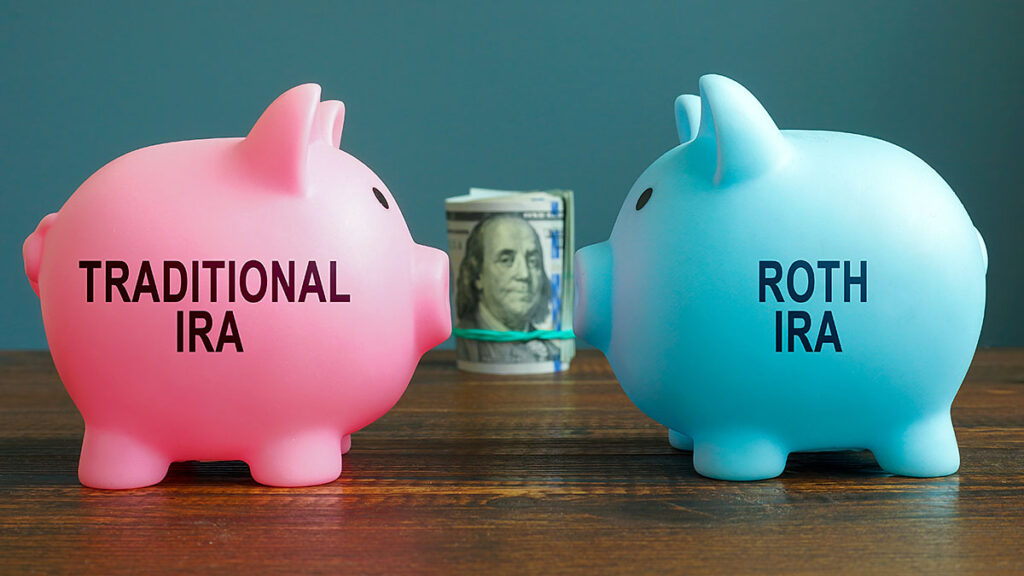
A reminder about the Roth IRA
The Roth IRA retirement plan is a version of the IRA (Individual Retirement Account), named after the person who came up with the idea, Senator William Roth.
Unlike a traditional IRA, contributions to a Roth IRA are not tax-deductible, and taxes on earnings are eliminated altogether, not just deferred as with other retirement plans. To have earnings completely tax-free, you need to keep the money in a Roth IRA for at least 5 years. Your contributions, on the other hand, can be withdrawn at any time without penalty. Earnings accumulated in the account that are withdrawn before age 59½ are subject to a 10-percent penalty. After age 73 there is no obligation to empty a Roth account, unlike a regular IRA. In 2026 you can contribute up to $7,500 a year to a Roth IRA ($8,600 for people over fifty), but no more than the person’s earned income. You can, however, transfer any amount to it from other qualifying retirement accounts.
What a Roth conversion involves
A Roth conversion means that you open a Roth account and move assets into it from a traditional, SEP or SIMPLE IRA or from a qualified employer retirement plan such as a 401(k), 403(b) or 457(b). The amount transferred will be added to your income and taxed at your bracket rate in the year of the conversion. You will, however, avoid the 10-percent penalty on early withdrawals made before age 59½.
Does it make sense to pay taxes on retirement savings sooner rather than later? The answer may be yes. Money goes into a Roth IRA after taxes, and qualified withdrawals are completely tax-free. In addition, Roth IRAs are not subject to required minimum distributions (RMDs), which gives you more control over your taxes in retirement.
Who can contribute to a Roth IRA
You cannot contribute to a Roth IRA if your modified adjusted gross income (MAGI) is equal to or above certain limits ($168,000 for single filers and $252,000 for married couples filing jointly in 2026).
For the well-off, however, there is a way around these limits: a Roth IRA conversion allows you, regardless of your income level, to move all or part of your existing traditional IRA funds to a Roth IRA.
When is it worth considering switching to a Roth IRA?
There are several scenarios in which it may work to your advantage:
- You have irregular income, and it is lower than usual this year. Maybe you run your own business and are having a lean year, or you were unemployed. This can be an ideal opportunity to move some funds to a Roth IRA and pay as little tax as possible.
- You believe your tax bracket will be higher in retirement than it is now. In this scenario, paying taxes at your current tax rate is better than paying a higher rate after you stop working. Higher taxes are a risk if you have not yet reached your peak earning years, or if in addition to Social Security you will also receive a generous private pension, or if you have built up substantial savings in retirement accounts that you will have to draw down after reaching age 73. In such a situation, converting all or part of the funds from a traditional IRA to a Roth may make sense.
- Because of a stock market crash, the value of the investment funds in your retirement account has dropped. You will now pay tax on a smaller amount, and the assets moved to the Roth will, after a year or a few years, return to their previous price level or even gain in value. You will be able to withdraw this larger pool tax-free in the future.
- You want to maximize your estate for your heirs. A Roth IRA is not subject to Required Minimum Distributions (RMDs), meaning it does not have to be emptied after you reach age 73. Thanks to this, the money can keep growing tax-free for longer and pass in full to your heirs (beneficiaries).
- You want to reduce your heirs’ taxes in the States. Heirs will pay income tax on an inherited IRA, and the amount depends on their tax bracket. If your children earn well (better than you), their taxes are high, and they will be even higher once their shares of your retirement account are added. So it is better to pay the taxes now, at your lower rate.
- You want to reduce your heirs’ taxes in Poland. Think carefully before you leave your retirement account to relatives in Poland. A nonresident (foreigner) who has inherited a traditional IRA must pay a flat 30% US income tax on the amount withdrawn. US tax treaties with some countries allow a lower tax rate for nonresidents on inherited retirement accounts, but the Polish-American treaty does not. That is why your Polish heir (beneficiary), who has neither American citizenship nor a green card, will have 30% of the value of his or her share withheld by the bank and sent to the IRS. If, on the other hand, the heir inherited a Roth account, he or she would pay no tax at all, either in the States or in Poland. It pays to use your head.
A conversion pays off most when you have a nondeductible IRA, because when you close it out, you will pay tax only on the accumulated earnings.
Who should not do a Roth IRA conversion
For some people, sticking with a traditional IRA or other tax-deferred accounts may be a better strategy. A Roth conversion may not be a good option in the following situations:
- You are close to retirement or already retired. In this situation you might not have time for the assets to appreciate enough to recover the taxes you paid.
- You are currently receiving Social Security or Medicare benefits. If a Roth conversion were to increase your taxable income, more of your benefits would become taxable and your Medicare costs could go up.
- You don’t have savings outside your retirement account to pay the tax on the conversion. If you have to pay the tax with retirement money, recovering the tax loss will take even longer and may cancel out the benefits.
- You plan to give a significant part of your traditional IRA to charity. A conversion then makes no sense, because you can avoid taxes through a Qualified Charitable Distribution (QCD). You can read about it in the book “Amerykańskie emerytury” (“American Pensions”).
A few suggestions
You will lower your taxes if you do the conversion gradually, over several years. For example, you can convert only as much as will keep the additional withdrawals from being taxed in the next higher tax bracket.
Early retirement, when your earnings drop but you are not yet subject to RMDs, is a particularly good time to put this strategy into practice.
The decision to switch to a Roth IRA does not have to be all or nothing. You may find that splitting your savings between a Roth and a traditional IRA, or between a Roth IRA and a traditional 401(k), is the best solution for you.
Generally speaking, switching to a Roth IRA can give you more flexibility in managing required minimum distributions and potentially lower your tax bills in retirement.
Think it over carefully and run the numbers to see whether a conversion pays off for you, and discuss it with your accountant or financial advisor, because under the Tax Cuts and Jobs Act a Roth conversion made on or after January 1, 2018, can no longer be undone.
Updated October 2026.