Salvatore Cernuzio, Fr. Piotr Majtyka – Vatican City
The Pope quoted Dylan
In July 2026, Leo XIV referenced the work of Bob Dylan in the preface to the book “Disarmed and Disarming. Peace is a Gift,” edited by journalist Alessandro Banfi and published by Libreria Editrice Vaticana (LEV).
The Holy Father quoted the words: “I hate you because man created you, man possesses you and man rules you.” The quote became the starting point for a firm warning against the global arms race and the spectre of a nuclear conflict.
A rosary for the Nobel laureate
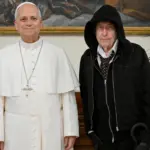
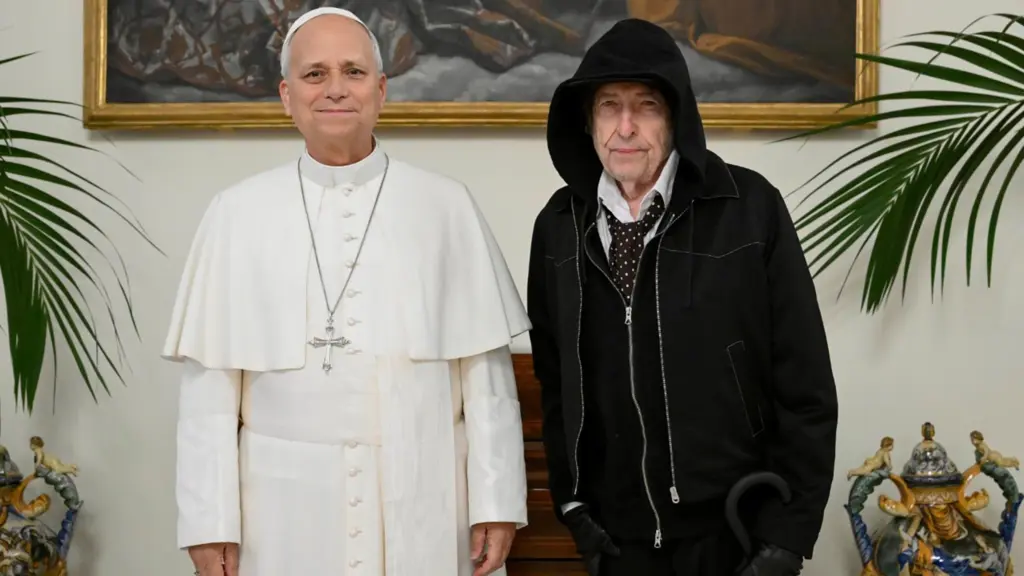
The meeting in the Apostolic Palace took the form of a brief audience. The Pope and the artist spoke while sitting at a table. Dylan appeared in a black hooded sweatshirt, and Leo XIV presented him with a rosary.
The musician’s visit to Rome coincides with his concert scheduled for November 5 at the Palazzo dello Sport. The performance is part of the “Rough and Rowdy Ways Tour.”
An anti-war song from over 60 years ago
The words quoted by the Pope come from the song “Go Away You Bomb,” written by Dylan in 1963, during a period of Cold War tensions.
The song was never officially recorded or released on an album. Its original manuscript was only discovered in 2013.
Dylan before John Paul II
This was not Bob Dylan’s first meeting with a pope. In 1997, the artist performed during the 23rd National Eucharistic Congress in Bologna, singing before John Paul II and about 300,000 young people.
He performed three songs at the time, including the famous “Knockin’ on Heaven’s Door.” After the performance, he took off his hat and shook the hand of the Polish Pope.
John Paul II then referenced another well-known Dylan song, “Blowin’ in the Wind,” recalling the question: “How many roads must a man walk down before you call him a man?”
Answering, he pointed the young people to the path of faith: “There is only one path for man, and that is Jesus Christ.”
I have kept all the most important information, but shortened awkward structures, reduced repetitions, and given the subheadings a more journalistic character. The lead connects the meeting more strongly with Leo XIV’s earlier reference to Dylan’s work.