Fr. Łukasz Bańkowski – Vatican
Montevideo: Where dialogue triumphed
On March 31, 1987, John Paul II arrived in Uruguay for the first time. His visit had not only a pastoral dimension, but also a special significance for the history of peace in South America.
At the Taranco Palace in Montevideo, the Pope recalled the events of the turn of 1978 and 1979, when Argentina and Chile found themselves on the brink of war due to a territorial dispute. Thanks to the mediation of the Holy See, in which Cardinal Antonio Samorè played an important role, both countries chose the path of negotiation.
It was in Montevideo on January 8, 1979, that the agreement was signed which paved the way for the Treaty of Peace and Friendship concluded in 1984.
John Paul II emphasized that war is not the inevitable destiny of nations. Peace requires courage, dialogue, and responsible decisions.
These words take on a special meaning today as well, when Leo XIV arrives in Latin America with a message of peace and reconciliation.
A Church that cannot remain silent
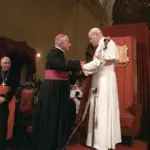
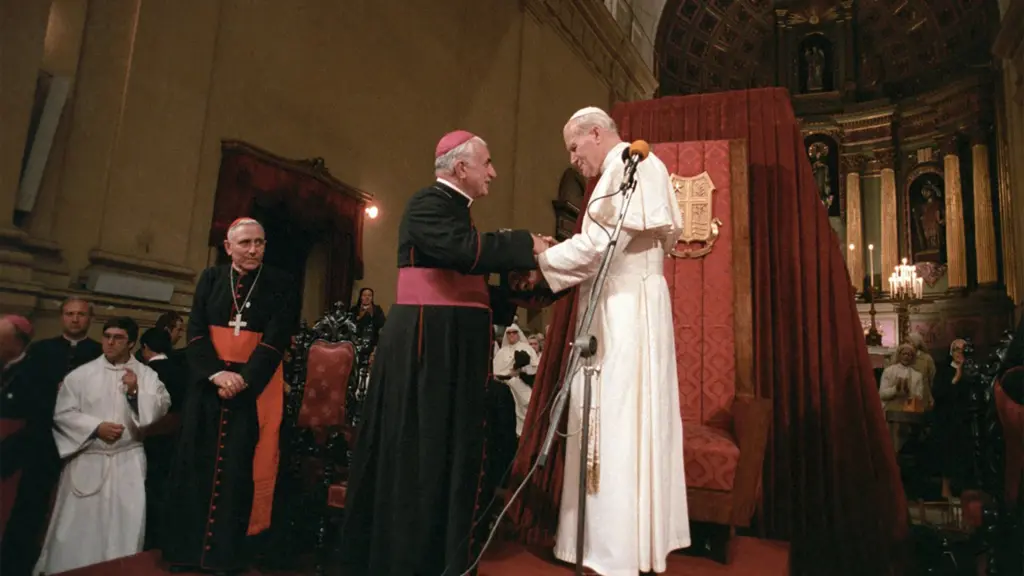
On March 31, 1987, John Paul II met in the cathedral of Montevideo with priests, male and female religious, and consecrated persons.
The Pope encouraged the courageous proclamation of the Gospel and recalled the words of St. Paul: “Woe to me if I do not preach the Gospel.”
He pointed out that the task of the Church is to reach all the inhabitants of the country with the truth about Christ and man. Evangelization cannot be limited to temples, but should transform human hearts and the entire society.
The next day, April 1, during Holy Mass at Tres Cruces Square in Montevideo, John Paul II reminded the faithful that Christ is the Good Shepherd of nations and of every human being.
Referring once again to the peaceful resolution of the Argentine-Chilean conflict, he emphasized that the Church cannot remain indifferent to the fate of humanity.
A Polish voice in Montevideo
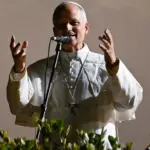
During the Holy Mass on April 1, 1987, there was also a Polish accent. After the homily, before the final blessing, John Paul II approached the microphone once again.
“Allow me now to say a few words in my native language because of the presence of a group of Poles living in Montevideo, Uruguay,” the Pope announced.
He then addressed warm greetings to his compatriots and the residents of the Uruguayan capital. He extended a special remembrance to Polish sailors who called at local ports, enjoying the hospitality of the Uruguayan coast.
He wished them God’s blessing and perseverance in their love for Our Lady of Częstochowa, in unity and peace.
It was a special moment of meeting between the Polish Pope and his compatriots living thousands of kilometers from their homeland. Even during his journey through South America, John Paul II remembered the Polish diaspora and its bond with Jasna Góra.
Florida – the Polish Pope at the feet of Mary
A year later, on May 8, 1988, John Paul II returned to Uruguay. One of the most important events was the Holy Mass in Florida, during which he conferred priestly ordinations.
It is precisely this city, associated with the birth of Uruguayan independence, that Leo XIV will visit on November 8. At the center of local devotion is the image of Our Lady of the Thirty-Three, the patroness of the country.
“I too have desired to become a pilgrim with your nation, in order here, in Florida, to fall at Her feet,” John Paul II said.
He began his homily with the words of Christ: “You did not choose me, but I chose you” (Jn 15:16).
Addressing the candidates for the priesthood, he reminded them that a vocation is not merely a personal decision, but a response to the love of Christ. A priest is to be above all a servant and witness of this love, ready to lay down his life for the people entrusted to him.
Two visits, one message
In John Paul II’s speeches from 1987–1988, three themes recur: peace built through dialogue, the Church’s responsibility for evangelization, and trust in Mary.
Nearly four decades later, Uruguay once again welcomes the Successor of St. Peter. Leo XIV is visiting places where the Polish Pope left an important witness of faith and concern for man.
In Montevideo, the memory of peace achieved through negotiations returns, as well as John Paul II’s meeting with the local Polish community. In Florida, the memory of entrusting oneself to Mary and the courage to respond to God’s call.
This is a legacy that unites both papal visits and reminds us that the Gospel can transform not only human hearts, but also the history of nations.