Attorney Advertising
In New York, the owner of a one- or two-family home who hires a contractor but does not direct or control the work is generally not liable under Labor Law 240 and 241. After a ladder or scaffold fall, the contractor, a subcontractor or the equipment supplier may be responsible.
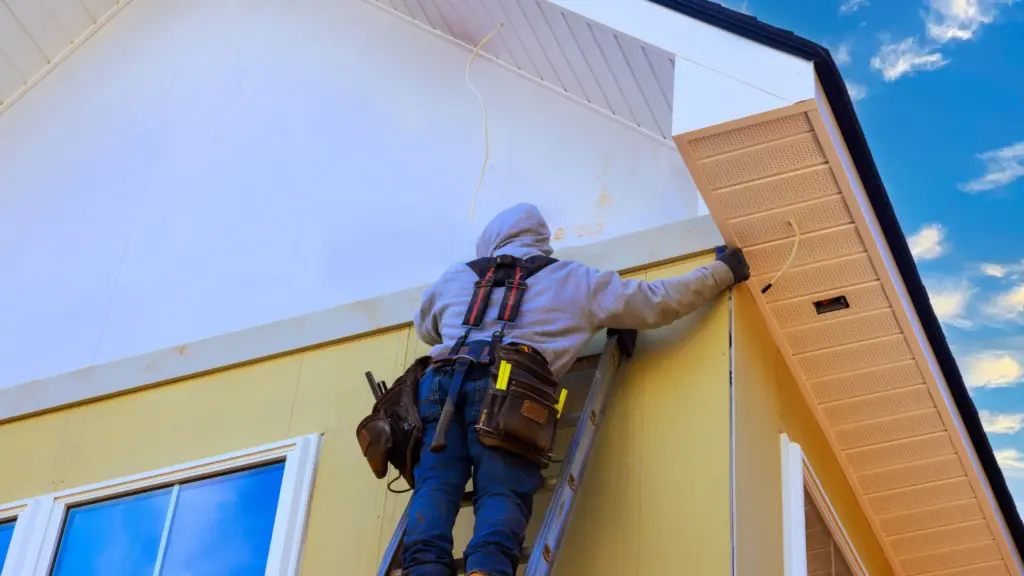
Thousands of Polish-speaking workers in New York earn their living on renovations: roofs, siding, gutters, painting, window replacement. It is work at height, often on private property in Queens, Brooklyn or Long Island. After a fall, the injured worker often hears one sentence: “the homeowner is not liable.” The Stein Law Group explains what that sentence means – and what it does not mean.
Why a home renovation is different from a large construction site
On a large Manhattan project it is usually clear who owns the building, who the general contractor is and who is responsible for safety at height. A home renovation is rarely that clear. The job is ordered by a private person, the contractor may be a small business, and the crew is a few people who do not always know under whose name the company is registered.
New York’s rules for work at height – mainly Labor Law 240, often called the Scaffold Law, and Labor Law 241 – require owners and contractors to provide proper protection: stable ladders, scaffolds, harnesses and railings. The same rules, however, contain an exception for owners of the smallest homes.
The homeowner exemption – when it applies and when it may not
The exemption covers owners of one- and two-family dwellings who hired someone to do the work but did not supervise or direct it. If the owner simply ordered a new roof and paid the contractor, a court will usually find that sections 240 and 241 do not reach the owner.
The protection is not automatic. Facts that can matter include:
- whether the owner personally told the workers where to set the ladder, how to work or what safety gear to use;
- whether the house is used only as a residence or also for a commercial purpose;
- whether the building really has no more than two dwelling units;
- whether the owner supplied a defective ladder or other equipment – supplying equipment usually does not by itself remove the 240/241 exemption, but it can matter for the owner’s liability under general negligence rules (Labor Law 200).
Each of these points has to be checked against the facts, not assumed.
Who may be liable instead of the homeowner
An exempt owner does not mean that no one is responsible. Duties under the work-at-height rules also apply to contractors and to companies that were given control of the work. In practice, the review usually covers:
- the general contractor who took the job from the owner;
- subcontractors working on the same property;
- the company that rented or delivered the scaffold, lift or ladder, if the equipment was defective.
Separately, the injured worker is generally entitled to Workers’ Compensation benefits through the employer’s insurance carrier.
That is why company names, license plates of work vans, invoices and text messages arranging the job matter so much. They are often the only record of who actually ran the renovation.
Workers’ Compensation and a claim against other companies
A worker employed by a contractor is generally entitled to Workers’ Compensation benefits – medical care and part of lost wages. That is not always the whole case. If a company other than the employer contributed to the fall, there may be a separate claim against that company. Workers’ Compensation itself is an exclusive remedy only against the employer, not against every business present on the site.
What to do after a fall from a ladder on a renovation job
Medical care and medical records come first – even when the injury seems minor. Then, while memory is fresh, write down:
- the property address and the date and time of the accident;
- the names of all companies and of the people who gave instructions;
- photos of the ladder or scaffold, if anyone was able to take them;
- names and phone numbers of coworkers who saw what happened.
Do not sign statements or “settlements” prepared by a contractor or an insurance company before speaking with The Stein Law Group. Such papers often describe the accident differently from how it actually happened.
Read also: Slip and Fall on Ice Outside a Store in NY – Who Is Liable · Company Vehicle Accident in NY – Workers’ Comp or Car Case? · Fired After Reporting a Work Injury in NY – Retaliation
Attorney Adam J. Stein, Esq. handles accident cases in New York and New Jersey, and when an injured person is in the hospital, the attorney can come to the hospital at the client’s request. The Stein Law Group, PLLC has its main offices in Greenpoint (144 Nassau Avenue, Brooklyn, NY 11222) and Maspeth (57-53 61st Street, Maspeth, NY 11378). The first conversation with the firm’s team is always in Polish, and the consultation is free. Phone: 718-383-0100. Practice areas and contact details – The Stein Law Group profile in the Polish Pages directory.
This article is for general information only and is not legal advice; reading it does not create an attorney–client relationship. Every case requires individual review. Attorney Advertising. Prior results do not guarantee a similar outcome.