Vatican News / Salvatore Cernuzio – Vatican
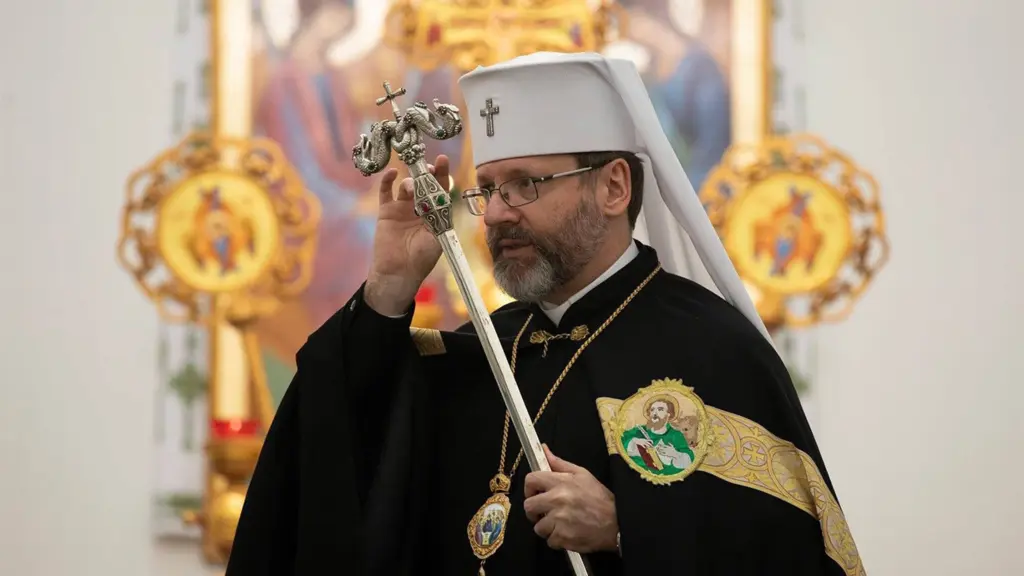
“Prophetic” – with this single word, Archbishop Sviatoslav Shevchuk describes the gesture of Leo XIV, who called Putin and Zelensky regarding the humanitarian truce in Oleshky. “It was a prophetic gesture in the middle of a humanitarian desert. Without the voice and direct intervention of the Holy Father, this truce would not have been possible,” says the head of the UGCC.
He has been in Rome for several weeks, far from his homeland, “wounded” and “exhausted” by nearly five years of war. In October, he met with the Pope and subsequently with representatives of the Roman Curia, to whom he presented the decisions of the Synod of Bishops of the UGCC. At the Roman University “Angelicum,” he also met with Ecumenical Patriarch Bartholomew. He presented the Bambino Gesù Hospital with the highest award of the UGCC in recognition of the assistance the papal institution has provided to thousands of children fleeing the war.
“We feel embraced by the Holy Father”
Vatican News: Your Excellency, on October 23, you met with Leo XIV for the fifth time to thank him for his and the Apostolic See’s support for Ukraine. The mission of Luis Marín de San Martín in the war-torn areas has also recently concluded. Do you feel the Pope’s closeness to your nation and Church?
We truly feel “embraced” by the Holy Father – through his words and prayer. He is also a voice that stirs the consciences of Europe and the world. The voice of people who have no voice of their own.
This was the case, for example, with our brothers from Oleshky, who were freed thanks to the direct intervention of the Holy Father. The journey of his envoy, whom I met here in the Vatican, was a very concrete gesture of love toward the country’s most urgent needs.
We are experiencing a very difficult time. Winter is approaching, it is getting colder, and Russia is systematically destroying the infrastructure necessary for the survival of our cities. For example, Kyiv is currently plunged into darkness. There is a lack of electricity and heating. The Pope not only appeals for Ukraine and not only prays, but also shows his closeness through concrete actions.
“A voice crying out in the humanitarian desert”
What did Your Excellency think when Pope Leo XIV, while staying at the Gemelli Hospital, called Russian President Vladimir Putin to ask for a humanitarian truce in Oleshky?
It was truly prophetic. It was a voice crying out in the humanitarian desert that has formed in the occupied territories. Before the war, 40,000 people lived in this small town. We do not know exactly how many residents are there today, but since the beginning of this year, the town has been surrounded and besieged. All roads were mined by the Russian military, and even food no longer reached there.
In the summer, people ate all the green leaves. There was terrible hunger… We all knew that if nothing was done, no one would survive the winter. However, to open humanitarian corridors, military operations had to be halted. Therefore, the Holy Father, still from the hospital, called Putin, and then on Monday, the first day after leaving the hospital, he called our President Zelensky, asking for this humanitarian truce. And this initiative yielded very good results.
Much is said about the merits and responsibilities of various political actors. But can it be said that the Pope was the first to draw public attention to the drama unfolding in Oleshky?
For all of us, the only person who acted effectively was the Pope. Later, others also began to speak about this situation, but without the direct intervention of the Holy Father, this truce would not have been possible.
Recently, about 800 residents of occupied Oleshky were evacuated to areas controlled by Ukraine. At the border with Belarus, they were also welcomed by our Caritas. Everyone thanked the Pope for this unprecedented act of rescue.
During the Sunday Angelus prayer, Leo XIV spoke of a “necessary humanitarian gesture” in Oleshky. At the same time, he expressed hope that this first truce – the longest since the beginning of the Russian invasion – could open the way to lasting peace in Ukraine. Does Your Excellency share this hope?
This action has shown that if there is even a minimum of good will, many human lives can be saved. We hope that perhaps Oleshky will go down in the history of modern Europe as a prophetic sign announcing a greater peace.
Unfortunately, the Russian president said that there will be no more similar truces. However, our president said: “It shows that it is possible.”>
We need to thoroughly analyze this event and use the gained experience as a point of reference for potential future negotiations.
You mentioned about 800 people who made their way out of Oleshky through the previously closed border and returned to unoccupied territories. How many people are still left there? Do you have contact with them, even indirect?
Yes, we maintain contact through volunteers and pastors who are on the other side. What is striking is that not everyone has returned. Regarding many people, we do not even know where they are located.
About eight hundred people out of 40,000 is very few. We are also surprised that between Oleshky and Kherson, which is in the free part of Ukraine, there are only nine kilometers. So it would be enough to open the road, and people could immediately cross the front line in large numbers.
Meanwhile, these individuals were transported by the Russian side by planes to Belarus and then by buses to the border with Ukraine. Why such a roundabout way? Many questions still remain unanswered.
Now we will try to determine how many people still remain there, where the others are, and whether the roads have remained open so that food can be delivered regularly.
Another issue is the fate of prisoners of war. Your Excellency has handed the Pope a list of names. Who are these people? Where are they located? What does Your Excellency expect for them? Let us also recall that Cardinal Matteo Zuppi, and more broadly the Apostolic See, are taking actions for the exchange of prisoners and their return home…
Every time I make pastoral visits, people come up to me and share their tragedies. And they constantly bring me more names. I collect them all and say: “I will place them in the hands of the Pope.” And they reply: “Then they will be in the hands of God!”
When I meet the Holy Father, I always bring lists of suffering people, but also information about their families. The Pope not only takes these papers into his hands, but truly devotes his attention to them. He doesn’t just skim them – he reads them.
Cardinal Zuppi told us that in a Russian prison he visited during his trip to Moscow, they try to erase people’s names. They are told: “Your names have already been forgotten, you are nobody.”
Therefore, handing over these lists is also a gesture of restoring a person’s name, telling them: “You are not forgotten.”
When these lists are analyzed, sometimes we are asked to verify specific information. Then the process begins of determining where a given person is located and whether their release can be secured. Just a few days after the audience with Leo XIV, 270 Ukrainian prisoners returned home. It would be interesting to check whether among them are people whose names I handed over to the Pope.
The topic of prisoners of war is linked to the situation of families. In Ukraine today, there are thousands of separated families, women forced to raise children alone, who learn about their husbands, sons, brothers, or partners from television or do not know what fate has befell them at all. Your Excellency participated in the summit dedicated to “Amoris Laetitia.” What does it mean today to be a family in a Ukraine engulfed by war?
It is a tragedy. Today, almost two-thirds of Ukrainian families live in forced separation. The family as a community of life is deeply wounded in Ukraine.
Most husbands are at the front, and women with children are either in safer parts of the country or outside Ukraine. We are also very hurt by the dramatic drop in the birth rate.
I remember that during the summit, the Archbishop of Salzburg sat at my table, talking about the fertility rate in Austria, which is 1.3. In Ukraine, it is 0.6. This is a demographic wound…
Of course, during a war, it is not easy to decide to have children. Fear makes it difficult to think about the future and plan for it.
It is also disturbing that new ways of concluding civil marriages in Ukraine somewhat weaken the institution of the family itself. Last year, it became possible to register a marriage before civil authorities via an application, even without appearing together at the registry office.
I said then: if you can get married over the internet, in a moment you will also be able to get a divorce over the internet. And that is what happened!
The number of marriages and divorces today is almost the same. Therefore, we must rethink our entire pastoral care for families and better accompany them.
And how is the Church trying to do this?
We have many pastoral initiatives and movements in which families organize themselves to help one another. The Church creates spaces for them in parishes where they can also count on the presence and accompaniment of a priest.
There is a huge need for education and preparation for family life. From an early age, a child should learn how to build relationships with another person. Today, this is greatly lacking.
We are starting to resemble a society of orphans. Many young people feel abandoned.
I remember a thirteen-year-old boy who said last year: “No one has time for me anymore. Only the Church.”
Today, one could say that the only one who always has time for these young people, for these “social orphans,” is artificial intelligence.
So, in Ukraine, is artificial intelligence not only a threat related to the war, but also a challenge for education, the Church, and society?
Of course! Ukraine, like the entire world, is experiencing a huge interest in artificial intelligence. All young people are talking to this type of application, asking them for advice and information.
So this becomes a question about humanity. In the past, a person who came to the Church asked for faith. Today, they come to the Church and ask for humanity. Not for humanitarian aid, but for humanity – the kind the Holy Father speaks of in the encyclical “Magnifica Humanitas.”
Humanity is truly magnificent.
How can humanity be magnificent, however, when it experiences the inhumanity of war?
Humanity is the only plane that connects us all.
When I went to Bucha right after its liberation, I saw bodies on the streets and mass graves. I stood there, prayed for these innocent killed people, and thought: here we are all equal.
Catholics, Orthodox, Jews, Muslims. A Russian bullet does not ask what church you go to or what your nationality is… We are all equal, we are all human beings.
During war, it is very dangerous to get used to cruelty and death. It is terrible, because the human heart can turn into stone, insensitive to suffering.
That is why we truly try to create spaces of humanity in the midst of war, to remain human in inhuman conditions. Perhaps this is the most important of all pastoral challenges.
Your Excellency, you hear many stories, voices, and testimonies. And how is Your Excellency feeling? If you had to describe your current state of mind in one word, what word would it be?
Believing.
Without faith in God, it would be impossible to survive, and above all, to find the meaning of life, suffering, and hope. Faith in God gives the light that allows one to understand the meaning of one’s own service and the events of history.
If I wake up alive in the morning, I thank the Lord for the new day He has given me. It is one more chance to do something good.
We live as believers, but every day we look death in the eye. From this perspective, one sees their own life and choices differently.
When and how will this war end?
We do not know, but we believe that the Lord is the one who can put an end to it.
People know how to start wars, but then they themselves become slaves to them. War is a demon that cannot be controlled.
Those who start it think it is a tool to achieve political goals. However, they do not know that this demon itself makes them slaves.
Man falls into a vicious circle, and liberation from this slavery is possible only through the intervention of God.
We are certain that the war will end – perhaps much earlier than we can imagine. However, we must believe in God and maintain the hope that we will be able to build peace.
In connection with the approaching winter and the difficulties that await the residents of Ukraine, would Your Excellency like to make a final appeal?
Above all, I ask for prayer for Ukraine, and then for solidarity.
We see how national egoisms are growing everywhere, especially when a country is preparing for elections. We cannot become victims of our own national egoism, which reawakens nationalism.
Therefore, we ask for solidarity, because Christian love saves lives – especially in Ukraine, especially this winter.
Love can bring light in this dark time for humanity.