American public education is regulated by the individual states, and there are about 13,000 school districts in the US, which enjoy a great deal of autonomy. They can specify the curriculum, set school rules, and even reject textbooks suggested by state authorities. Elementary schools must follow the rules set by local school districts and by the state authorities (State Department of Education), as well as federal guidelines. Private schools, on the other hand, are independent entities, subject to government oversight to a much lesser degree.
Elementary and secondary education is compulsory in the United States. The age range during which young people must attend school depends on state law. For example, the compulsory school age is 6 to 17 in Illinois, 6 to 16 in New Jersey, and 6 to 16 in New York State (local education authorities may require young people who are not working to attend school until age 17).
Elementary School
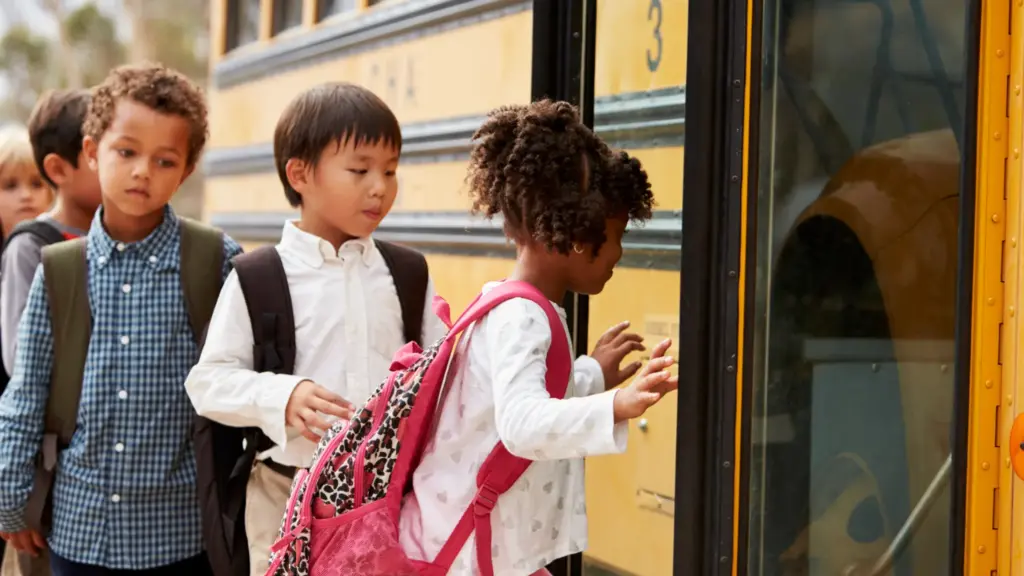
About 34 million children in the US attend public elementary schools (from kindergarten through 8th grade). The school year runs from the first week of September to mid-June and is divided into 3 or 4 marking periods, at the end of which the child is graded in each subject and the parents are informed of progress or difficulties. If a school has several parallel classes in a grade, children are assigned to them based on ability. For more gifted and hardworking children, the curriculum is a bit more demanding. Lessons last 45 minutes each, from 9 a.m. to 3 p.m. The only break is the lunch break, during which children can eat a sandwich or a hot meal in the cafeteria.
In the first grades of elementary school, children mainly learn math and English, which is divided into reading, writing and spelling. In the upper grades, science subjects (botany, chemistry, physics), social studies (history, geography) and the arts (drawing, music, singing) are gradually introduced. Physical education is not offered everywhere. Almost all schools have computer rooms. Extra sports activities, scouting, and English lessons for immigrant children are organized.
Parent-teacher meetings are held several times a year. Once a year there is a so-called Open Day, when parents are invited to the school to observe lessons. Children have two days off for Thanksgiving, a week for Christmas and a week for Easter.
High School
In high school, students have certain required subjects, and they can choose the rest from a list of optional subjects (electives). The number of electives varies: about 25% in Catholic schools and considerably more in public schools. Some electives raise doubts about their usefulness and even controversy, as in the case of, for example, death education (!) or science fiction, introduced in a few innovative public schools. The student sets his or her program for a given term with the help of a teacher and registers for classes in the chosen subjects.
Usually it is only in high school that students begin learning foreign languages (most often Spanish, Italian, German or French), as well as trigonometry, economics, world history, chemistry, physics, computer-related subjects, and so on.
The school year in high school begins and ends as in elementary school and is divided into three terms: fall, spring and summer. During the summer term, the school offers remedial courses (in subjects students failed), advanced subjects (e.g., higher math) or additional ones (e.g., computer programming). Some subjects are passed by completing a project, but usually by passing an exam. Besides smaller tests, the most important are the midterm exam (taken in the middle of the term) and the final exam. This system resembles the one used in college.
Some high schools prepare young people for a trade. Many of them have programs in agriculture, veterinary science, horticulture, journalism or engineering, or specialize in fashion, interior design, and so on. There are also schools that are typically vocational in character and prepare students to become plumbers, carpenters, beauticians or nurses; they also have bookkeeping courses and many others.
In the US there is no final matriculation exam. Besides passing their regular subjects, starting in ninth grade students take various tests, such as the Regents Test in New York State. For college admissions, the results of the SAT (Scholastic Aptitude Test) or ACT may count, but each college decides whether it requires them.
Private vs. Public Schools
In the United States, every elementary school, high school and college is either public or private.
Public elementary and high schools are maintained by local authorities with taxpayer money and are free. There are nearly 99,000 public schools in the United States. Their quality varies greatly, ranging from very good to scandalous, especially in the run-down neighborhoods of big cities (the so-called inner cities). As a rule, a student is required to attend a school in his or her own zone, although in many places there are also public schools with separate admissions (e.g., magnet and charter schools). People often choose where to live based on a good school.
American public education struggles with enormous problems. For years, the skills of American young people have compared embarrassingly with those of young people in other industrialized countries. In public schools in run-down neighborhoods, teachers struggle to maintain reasonable discipline, because problems from the street (drug addiction, crime) seep into the school. That is why, despite free elementary and secondary education and a dense network of schools, many parents decide to send their children to private schools. Nevertheless, it should be noted that some public schools in the suburbs or in small towns are good, and even excellent.
Private schools generally maintain higher standards than public ones and provide children with better supervision, discipline and curriculum. Tuition varies widely – from relatively low at parochial schools to very high at elite private schools. The most common type of private school is the parochial school, run by churches and religious organizations of various denominations. Most such schools are run by Catholic and Lutheran churches, Baptists and Jewish synagogues. Because of the constitutional separation of church and state, parochial schools do not receive federal aid. They are supported by charitable donations and by tuition paid by parents, usually much lower than at other private schools. Parochial schools generally teach secular and religious subjects at a good level. Secular private schools, often nonprofit, are supported by tuition and donations. Some, considered elite, are expensive and very selective in admitting students.
Elżbieta Baumgartner
Elżbieta Baumgartner is the author of many books on financial and consumer topics, including “Jak ułatwić dziecku życiowy start” (“How to Give Your Child a Good Start in Life”), “Jak działa giełda” (“How the Stock Market Works”), “Jak inwestować w fundusze powiernicze” (“How to Invest in Mutual Funds”), “Życie od nowa” (“Life Anew”) and “Jak chować pieniądze przed fiskusem” (“How to Hide Money from the Taxman”). 255 Park Lane, Douglaston, NY 11363, tel. 1-718-224-3492, www.PoradnikSukces.com.
Updated October 2026.