Author: Vatican News / Piotr Kowalczuk
The installation consists of 1,096 individually recorded sounds emitted at irregular intervals over 49 hours. According to the design, each sound represents one person killed in the war during that time. A sound occurs on average every 2.62 minutes. Over the course of three months, the project recorded more than 24,000 samples of clicking, tapping, and snapping sounds. Recordings included light switches, old telegraphs, clocks, and door locks. They were then edited into a 49-hour film containing 1,096 sounds.
A Call to Responsibility
Cardinal José Tolentino de Mendonça, Prefect of the Dicastery for Culture and Education, noted that the author sows the fertile ground of silence with short sounds that draw our attention to the daily tragedy of victims of war worldwide. He called Philip Gröning a “true master of silence.” He described the project as “a call to responsibility,” urging people to hear the cry of the victims of violence and aggression.
A Space for Reflection
Cardinal Mauro Gambetti, Archpriest of St. Peter’s Basilica, said that hosting this installation means offering “a space for listening and reflection on the victims of conflicts.” He added that the installation “reminds us of the value of every human life and our shared responsibility in building paths of peace.”
Remembering the Lives Behind the Statistics
Paolo Ruffini, Prefect of the Dicastery for Communication, is grateful to Gröning for the idea of the project, which can “awaken us from our numbness in the face of war.” “A thousand sounds in 49 hours will remind us of just as many victims of war and hearts that stop beating,” Ruffini said. He also referred to the encouragement of Pope Leo XIV, contained in the Message for World Communications Day, to think of the faces and voices of those affected by war.
A Work of Art Built from Sound
Philip Gröning began working on the project in the winter of 2026, when he realized how many people lose their lives in wars every day. “I felt it was time to realize that in wars, a human being dies every 2.6 minutes,” he said. He explained that the work is a response to something that cannot be understood through statistics alone. He pointed out that “images are fleeting. Repetition and sound speak more powerfully.”
Irregular Sounds
The clicks are intentionally irregular, sometimes appearing in groups. Their volume also varies. As the author explains, these differences are meant to reflect the unequal attention often given to victims of war due to cultural, religious, or racial factors.
Broadcast
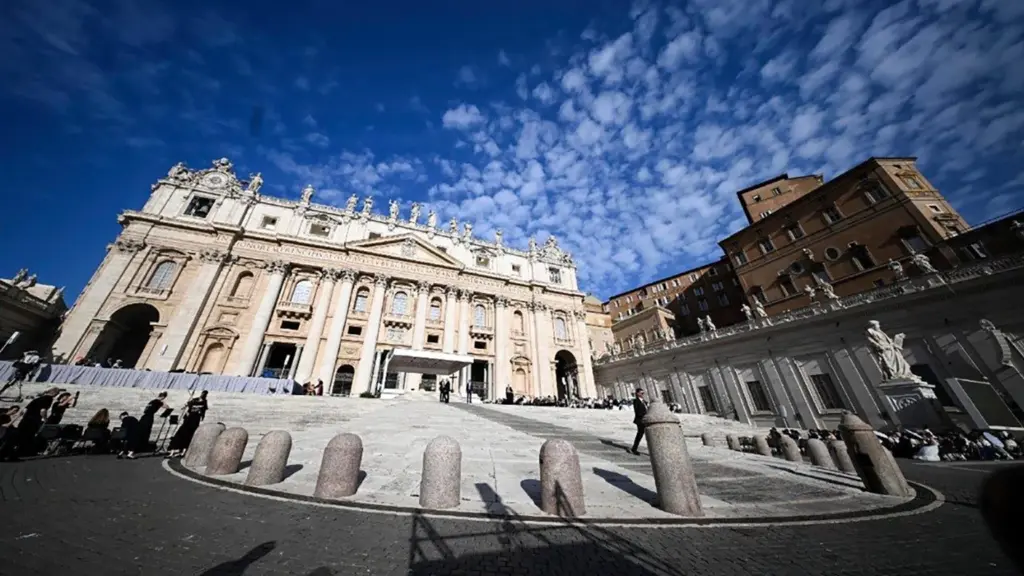
The Vatican News website will provide a live broadcast from St. Peter’s Square, combined with “Sounds of Loss,” on September 20 and 21.