Author: Vatican News
“Let us pause and truly reflect on what the consequences of artificial intelligence and its use might be,” Cardinal Parolin appealed, “let us truly consider what risks may arise in connection with artificial intelligence.”
The Italian President’s timely appeal
The Cardinal described as “just” the recent appeal by Italian President Sergio Mattarella for responsibility among states and supranational organizations in managing new technologies. “A global phenomenon requires the participation of all,” the Secretary of State emphasized. He added that his “concern is that there are states that actually want to act on their own”; meanwhile, “everyone should be involved in working out common rules that will truly allow this phenomenon to be properly regulated.”
He expressed hope that everyone will “unite to find answers,” because it seems that “this is truly about the future of humanity.”
Cooperation between states
Asked about his participation in the United Nations General Assembly and whether he would use the occasion to advocate for the creation of an international council to govern artificial intelligence, the Cardinal replied: “Probably at this stage we will not be looking for immediate technical solutions. The Holy See usually presents and points out principles. However, the solution to the problem of cooperation will have to be worked out by those concerned — at the level of states and institutions involved in this reality.”
Personal use of artificial intelligence
“Today, artificial intelligence imposes itself, because when you open your computer and read something, it immediately presents you with a summary,” said the Cardinal when asked if he uses artificial intelligence himself. He added, however, that he certainly does not use it to prepare his homilies: “Artificial intelligence is just a head and has no heart. I try to put a little heart into my homilies.”
Holy See diplomacy regarding Ukraine
The Secretary of State then answered several questions concerning the situation in Ukraine and the role of the Holy See in the conflict, which is increasingly escalating and approaching the borders of Europe. “The results are rather modest,” but “we continue on our path,” he assured, pointing to humanitarian diplomacy.
“The diplomacy of the Holy See, the diplomacy of sowing, does not yield a harvest immediately. So we hope that if we continue to sow, one day, when God wills, we will also be able to reap the harvest,” the Secretary of State emphasized.
The importance of ‘talking to each other’
The Cardinal said he had no specific information on when Cardinal Matteo Zuppi, President of the Italian Bishops’ Conference (CEI), would travel to Russia to continue his mission begun last summer in Ukraine.
He stressed, however, that the Holy See will continue its humanitarian efforts, “hoping that this may open some doors” to a “ceasefire,” “negotiations,” and “dialogue.”
In this context, he reiterated that Moscow should not be isolated and that it is important for “some kind of channel to be established through which people can talk to each other,” because “only by talking to each other can solutions be found,” the prelate emphasized.
He did not comment on recent remarks by European Commission President Ursula von der Leyen regarding Russian ultranationalists wanting to destroy Europe. Instead, he expressed hope that a “platform can be found where everyone feels safe and everyone can also develop in terms of welfare and prosperity.”
“I believe this is the very path to take,” the Cardinal Secretary of State stressed. It is a path that — as he noted — diplomacy frequently describes as a win-win solution.
“It is about ensuring that every solution can truly benefit both sides. And I think that if we follow this path, perhaps there will no longer be the need or the prospect for one side to dominate the other or for one side to destroy the other.”
Tower of Babel or the walls of Jerusalem
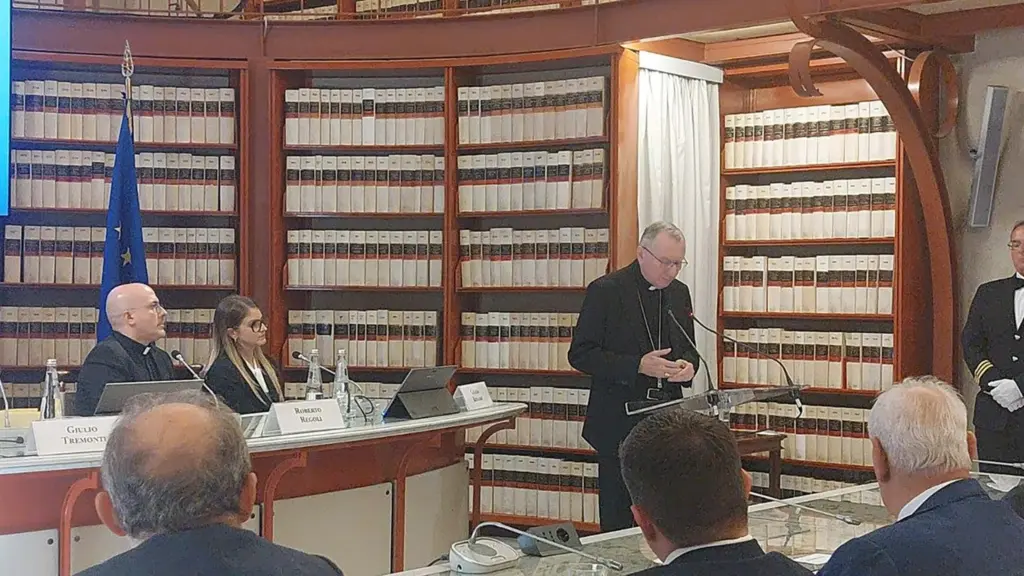
Artificial intelligence, its capabilities, and the threats it poses to humanity and the common good were the main topics of Cardinal Parolin’s address during the conference.
In his speech at the end of the conference, in the presence of its president Lorenzo Fontana, the Cardinal extensively analyzed the current situation regarding artificial intelligence, “the most advanced and recent product of science, the pride of technology born from man’s drive for autonomy and freedom.”
He stated that artificial intelligence “paradoxically becomes a deity that devours spaces of freedom and decision-making capacity, in order to homogenize man and system.”
In itself, AI “is neither good nor bad,” but it forces certain choices to be made. In this context, Pope Leo XIV’s encyclical *Magnifica humanitas* serves as a guide. “Faced with a technological power that serves private interests rather than the common good, the Pope emphasizes precisely this aspect: one must choose whether to build the tower of Babel or rebuild the walls of Jerusalem,” Cardinal Parolin said. In conclusion, he added: “At stake is the defense of the human person, his dignity, his freedom, and his very identity.”