
Dorota Abdelmoula-Viet – Vatican
Day 1, Paris: Notre-Dame Cathedral, youth, and a historic visit to UNESCO
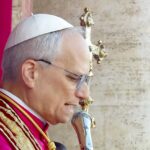
The first stop of the papal visit to France will be its capital. The Pope will arrive in Paris at 10:00 AM on September 25 and will head first to the Elysee Palace (the presidential residence), where he will be received by President Emmanuel Macron. There, he will also meet with representatives of the political, diplomatic, and civil society spheres and deliver his first address.
Then, at 3:00 PM, he will head to the UNESCO headquarters. He will be the second pope to visit this institution, following the visit of St. John Paul II in 1980, during which he delivered a historic address on the rights of nations and human dignity. Leo XIV will also deliver an address there – the second of ten scheduled throughout the entire visit.
At 5:15 PM, the Pope will preside over Vespers with bishops, priests, consecrated persons, and seminarians. The service will take place at the Notre-Dame Cathedral, where the Holy Father was already expected during the ceremony for its reopening and the consecration of the new altar following the tragic fire of 2019.
At 9:00 PM at the stadium in Saint-Denis, a town near Paris whose cathedral houses the tombs of most French kings, Leo XIV will meet with young people during a prayer vigil.
Day 2: Mass at Place de la Concorde and prayer at the Massabieelle Grotto
On the second day of his stay in Paris, Leo XIV will visit the Maison Bakhita migrant support center, built in response to Pope Francis’s request to care for and support the integration of those forced to leave their homes.
Then, on the campus of the Catholic Institute – a prestigious higher education institution – he will meet with members of the provincial synod, neophytes, and catechumens, whose significant number represents a pastoral phenomenon for the Church in France.
At 3:00 PM at Place de la Concorde, the Pope will celebrate Mass for all the faithful, and in the afternoon he will travel by plane to Lourdes. There, at 7:40 PM, he will pray at the Grotto of Apparitions, where the Blessed Virgin Mary appeared to the teenage Bernadette Soubirous in 1858.
Day 3: Lourdes: Encounter with the Church
The Pope will spend the entire Sunday in Lourdes, which is a spiritual center and a place of pilgrimage for the French, especially for youth and the exceptionally well-developed pastoral care of the sick. At 9:00 AM, the Pope will meet with bishops there. Then, at 11:00 PM, he will preside over Mass on the sanctuary grounds, and in the afternoon he will meet with those involved in welcoming and caring for the sick at the Accueil Notre-Dame center, which annually welcomes over 30,000 sick and disabled pilgrims.
In the evening, the Pope will have a private meeting with the Carmelite sisters from the convent in Lourdes, built, according to tradition, exactly on the site of the garden where St. Bernadette was during Mary’s final apparition. Afterward, in the evening, he will take part in the rosary prayer and torchlight procession in front of the sanctuary.
Day 4: Metz and an encounter with Europe
On the final day of his visit, Leo XIV will travel to the hometown of the Venerable Servant of God Robert Schuman, Prime Minister of France and co-founder of the European Union, whose beatification awaits a miracle obtained through his intercession. This will be the second papal visit to the city, following John Paul II, who traveled there in 1988.
At 10:00 AM, the Pope will participate in an interreligious meeting at the Robert Schuman Convention Center, followed by a meeting entitled “Towards the Roots of Europe, for Peace and Unity,” and at 4:00 PM he will celebrate Mass at Saint Stephen’s Cathedral.
Following the farewell ceremony, scheduled for 6:30 PM, the Holy Father will begin his return journey to Rome, where he is expected at 8:50 PM.
“That they may have life”
These words, which serve as the motto of the papal journey, refer to Jesus’s Eucharistic Discourse recorded in the 6th chapter of the Gospel of John (especially John 6:51). As the organizers write, they are an invitation “to recognize the greatest gift brought to us by Christ the Saviour. It is also a call to hope and communion, encouraging the overcoming of divisions and the sharing of peace, reconciliation, and fraternity – signs of new life in the world. These words also express the attitude with which the Church in France welcomes the Holy Father’s visit: with joy, openness, and a deep desire to bear witness to all about the life that comes from God.”
They also fit into the context of the debate on life that has been taking place in France for many months, including around the legalization of euthanasia.
Meanwhile, the logo accompanying the Holy Father’s visit features a circular stained-glass window reminiscent of the rose windows of Gothic cathedrals, in the colors of the French and Vatican flags. The cross inscribed within it emphasizes the apostolic and liturgical dimension of the papal journey, and the dove with an olive branch is a sign of the Holy Spirit and a symbol of peace.