Artur Hanula
More than a catastrophe
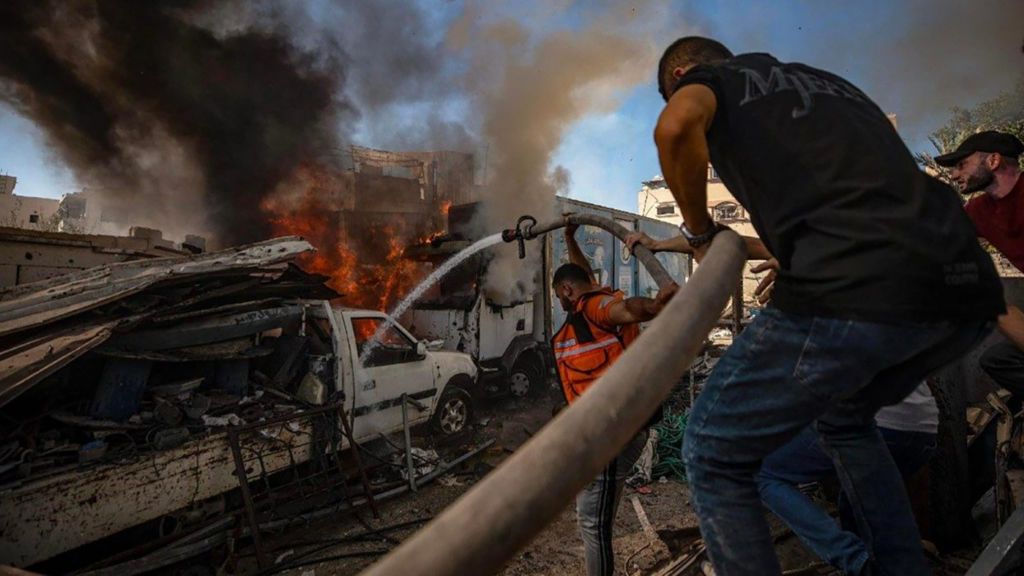
Fr. Romanelli renewed his appeal for urgent humanitarian aid, warning that the situation in the region has deteriorated to the point where even the word “catastrophic” is no longer enough to describe it.
“When people say the situation here is catastrophic, believe me: it really is catastrophic – in fact, it deserves an even stronger term,” said the priest, who is originally from Argentina, in a video posted on the parish’s social media profiles and in an interview with the Italian Catholic news agency SIR.
Movement is increasingly difficult
Fr. Romanelli describes the daily struggle. Moving even short distances is becoming increasingly difficult. Most parish vehicles are no longer usable because spare parts are lacking. “We even took the battery out of one car so another could keep running,” he explains. The only vehicle that still works and is used by the priests almost broke down recently due to bad engine oil and a nearly completely clogged fuel system.
According to the priest, obtaining fuel is very difficult. It is extremely expensive – a liter of diesel costs about 13 US dollars. At the same time, many people have started using makeshift fuel made from processed plastic and nylon waste.
“I don’t know exactly how this process works,” Fr. Romanelli says, “but many people say it produces diesel from processed plastic. The problem is that this is very low-quality fuel,” which can cause severe damage to vehicles and generators.
The crisis has become so severe that Fr. Romanelli even considered replacing the parish vehicles with a donkey-drawn cart. However, this option is also currently out of reach. “I was told that a donkey now costs about 50,000 shekels, which is between 16,000 and 17,000 dollars,” he says. “Before the war, it cost 1,000 to 2,000 shekels,” he adds.
The priest emphasizes that transportation is essential for daily life, enabling people to reach hospitals, schools, and workplaces, as well as to visit the sick and deliver humanitarian aid. “Gaza is not small enough for everything to be done on foot,” he says, pointing out that countless roads have been destroyed during the conflict.
A light of hope amid the darkness
Among the few hopeful signs, Fr. Romanelli points to reports that the Israeli government has given preliminary approval for international forces associated with the Peace Council to enter the Rafah area. “This would at least be a first step,” he says.
Nevertheless, Fr. Romanelli stresses that the greatest need remains support for the civilian population in the Gaza Strip. “People are living with nothing,” he says. “Rebuilding is of course essential, but all basic items necessary for daily life are just as important,” he concludes.