Fr. Łukasz Bankowski – Vatican City
German parishes open to pilgrims
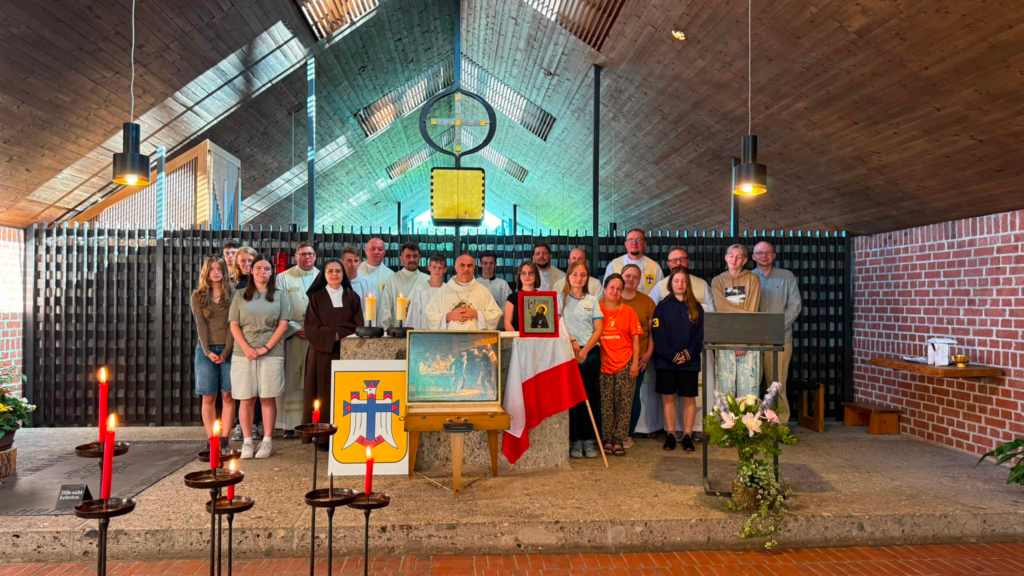
The third week of the pilgrimage led through Bavaria. The preparation of this stage was coordinated by Fr. Tomasz Wołoszynowski from the Diocese of Bydgoszcz, who has served for years in the Polish Catholic Mission in Saarland.
As he recounts in an interview with Vatican News, even during the preparations he was moved by the kindness with which German parishes embraced the idea of the pilgrimage. Many pastors heard about St. Stanislaus Kostka for the first time, while others immediately took up the initiative with enthusiasm. Special support was provided by the Bishop of Augsburg, who extended his care over the pilgrimage.
Prayer for vocations takes on new meaning
Fr. Wołoszynowski emphasizes that already at the organizational stage he was struck by the problem of the shortage of priests in Germany. In many localities, pilgrims could not meet a parish priest because a single clergyman is now responsible for several merged parishes.
“This made us even more aware of how much prayer for vocations is needed,” the priest says.
A testimony of faith on German roads
The pilgrims began their journey at the Shrine of Our Lady in Altötting, often called the “German Częstochowa.” Although the first day brought heavy rain, the subsequent stages took place in favorable weather.
Walking in cassocks and pilgrimage t-shirts, they attracted the interest of the residents. They distributed holy cards of St. Stanislaus Kostka and talked about the young saint who in the 16th century traveled on foot from Vienna to Rome to answer God’s call. “Many people could not believe that we were walking all the way to Rome. These conversations became an opportunity to bear witness to the faith and talk about St. Stanislaus,” Fr. Wołoszynowski emphasizes.
The Church in Germany is still alive
The priest points out that the pilgrimage allowed them to break many stereotypes regarding the Church in Germany.
“This is not a nation distant from God. Especially in Bavaria, faith is still very much alive, particularly outside the big cities. The shared Eucharist with German believers was one of the most beautiful experiences of this journey,” he says.
Prayer during the Eucharist in German churches was an opportunity to understand that the Church of Jesus is one
In the footsteps of St. Stanislaus Kostka
The pilgrimage was also attended by Fr. Łukasz Krzewiński from the Diocese of Bydgoszcz. As he admits, the invitation to participate came as a surprise to him, but he decided to accept it because of the intention to pray for vocations.
He was most impressed by the determination of St. Stanislaus Kostka and the figure of St. Peter Canisius, who was able to see the spiritual potential of the young Jesuit. “This is also our task: to be able to see in young people the goodness and potential with which God has endowed them,” he emphasizes.
The laity as an inspiration for the Church
Fr. Krzewiński also draws attention to the involvement of German laypeople in parish life.
“Despite the vocation crisis, the laity care for their communities with immense dedication. This experience can be a valuable inspiration for the Church in Poland as well,” he points out.
As he adds, throughout the journey the pilgrims entrusted to God the intentions of people asking for prayer, primarily for new priestly and religious vocations.
The Polish diaspora carries the prayer for vocations
The pilgrimage was also attended by Katarzyna Piątek from the Polish Catholic Mission in Saarland. As she emphasizes, the third stage of the journey from Altötting to Augsburg was a time of silence, entrusting herself to God, and strengthening her own vocation.
“In my heart I carried the intentions of the entire Polish diaspora in Germany, especially prayer for new priestly and religious vocations in these lands. I also prayed for the discernment and strengthening of my own vocation,” she says in an interview with Vatican News.
As she explains, although she grew up in Germany, it was the Polish Catholic Mission that was the place where her faith matured. Therefore, the fate of the Church and new vocations in Germany is particularly close to her heart.
Every day from the early morning hours, the pilgrims cover a dozen or so kilometers
Every step reminded them that it is worth following Jesus
Katarzyna admits that the beginning of the pilgrimage was not easy. However, the hardship of the journey became a reminder for her that every vocation requires the courage to leave what is familiar and trust God.
“Every step reminded me that it is worth following Jesus, even when the road is demanding,” she emphasizes.
Walking along the trail that St. Stanislaus Kostka trod centuries ago, she often thought of his experience of the kindness of people met along the way. As she notes, contemporary pilgrims experienced the exact same openness. “We met people who opened their hearts to us and asked us for prayer. These were truly exceptional encounters,” she says.
At the end of the pilgrimage, she was left above all with gratitude. “I believe that the Lord God leads us down paths that we ourselves might never have chosen. It is precisely there that He strengthens us, meets us, and allows us to experience His presence,” she adds.
The relay pilgrimage from Vienna to Rome is taking place on the occasion of the 300th anniversary of the canonization of St. Stanislaus Kostka. Its participants pray for new vocations to the priesthood and consecrated life, and popularize the figure of the patron of youth and vocations, who centuries ago traveled a similar path in response to God’s call.