
Federico Piana – Castel Gandolfo
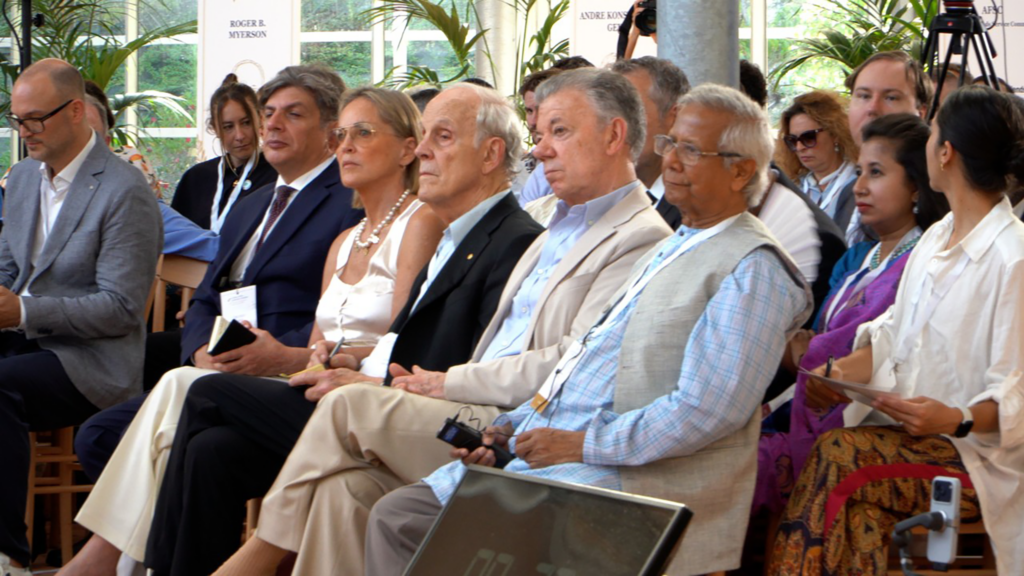
Thirty Nobel laureates, twenty leading experts in artificial intelligence, including representatives of tech giants such as OpenAI, Google DeepMind, AarU, and Anthropic. In addition, thirty former heads of state and government, and thirty representatives of the world’s most prestigious and influential universities and research institutions, such as Harvard University, University of Oxford, and Columbia University, to name just a few. These are the individuals and institutions represented at the World Assembly of Nobel Laureates, taking place from July 14 to 16 at Borgo Laudato si’.
The debate is dedicated to artificial intelligence and nuclear war. And the goal is to initiate a constructive debate on “the future of international security, the management of new technologies, disarmament, and the building of an economy of peace”.
As Cardinal Fabio Baggio, Pro-Prefect of the Dicastery for Promoting Integral Human Development and Director General of the Borgo Laudato si’ Higher Education Centre, emphasized in his welcoming speech, peace “does not simply mean the absence of war. It is an order based on justice, mutual trust, respect for the law, and the inviolable dignity of every human being”.
Broad perspective
The event, which began on Tuesday morning and was initiated by several international organizations dealing with disarmament, humanitarian crisis management, and advanced scientific research, draws inspiration and strength from Pope Leo XIV’s encyclical Magnifica humanitas. This document is dedicated to the protection of the human person in the age of artificial intelligence.
As the organizers of the meeting emphasize, “it fits into the Pope’s vision of unarmed and disarming peace. At the center of the debate these days is the search for a new global paradigm capable of combining innovation, responsibility, and ethics”.
It is certainly no coincidence that an event of such great importance is taking place precisely in Borgo Laudato si’ — an area of 55 hectares within the papal villas in Castel Gandolfo. There are not only historic gardens, greenhouses, vegetable gardens, olive groves, vineyards, monumental trees, and numerous plant species, but above all, a center for research, hospitality, formation, and reflection on the relationship between man, nature, technology, and development.
Geopolitical change
Technological development, which in recent years has been strongly boosted by the race in the field of algorithms, means — as Cardinal Silvano Maria Tomasi, Apostolic Nuncio and President of the Communis Foundation, an organization supporting international meetings, forums, and events dedicated to ethics and the promotion of the common good, explained — that “artificial intelligence, autonomous systems, quantum technologies, computing capabilities, and advanced computing infrastructure redefine the very concept of security”.
The danger of the Tower of Babel
Cardinal Tomasi noted with concern that regional conflicts are increasingly involving global powers, and the possibility of nuclear escalation is no longer seen as an abstract scenario, but as a concrete and direct threat.
Citing the encyclical Magnifica humanitas, the cardinal recalled that humanity today faces a choice, as indeed every generation does: It can build a new Tower of Babel, or rebuild Jerusalem, where diversity becomes community, technology serves fraternity. “The Holy Father reminds us that technology is never morally neutral,” he stated.
Fundamental rights
Cardinal Ángel Fernández Artime, Pro-Prefect of the Dicastery for Institutes of Consecrated Life and Societies of Apostolic Life. In his address to the speakers and international guests, he emphasized that “the problem is not technology, but the direction we want to give it. If fundamental rights are not taken into account, there is a risk of creating systems that favor control, manipulation, and even new forms of inequality”.
Towards the Rome Declaration
Throughout the morning, numerous speeches were delivered by Nobel laureates, experts, former heads of state and government, and representatives of civil society organizations. In the afternoon, deliberations continued during closed sessions.
After the conclusion of the three-day deliberations, the “Rome Declaration for an Unarmed and Disarming Peace in the Age of Artificial Intelligence, Nuclear and Autonomous Weapons, New Digital Protocols, and Emerging Digital Development Models” will be drafted. The document will be presented on July 16 during a solemn event at the Capitoline Hill, where the seat of Rome’s authorities is located.
As announced by the organizers, this document will aim to define principles and guidelines for the governance of artificial intelligence, promoting a vision of international security based on cooperation, human dignity, integral development, and peace among nations.