Daniele Piccini, Artur Hanula
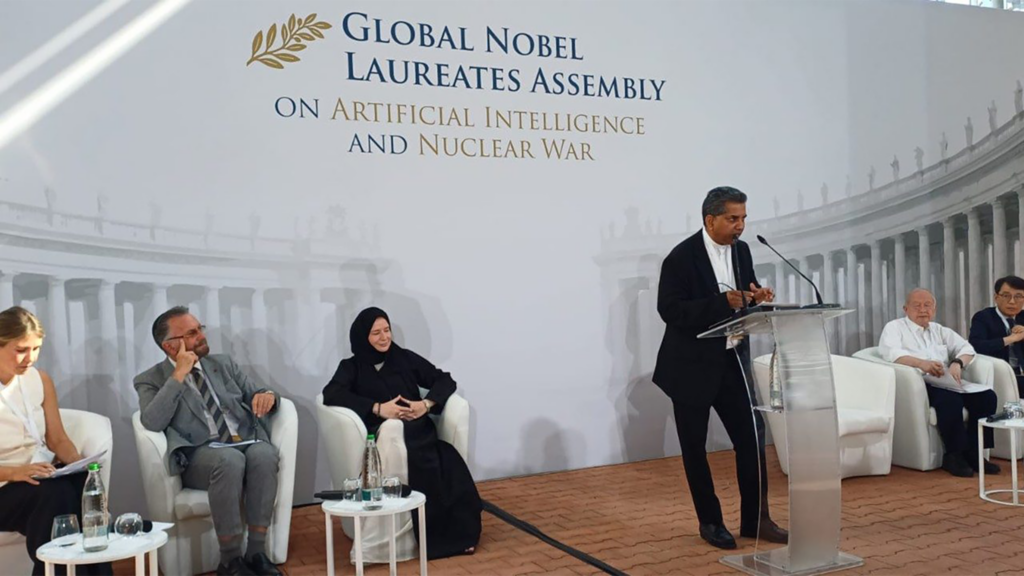
As Vatican News reminds us, a meeting of Nobel laureates dedicated to artificial intelligence and nuclear war has been taking place since Tuesday, July 14, in Borgo Laudato si’ in Castel Gandolfo. The session, which took place on July 15, was titled: “Faith and the Future of Humanity in the Era of Artificial Intelligence and Nuclear Weapons”.
Alleviating Human Suffering
Hospitality, dialogue, and cooperation in action. These are the three concepts proposed by Fr. Indunil J. Kodithuwakku K., Secretary of the Dicastery for Interreligious Dialogue, as guidelines for the common action of all religions, so that “humanity may prevail,” as the title of the second day of discussions states. Starting from “common values – the secretary emphasized – we must cooperate to alleviate human suffering, free people from prejudice and false beliefs.”
The Tower of Babel and the Walls of Jerusalem
Rabbi David Rosen spoke about the Tower of Babel symbolizing domination and the “risk of dehumanization.” He pointed out that “the Bible does not explain what exactly was wrong with the construction of the tower, although it is clear that God did not like it. It was about an attempt to unify, to create a totalitarian society.”
The Rabbi recalled that the name of the city of Jerusalem, despite the difficult reality, means city of peace. “However, the vision remains that one day Jerusalem will indeed become a city of peace, and this peace will ultimately be able to spread to all humanity,” Rosen emphasized.
Jerusalem is also called the “city of awe” – the rabbi noted. “This is a warning against arrogance, against pride, against the belief in one’s own omnipotence. It reminds us of our limitations. If we learn to enrich each other through these different perspectives and adopt an attitude of modesty and humility – theological or philosophical – then we will be able to contribute much more effectively to the good and flourishing of society,” he said.
Eliminate Nuclear Weapons
The program of the Buddhist religious movement Sōka Gakkai, as explained by Yoshiyuki Nagaoka, Executive Director of the Office of Public Affairs, is to “constantly reach out across religious, ethnic, and national divides, aiming to make the Earth one human community.”
In practice, this commitment focuses on the pursuit of nuclear disarmament and the education of the younger generation. “We are also deeply concerned about the development of autonomous weapons” – dangerous devices that are capable of selecting and hitting a target without further direct human intervention – Nagaoka concluded – “they represent an act of merciless cruelty and a complete lack of responsibility.”
Community Engagement
Anna A. MacMillan, a researcher in artificial intelligence policy and a member of the Supervisory Board of the Domus Communis Foundation, indicated that “governments, regulatory bodies, and all those who can create a legal framework in which technology can develop lawfully” should be involved.
“I do not believe – the expert stated – that there is one path to developing artificial intelligence, or any other technology, that would be safe, ethical, and responsible. This will only be possible if all the different stakeholder groups are truly engaged and committed to the cause, without abandoning their moral and ethical principles.”
Not Deterrence, but Reconciliation
Ignatius Ki-young Sung from the Institute for Peace-Sharing at the Archdiocese of Seoul presented a concrete example of the situation in his country: South Korea. “Korea and the Korean Peninsula – the researcher emphasized – are currently going through a very difficult period from a political and security point of view, primarily due to the nuclear threat from North Korea. Deterrence has worked so far. Deterrence allows us to live, allows us to survive. However, this cannot be the end of the story. Therefore, we continue to strive for true reconciliation between people, between the inhabitants of South Korea and North Korea.” “As the Catholic Church in South Korea – Ki-young Sung added – we will not cease our efforts and prayers for lasting peace and reconciliation on the Korean Peninsula.”