Fr. Jakub Ostrożański RCI
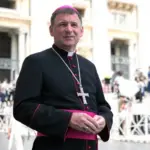
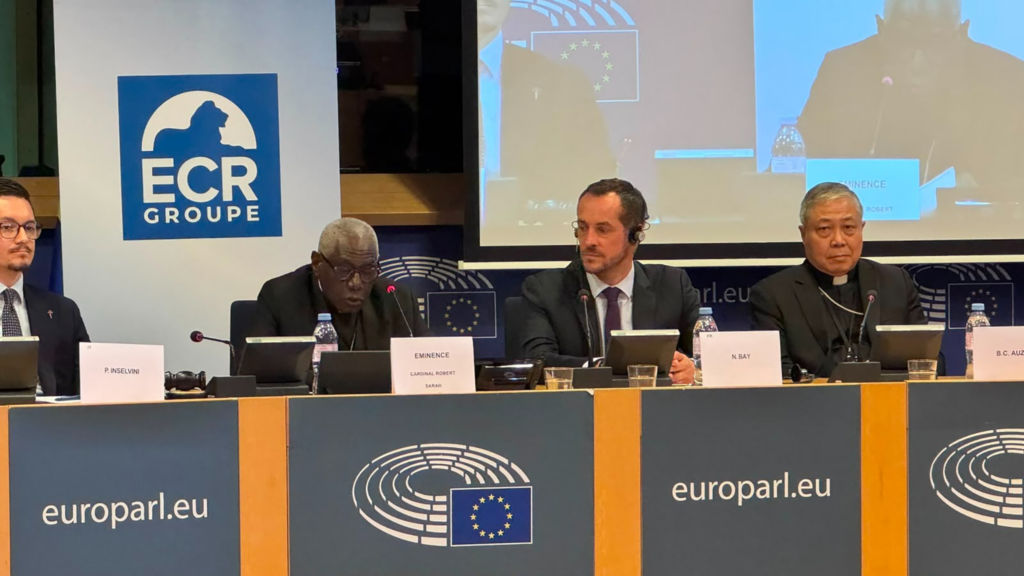
According to Vatican News, the Guinean cardinal arrived at the Brussels headquarters of the European Parliament at the invitation of a group of ECR MEPs, who organized a meeting aimed at reflecting on European-African relations. Archbishop Bernardito Auza – Apostolic Nuncio to the European Union – also took part in the event.
The Meaning of Concepts
“In relations between the European Union and Africa, words are used today not to reveal reality, but to conceal it, and even to turn it upside down,” Cardinal Sarah emphasized, also quoting words spoken by Leo XIV on January 9 this year, during a meeting with members of the diplomatic corps accredited to the Holy See: “We need words anew to express unambiguous realities clearly and distinctly. Only in this way can authentic dialogue be resumed without misunderstandings.”
“I would like to use these words of the Pope as a key to understanding all of my reflection today,” the cardinal noted, adding that the problem of concepts is not just a matter of “academic semantics”: “A treaty, resolution, or action plan that uses ambiguous vocabulary is not a tool for cooperation, but for cultural and economic neocolonialism.”
Benedict XVI and the primacy of logos
“To fully understand this crisis of words, we must go back to a deeper source: the crisis of reason itself,” stated the retired prefect of the Congregation for Divine Worship and the Discipline of the Sacraments. To delve into this issue, Cardinal Sarah recalled several speeches by Benedict XVI, including the one delivered in Regensburg in 2006, in which the German Pope recalled, quoting the Byzantine Emperor Manuel II Palaiologos, that “not to act reasonably is contrary to the nature of God.” “When Europe constructs laws detached from the truth about humanity – abortion is attempted to be elevated to the rank of a fundamental right, and sexual identity is reduced to purely subjective self-determination – reason itself becomes distorted: from a tool for knowing the truth, it becomes a tool of power that, by force of law and money, imposes these premises on those who do not share them,” Cardinal Sarah emphasized.
Francis and ideological colonization
In his speech, the Guinean cardinal also referred to the teaching of Pope Francis, who in 2015, during a meeting with families in Manila, warned against “ideological colonization” that “tries to destroy the family”: “It did not arise from the vision we received from God, from prayer and from the mission God entrusts to us. It comes from outside. And that is why I say it is colonization,” Francis said then, who a few days later, during a press conference on the plane, drew attention to the phenomenon, condemned by African bishops, of imposing certain ideas, making the granting of loans dependent on them.
The right of nations to self-determination
Cardinal Sarah also reflected on the right of African nations to self-determination, linking this topic with the issue of religious freedom: “Human dignity and religious freedom also have a communal and historical dimension: a nation has the right to live, preserve, and transmit its own religious, cultural, and family tradition,” the cardinal said, emphasizing that in the case of Africa, this does not mean “defending tribal particularism in opposition to a supposed European universalism.” Recalling figures such as Tertullian, Cyprian of Carthage, Athanasius, and Augustine of Hippo, Cardinal Sarah stressed that “the history of the Church teaches us that the gift of faith has always been mutual and that Africa has as much to give as it has received.”
The principle of subsidiarity
There was also a reference to the teaching of St. John Paul II, who in the encyclical Centesimus Annus, taught that “a community of a higher order should not interfere in the internal life of a community of a lower order, depriving the latter of its competence, but rather should support it in case of need and help to coordinate its activity with the activities of other groups in society, with a view to the common good.” Referring to the principle of subsidiarity described by the Polish Pope, Cardinal Sarah emphasized that the task of the European Union is not “to rewrite the family law, criminal law, and educational systems of sovereign African states.” Reversing this order is not subsidiarity, but its opposite: “it is ideological centralization, which the Church’s social doctrine has always condemned, no matter where it comes from,” the cardinal stated.
Africa and the West: true help instead of blackmail
As a son of the African Church, Cardinal Sarah condemned “the desire of some powers to impose false values through political and financial arguments,” drawing attention to the creation of ministries dedicated to gender theory in some African countries in exchange for financial support from the West. The cardinal also recalled that Africa rightly expects from the West “not ideological interference, but authentic solidarity in reconciliation, justice, and peace, capable of accompanying without replacing, and giving without claiming the right to transform the souls of nations in its own image.” “This means,” Cardinal Sarah continued, “a renewed commitment to debt cancellation, sharing of health and agricultural technologies, and supporting the networks of schools and healthcare facilities that the Catholic Church has managed for centuries across the continent.”
At the conclusion of his speech, the retired prefect of the Congregation for Divine Worship and the Discipline of the Sacraments appealed: “Listen to Africa. Respect its cultural sovereignty. Offer free cooperation, unconstrained by ideological agendas. Be ready to receive from Africa what it can still offer to a weary West: the testimony of a living faith and the value of the family, which can help Europe rediscover its logos.”