Karol Darmoros
No surprise
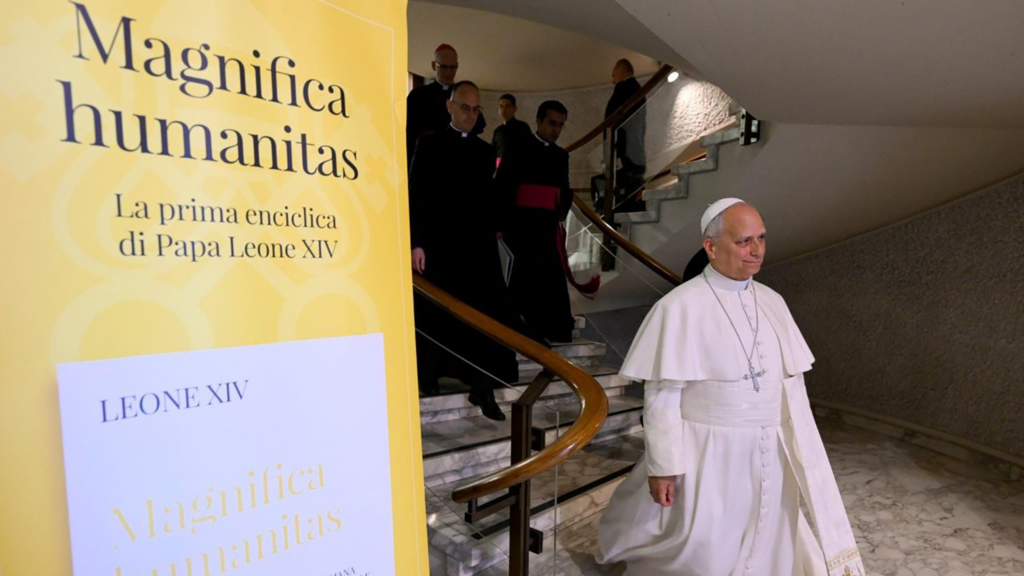
According to Fr. Prof. Kloch, the fact that Leo XIV’s first encyclical concerns artificial intelligence should not surprise those who followed the beginning of his pontificate. The Pope spoke about AI from his very first addresses, including to the diplomatic corps. “From the moment the first chatbot became widely available, reaching everyone without any restrictions, the table was practically turned in every field,” notes the Vatican News interlocutor.
As he emphasizes, the papal document should be read from two perspectives: as an indication of technology’s positive potential and as a catalog of serious warnings. “Nowhere in the encyclical did I find a negative opinion about artificial intelligence as such. The Pope does not present AI as a threat,” says Fr. Kloch.
Valuable support
The central message of the encyclical concerns the responsible use of technology. AI can support people in many areas, improve the efficiency and quality of services, and free humans from arduous, repetitive, and dangerous work. Fr. Kloch cites the Pope’s formulation that “AI is valuable support requiring attention.”
However, this support cannot mean replacing humans. “It cannot be that artificial intelligence displaces people from jobs,” emphasizes the pioneer of IT applications, and subsequently the internet, in the Church’s mission in Poland. He adds that AI should help, support, and make work more efficient, but “it cannot remove people from their positions.”
Disarming AI
One of the key concepts of the encyclical, pointed out by Fr. Prof. Kloch, is the “disarming” of artificial intelligence. It is not about rejecting technology or renouncing progress, but about preventing a situation where technology dominates humans. “The positive goal is this: to make artificial intelligence a human-friendly space,” explains Fr. Kloch.
This entails the need for legal frameworks, algorithmic transparency, and clear accountability. “There is no such thing as AI responsibility. Responsibility belongs to humans and companies,” emphasizes the Vatican News interlocutor. He also points to the problem of data, its monopolization, and instructions that can influence the responses provided by AI systems.
New inequalities
Leo XIV also draws attention to the threat of technological power concentration. The development of artificial intelligence is currently driven primarily by private entities, often transnational. This raises questions about law, control, and access to technology.
Fr. Kloch also speaks about inequalities between the richer North and the poorer South. It cannot be that poorer societies are deprived of access to AI or receive only severely limited tools. This, he notes, threatens a phenomenon described as “digital colonialism, the dependence of the weaker on the stronger.”
Humans decide
A particularly serious problem is the militarization of AI. The Vatican News interlocutor points out that the war in Ukraine showed a transition from “lines of tanks” to modern warfare conducted with drones and new technologies. Therefore, the Pope’s warning that no AI system “can decide over human life and death” is so crucial.
According to Fr. Kloch, the encyclical fits into the logic of the great social documents of the Church. Just as Leo XIII responded to the challenges of the industrial revolution, so Leo XIV speaks out in the face of the new era of artificial intelligence. “We are not dealing with an era of change, but a change of era,” he recalls Pope Francis’ words. Similarly – notes Professor UPJPII – Pope Leo XIV indicates that education “should be rethought.”