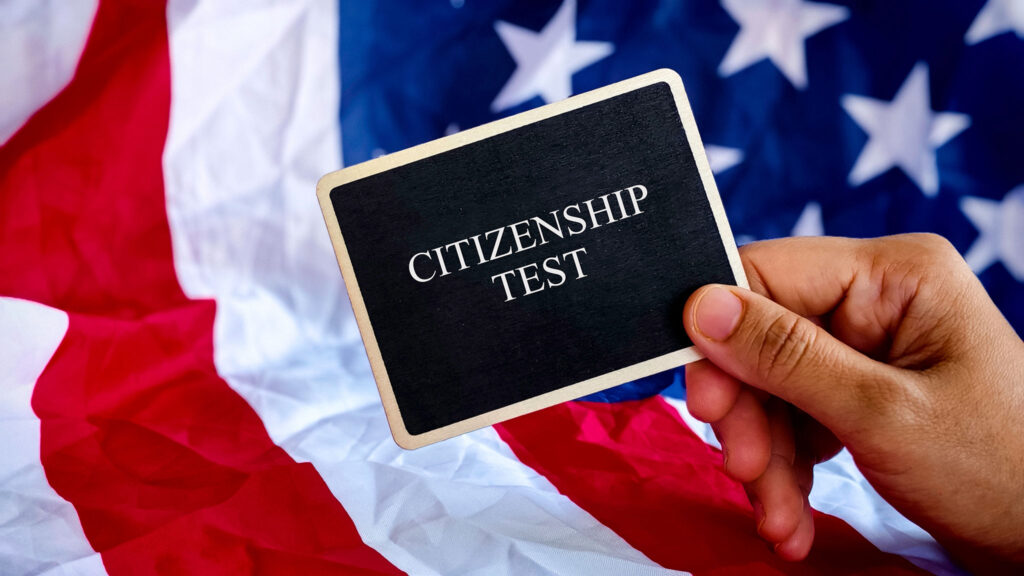
Urzędnik zadaje do 20 pytań z puli 128. Musisz odpowiedzieć poprawnie na minimum 12. Test kończy się przy 12 poprawnych lub 9 błędnych odpowiedzi. Odpowiedzi dotyczące polityków zmieniają się — sprawdź aktualne na uscis.gov/citizenship/testupdates.
RZĄD AMERYKAŃSKI (AMERICAN GOVERNMENT)
A: Zasady rządu amerykańskiego (Principles of American Government)
1. What is the form of government of the United States?
Jaka jest forma rządu Stanów Zjednoczonych?
* Republic / Republika
* Constitution-based federal republic / Republika federalna oparta na konstytucji
* Representative democracy / Demokracja przedstawicielska
2. What is the supreme law of the land? ✱
Co jest najwyższym prawem w kraju?
* (U.S.) Constitution / Konstytucja (USA)
3. Name one thing the U.S. Constitution does.
Wymień jedną rzecz, którą robi Konstytucja USA.
* Forms the government / Tworzy rząd
* Defines powers of government / Określa uprawnienia rządu
* Defines the parts of government / Określa części rządu
* Protects the rights of the people / Chroni prawa ludzi
4. The U.S. Constitution starts with the words “We the People.” What does “We the People” mean?
Konstytucja USA zaczyna się od słów „We the People”. Co to oznacza?
* Self-government / Samorządność
* Popular sovereignty / Suwerenność ludu
* Consent of the governed / Zgoda rządzonych
* People should govern themselves / Ludzie powinni rządzić się sami
* (Example of) social contract / (Przykład) umowy społecznej
5. How are changes made to the U.S. Constitution?
Jak wprowadza się zmiany do Konstytucji USA?
* Amendments / Poprawki
* The amendment process / Proces wprowadzania poprawek
6. What does the Bill of Rights protect?
Co chroni Karta Praw (Bill of Rights)?
* (The basic) rights of Americans / (Podstawowe) prawa Amerykanów
* (The basic) rights of people living in the United States / (Podstawowe) prawa osób mieszkających w USA
7. How many amendments does the U.S. Constitution have? ✱
Ile poprawek ma Konstytucja USA?
* Twenty-seven (27) / Dwadzieścia siedem (27)
8. Why is the Declaration of Independence important?
Dlaczego Deklaracja Niepodległości jest ważna?
* It says America is free from British control. / Mówi, że Ameryka jest wolna od kontroli brytyjskiej.
* It says all people are created equal. / Mówi, że wszyscy ludzie są stworzeni równi.
* It identifies inherent rights. / Wymienia niezbywalne prawa.
* It identifies individual freedoms. / Wymienia wolności jednostki.
9. What founding document said the American colonies were free from Britain?
Jaki dokument założycielski ogłosił, że kolonie amerykańskie są wolne od Brytanii?
* Declaration of Independence / Deklaracja Niepodległości
10. Name two important ideas from the Declaration of Independence and the U.S. Constitution.
Wymień dwie ważne idee z Deklaracji Niepodległości i Konstytucji USA.
* Equality / Równość
* Liberty / Wolność
* Social contract / Umowa społeczna
* Natural rights / Prawa naturalne
* Limited government / Ograniczony rząd
* Self-government / Samorządność
11. The words “Life, Liberty, and the pursuit of Happiness” are in what founding document?
Słowa „Life, Liberty, and the pursuit of Happiness” znajdują się w jakim dokumencie założycielskim?
* Declaration of Independence / Deklaracja Niepodległości
12. What is the economic system of the United States? ✱
Jaki jest system ekonomiczny Stanów Zjednoczonych?
* Capitalism / Kapitalizm
* Free market economy / Gospodarka wolnorynkowa
13. What is the rule of law?
Czym są rządy prawa (rule of law)?
* Everyone must follow the law. / Każdy musi przestrzegać prawa.
* Leaders must obey the law. / Przywódcy muszą przestrzegać prawa.
* Government must obey the law. / Rząd musi przestrzegać prawa.
* No one is above the law. / Nikt nie stoi ponad prawem.
14. Many documents influenced the U.S. Constitution. Name one.
Wiele dokumentów wpłynęło na Konstytucję USA. Wymień jeden.
* Declaration of Independence / Deklaracja Niepodległości
* Articles of Confederation / Artykuły Konfederacji
* Federalist Papers / Federalista
* Anti-Federalist Papers / Antyfederalista
* Virginia Declaration of Rights / Deklaracja Praw Wirginii
* Fundamental Orders of Connecticut / Prawa Podstawowe Connecticut
* Mayflower Compact / Pakt z Mayflower
* Iroquois Great Law of Peace / Wielkie Prawo Pokoju Irokezów
15. There are three branches of government. Why?
Istnieją trzy gałęzie władzy. Dlaczego?
* So one part does not become too powerful / Żeby jedna część nie stała się zbyt potężna
* Checks and balances / Kontrola i równowaga (checks and balances)
* Separation of powers / Podział władzy
B: System rządów (System of Government)
16. Name the three branches of government.
Wymień trzy gałęzie władzy.
* Legislative, executive, and judicial / Ustawodawcza, wykonawcza i sądownicza
* Congress, president, and the courts / Kongres, prezydent i sądy
17. The President of the United States is in charge of which branch of government?
Prezydent USA kieruje jaką gałęzią władzy?
* Executive branch / Władza wykonawcza
18. What part of the federal government writes laws?
Jaka część rządu federalnego pisze prawa?
* (U.S.) Congress / Kongres (USA)
* (U.S. or national) legislature / Legislatura (krajowa)
* Legislative branch / Władza ustawodawcza
19. What are the two parts of the U.S. Congress?
Jakie są dwie części Kongresu USA?
* Senate and House (of Representatives) / Senat i Izba (Reprezentantów)
20. Name one power of the U.S. Congress. ✱
Wymień jedno uprawnienie Kongresu USA.
* Writes laws / Pisze prawa
* Declares war / Wypowiada wojnę
* Makes the federal budget / Ustala budżet federalny
21. How many U.S. senators are there?
Ilu jest senatorów USA?
* One hundred (100) / Stu (100)
22. How long is a term for a U.S. senator?
Jak długo trwa kadencja senatora USA?
* Six (6) years / Sześć (6) lat
23. Who is one of your state’s U.S. senators now?
Kto jest jednym z senatorów Twojego stanu?
* Odpowiedzi się różnią. [Mieszkańcy D.C. i terytoriów USA: D.C. (lub dane terytorium) nie ma senatorów USA.] Sprawdź na uscis.gov/citizenship/testupdates.
24. How many voting members are in the House of Representatives?
Ilu jest członków z prawem głosu w Izbie Reprezentantów?
* Four hundred thirty-five (435) / Czterysta trzydzieści pięć (435)
25. How long is a term for a member of the House of Representatives?
Jak długo trwa kadencja członka Izby Reprezentantów?
* Two (2) years / Dwa (2) lata
26. Why do U.S. representatives serve shorter terms than U.S. senators?
Dlaczego przedstawiciele USA mają krótsze kadencje niż senatorowie?
* To more closely follow public opinion / Aby lepiej odzwierciedlać opinię publiczną
27. How many senators does each state have?
Ilu senatorów ma każdy stan?
* Two (2) / Dwóch (2)
28. Why does each state have two senators?
Dlaczego każdy stan ma dwóch senatorów?
* Equal representation (for small states) / Równa reprezentacja (dla małych stanów)
* The Great Compromise (Connecticut Compromise) / Wielki Kompromis (Kompromis z Connecticut)
29. Name your U.S. representative.
Podaj nazwisko swojego przedstawiciela w Izbie Reprezentantów.
* Odpowiedzi się różnią. [Mieszkańcy terytoriów z delegatami bez prawa głosu mogą podać nazwisko delegata lub komisarza-rezydenta.]
30. What is the name of the Speaker of the House of Representatives now? ✱
Jak się nazywa obecny Przewodniczący Izby Reprezentantów (Speaker)?
* Sprawdź na uscis.gov/citizenship/testupdates.
31. Who does a U.S. senator represent?
Kogo reprezentuje senator USA?
* Citizens of their state / Obywateli swojego stanu
* People of their state / Ludzi ze swojego stanu
32. Who elects U.S. senators?
Kto wybiera senatorów USA?
* Citizens from their state / Obywatele z ich stanu
33. Who does a member of the House of Representatives represent?
Kogo reprezentuje członek Izby Reprezentantów?
* Citizens in their (congressional) district / Obywateli w ich okręgu (kongresowym)
* People in their district / Ludzi z ich okręgu
34. Who elects members of the House of Representatives?
Kto wybiera członków Izby Reprezentantów?
* Citizens from their (congressional) district / Obywatele z ich okręgu (kongresowego)
35. Some states have more representatives than other states. Why?
Niektóre stany mają więcej przedstawicieli niż inne. Dlaczego?
* (Because of) the state’s population / (Z powodu) liczby ludności stanu
* (Because) they have more people / (Ponieważ) mają więcej ludzi
* (Because) some states have more people / (Ponieważ) niektóre stany mają więcej ludzi
36. The President of the United States is elected for how many years? ✱
Na ile lat wybierany jest Prezydent USA?
* Four (4) years / Cztery (4) lata
37. The President of the United States can serve only two terms. Why?
Prezydent USA może pełnić tylko dwie kadencje. Dlaczego?
* (Because of) the 22nd Amendment / (Z powodu) 22. Poprawki
* To keep the president from becoming too powerful / Żeby prezydent nie stał się zbyt potężny
38. What is the name of the President of the United States now? ✱
Jak się nazywa obecny Prezydent USA?
* Sprawdź na uscis.gov/citizenship/testupdates.
39. What is the name of the Vice President of the United States now? ✱
Jak się nazywa obecny Wiceprezydent USA?
* Sprawdź na uscis.gov/citizenship/testupdates.
40. If the president can no longer serve, who becomes president?
Jeśli prezydent nie może dalej pełnić urzędu, kto zostaje prezydentem?
* The Vice President (of the United States) / Wiceprezydent (USA)
41. Name one power of the president.
Wymień jedno uprawnienie prezydenta.
* Signs bills into law / Podpisuje ustawy
* Vetoes bills / Zawetowuje ustawy
* Enforces laws / Egzekwuje prawa
* Commander in Chief (of the military) / Naczelny Dowódca (sił zbrojnych)
* Chief diplomat / Główny dyplomata
* Appoints federal judges / Mianuje sędziów federalnych
42. Who is Commander in Chief of the U.S. military?
Kto jest Naczelnym Dowódcą sił zbrojnych USA?
* The President (of the United States) / Prezydent (USA)
43. Who signs bills to become laws?
Kto podpisuje ustawy, żeby stały się prawem?
* The President (of the United States) / Prezydent (USA)
44. Who vetoes bills? ✱
Kto zawetowuje ustawy?
* The President (of the United States) / Prezydent (USA)
45. Who appoints federal judges?
Kto mianuje sędziów federalnych?
* The President (of the United States) / Prezydent (USA)
46. The executive branch has many parts. Name one.
Władza wykonawcza ma wiele części. Wymień jedną.
* President (of the United States) / Prezydent (USA)
* Cabinet / Gabinet
* Federal departments and agencies / Departamenty i agencje federalne
47. What does the President’s Cabinet do?
Co robi gabinet prezydenta?
* Advises the President (of the United States) / Doradza Prezydentowi (USA)
48. What are two Cabinet-level positions?
Wymień dwa stanowiska na poziomie gabinetu.
* Attorney General / Prokurator Generalny
* Secretary of Agriculture / Sekretarz Rolnictwa
* Secretary of Commerce / Sekretarz Handlu
* Secretary of Education / Sekretarz Edukacji
* Secretary of Energy / Sekretarz Energii
* Secretary of Health and Human Services / Sekretarz Zdrowia
* Secretary of Homeland Security / Sekretarz Bezpieczeństwa Krajowego
* Secretary of Housing and Urban Development / Sekretarz Mieszkalnictwa
* Secretary of the Interior / Sekretarz Spraw Wewnętrznych
* Secretary of Labor / Sekretarz Pracy
* Secretary of State / Sekretarz Stanu
* Secretary of Transportation / Sekretarz Transportu
* Secretary of the Treasury / Sekretarz Skarbu
* Secretary of Veterans Affairs / Sekretarz ds. Weteranów
* Secretary of War (Defense) / Sekretarz Wojny (Obrony)
* Vice-President / Wiceprezydent
* Administrator of the Environmental Protection Agency / Administrator EPA
* Administrator of the Small Business Administration / Administrator SBA
* Director of the Central Intelligence Agency / Dyrektor CIA
* Director of the Office of Management and Budget / Dyrektor OMB
* Director of National Intelligence / Dyrektor Wywiadu Narodowego
* United States Trade Representative / Przedstawiciel Handlowy USA
49. Why is the Electoral College important?
Dlaczego Kolegium Elektorów jest ważne?
* It decides who is elected president. / Decyduje, kto zostaje wybrany na prezydenta.
* It provides a compromise between the popular election of the president and congressional selection. / Stanowi kompromis między powszechnym wyborem prezydenta a wyborem przez Kongres.
50. What is one part of the judicial branch?
Jaka jest jedna część władzy sądowniczej?
* Supreme Court / Sąd Najwyższy
* Federal Courts / Sądy federalne
51. What does the judicial branch do?
Co robi władza sądownicza?
* Reviews laws / Sprawdza prawa
* Explains laws / Wyjaśnia prawa
* Resolves disputes (disagreements) about the law / Rozstrzyga spory dotyczące prawa
* Decides if a law goes against the (U.S.) Constitution / Decyduje, czy prawo jest sprzeczne z Konstytucją
52. What is the highest court in the United States? ✱
Jaki jest najwyższy sąd w USA?
* Supreme Court / Sąd Najwyższy
53. How many seats are on the Supreme Court?
Ile miejsc jest w Sądzie Najwyższym?
* Nine (9) / Dziewięć (9)
54. How many Supreme Court justices are usually needed to decide a case?
Ilu sędziów Sądu Najwyższego jest zwykle potrzebnych do rozstrzygnięcia sprawy?
* Five (5) / Pięciu (5)
55. How long do Supreme Court justices serve?
Jak długo służą sędziowie Sądu Najwyższego?
* (For) life / Dożywotnio
* Lifetime appointment / Mianowanie dożywotnie
* (Until) retirement / (Do) przejścia na emeryturę
56. Supreme Court justices serve for life. Why?
Sędziowie Sądu Najwyższego służą dożywotnio. Dlaczego?
* To be independent (of politics) / Aby być niezależnymi (od polityki)
* To limit outside (political) influence / Aby ograniczyć zewnętrzne (polityczne) wpływy
57. Who is the Chief Justice of the United States now?
Kto jest obecnym Prezesem Sądu Najwyższego USA?
* Sprawdź na uscis.gov/citizenship/testupdates.
58. Name one power that is only for the federal government.
Wymień jedno uprawnienie wyłącznie rządu federalnego.
* Print paper money / Drukować pieniądze papierowe
* Mint coins / Bić monety
* Declare war / Wypowiadać wojnę
* Create an army / Tworzyć armię
* Make treaties / Zawierać traktaty
* Set foreign policy / Ustalać politykę zagraniczną
59. Name one power that is only for the states.
Wymień jedno uprawnienie wyłącznie stanów.
* Provide schooling and education / Zapewniać edukację
* Provide protection (police) / Zapewniać ochronę (policja)
* Provide safety (fire departments) / Zapewniać bezpieczeństwo (straż pożarna)
* Give a driver’s license / Wydawać prawo jazdy
* Approve zoning and land use / Zatwierdzać zagospodarowanie terenu
60. What is the purpose of the 10th Amendment?
Jaki jest cel 10. Poprawki?
* (It states that the) powers not given to the federal government belong to the states or to the people. / (Stanowi, że) uprawnienia nieprzyznane rządowi federalnemu należą do stanów lub do ludzi.
61. Who is the governor of your state now? ✱
Kto jest obecnym gubernatorem Twojego stanu?
* Odpowiedzi się różnią. [Mieszkańcy D.C.: D.C. nie ma gubernatora.]
62. What is the capital of your state?
Jaka jest stolica Twojego stanu?
* Odpowiedzi się różnią. [Mieszkańcy D.C.: D.C. nie jest stanem i nie ma stolicy. Mieszkańcy terytoriów: podaj stolicę terytorium.]
C: Prawa i obowiązki (Rights and Responsibilities)
63. There are four amendments to the U.S. Constitution about who can vote. Describe one of them.
W Konstytucji USA są cztery poprawki dotyczące tego, kto może głosować. Opisz jedną.
* Citizens eighteen (18) and older (can vote). / Obywatele w wieku 18 lat i starsi mogą głosować.
* You don’t have to pay (a poll tax) to vote. / Nie musisz płacić podatku wyborczego, żeby głosować.
* Any citizen can vote. (Women and men can vote.) / Każdy obywatel może głosować (kobiety i mężczyźni).
* A male citizen of any race (can vote). / Obywatel męski każdej rasy może głosować.
64. Who can vote in federal elections, run for federal office, and serve on a jury in the United States?
Kto w USA może głosować, kandydować na urząd federalny i zasiadać w ławie przysięgłych?
* Citizens / Obywatele
* Citizens of the United States / Obywatele Stanów Zjednoczonych
* U.S. citizens / Obywatele USA
65. What are three rights of everyone living in the United States?
Jakie są trzy prawa każdego mieszkańca USA?
* Freedom of expression / Wolność wypowiedzi
* Freedom of speech / Wolność słowa
* Freedom of assembly / Wolność zgromadzeń
* Freedom to petition the government / Wolność składania petycji do rządu
* Freedom of religion / Wolność wyznania
* The right to bear arms / Prawo do noszenia broni
66. What do we show loyalty to when we say the Pledge of Allegiance? ✱
Czemu wyrażamy lojalność, mówiąc Przysięgę Wierności (Pledge of Allegiance)?
* The United States / Stanom Zjednoczonym
* The flag / Fladze
67. Name two promises that new citizens make in the Oath of Allegiance.
Wymień dwie obietnice składane przez nowych obywateli w Przysiędze Wierności.
* Give up loyalty to other countries / Zrzec się lojalności wobec innych krajów
* Defend the (U.S.) Constitution / Bronić Konstytucji (USA)
* Obey the laws of the United States / Przestrzegać praw USA
* Serve in the military (if needed) / Służyć w wojsku (jeśli potrzeba)
* Serve (help, do important work for) the nation (if needed) / Służyć narodowi (jeśli potrzeba)
* Be loyal to the United States / Być lojalnym wobec USA
68. How can people become United States citizens?
Jak ludzie mogą zostać obywatelami USA?
* Be born in the United States, under the conditions set by the 14th Amendment / Urodzić się w USA, zgodnie z warunkami 14. Poprawki
* Naturalize / Naturalizować się
* Derive citizenship (under conditions set by Congress) / Uzyskać obywatelstwo pochodne (na warunkach ustalonych przez Kongres)
69. What are two examples of civic participation in the United States?
Jakie są dwa przykłady uczestnictwa obywatelskiego w USA?
* Vote / Głosować
* Run for office / Kandydować na urząd
* Join a political party / Dołączyć do partii politycznej
* Help with a campaign / Pomóc w kampanii
* Join a civic group / Dołączyć do grupy obywatelskiej
* Join a community group / Dołączyć do grupy społecznej
* Give an elected official your opinion (on an issue) / Wyrazić opinię wybranemu urzędnikowi
* Contact elected officials / Kontaktować się z wybranymi urzędnikami
* Support or oppose an issue or policy / Popierać lub sprzeciwiać się kwestii lub polityce
* Write to a newspaper / Pisać do gazety
70. What is one way Americans can serve their country?
Jaki jest jeden sposób, w jaki Amerykanie mogą służyć krajowi?
* Vote / Głosować
* Pay taxes / Płacić podatki
* Obey the law / Przestrzegać prawa
* Serve in the military / Służyć w wojsku
* Run for office / Kandydować na urząd
* Work for local, state, or federal government / Pracować dla władz lokalnych, stanowych lub federalnych
71. Why is it important to pay federal taxes?
Dlaczego ważne jest płacenie podatków federalnych?
* Required by law / Wymaga tego prawo
* All people pay to fund the federal government / Wszyscy płacą, żeby finansować rząd federalny
* Required by the (U.S.) Constitution (16th Amendment) / Wymaga tego Konstytucja (16. Poprawka)
* Civic duty / Obowiązek obywatelski
72. It is important for all men age 18 through 25 to register for the Selective Service. Name one reason why.
Ważne jest, aby wszyscy mężczyźni w wieku 18–25 lat rejestrowali się w Selective Service. Podaj jeden powód.
* Required by law / Wymaga tego prawo
* Civic duty / Obowiązek obywatelski
* Makes the draft fair, if needed / Sprawia, że pobór jest sprawiedliwy, jeśli potrzebny
Pytania oznaczone ✱ to pytania dla wyjątku 65/20. Na egzaminie odpowiadasz po angielsku.
HISTORIA AMERYKI (AMERICAN HISTORY)
A: Okres kolonialny i niepodległość (Colonial Period and Independence)
73. The colonists came to America for many reasons. Name one.
Koloniści przybyli do Ameryki z wielu powodów. Wymień jeden.
* Freedom / Wolność
* Political liberty / Wolność polityczna
* Religious freedom / Wolność religijna
* Economic opportunity / Możliwości ekonomiczne
* Escape persecution / Ucieczka przed prześladowaniami
74. Who lived in America before the Europeans arrived? ✱
Kto mieszkał w Ameryce przed przybyciem Europejczyków?
* American Indians / Indianie amerykańscy
* Native Americans / Rdzenni Amerykanie
75. What group of people was taken and sold as slaves?
Jaka grupa ludzi była porywana i sprzedawana jako niewolnicy?
* Africans / Afrykanie
* People from Africa / Ludzie z Afryki
76. What war did the Americans fight to win independence from Britain?
Jaką wojnę stoczyli Amerykanie, żeby zdobyć niepodległość od Brytanii?
* American Revolution / Rewolucja amerykańska
* The (American) Revolutionary War / (Amerykańska) wojna o niepodległość
* War for (American) Independence / Wojna o (amerykańską) niepodległość
77. Name one reason why the Americans declared independence from Britain.
Wymień jeden powód, dla którego Amerykanie ogłosili niepodległość od Brytanii.
* High taxes / Wysokie podatki
* Taxation without representation / Opodatkowanie bez reprezentacji
* British soldiers stayed in Americans’ houses (boarding, quartering) / Żołnierze brytyjscy mieszkali w domach Amerykanów
* They did not have self-government / Nie mieli samorządności
* Boston Massacre / Masakra bostońska
* Boston Tea Party (Tea Act) / Bostońskie Picie Herbaty
* Stamp Act / Ustawa stemplowa
* Sugar Act / Ustawa cukrowa
* Townshend Acts / Ustawy Townshenda
* Intolerable (Coercive) Acts / Ustawy Nieznośne (Przymusowe)
78. Who wrote the Declaration of Independence? ✱
Kto napisał Deklarację Niepodległości?
* (Thomas) Jefferson
79. When was the Declaration of Independence adopted?
Kiedy uchwalono Deklarację Niepodległości?
* July 4, 1776 / 4 lipca 1776
80. The American Revolution had many important events. Name one.
Rewolucja amerykańska miała wiele ważnych wydarzeń. Wymień jedno.
* (Battle of) Bunker Hill / (Bitwa pod) Bunker Hill
* Declaration of Independence / Deklaracja Niepodległości
* Washington Crossing the Delaware (Battle of Trenton) / Przeprawa Waszyngtona przez Delaware (Bitwa pod Trenton)
* (Battle of) Saratoga / (Bitwa pod) Saratogą
* Valley Forge (Encampment) / Valley Forge (Obozowisko)
* (Battle of) Yorktown (British surrender at Yorktown) / (Bitwa pod) Yorktown (kapitulacja Brytyjczyków)
81. There were 13 original states. Name five.
Było 13 pierwotnych stanów. Wymień pięć.
* New Hampshire, Massachusetts, Rhode Island, Connecticut, New York, New Jersey, Pennsylvania, Delaware, Maryland, Virginia, North Carolina, South Carolina, Georgia
82. What founding document was written in 1787?
Jaki dokument założycielski napisano w 1787 roku?
* (U.S.) Constitution / Konstytucja (USA)
83. The Federalist Papers supported the passage of the U.S. Constitution. Name one of the writers.
Federalista wspierał uchwalenie Konstytucji USA. Wymień jednego z autorów.
* (James) Madison
* (Alexander) Hamilton
* (John) Jay
* Publius
84. Why were the Federalist Papers important?
Dlaczego Federalista był ważny?
* They helped people understand the (U.S.) Constitution. / Pomogły ludziom zrozumieć Konstytucję.
* They supported passing the (U.S.) Constitution. / Wspierały uchwalenie Konstytucji.
85. Benjamin Franklin is famous for many things. Name one.
Benjamin Franklin jest sławny z wielu rzeczy. Wymień jedną.
* Founded the first free public libraries / Założył pierwsze bezpłatne biblioteki publiczne
* First Postmaster General of the United States / Pierwszy Dyrektor Generalny Poczty USA
* Helped write the Declaration of Independence / Pomagał pisać Deklarację Niepodległości
* Inventor / Wynalazca
* U.S. diplomat / Dyplomata USA
86. George Washington is famous for many things. Name one. ✱
George Washington jest sławny z wielu rzeczy. Wymień jedną.
* “Father of Our Country” / „Ojciec Naszego Kraju”
* First president of the United States / Pierwszy prezydent USA
* General of the Continental Army / Generał Armii Kontynentalnej
* President of the Constitutional Convention / Przewodniczący Konwencji Konstytucyjnej
87. Thomas Jefferson is famous for many things. Name one.
Thomas Jefferson jest sławny z wielu rzeczy. Wymień jedną.
* Writer of the Declaration of Independence / Autor Deklaracji Niepodległości
* Third president of the United States / Trzeci prezydent USA
* Doubled the size of the United States (Louisiana Purchase) / Podwoił rozmiar USA (Zakup Luizjany)
* First Secretary of State / Pierwszy Sekretarz Stanu
* Founded the University of Virginia / Założył Uniwersytet Wirginii
* Writer of the Virginia Statute on Religious Freedom / Autor Statutu Wirginii o Wolności Religijnej
88. James Madison is famous for many things. Name one.
James Madison jest sławny z wielu rzeczy. Wymień jedną.
* “Father of the Constitution” / „Ojciec Konstytucji”
* Fourth president of the United States / Czwarty prezydent USA
* President during the War of 1812 / Prezydent podczas wojny 1812 roku
* One of the writers of the Federalist Papers / Jeden z autorów Federalisty
89. Alexander Hamilton is famous for many things. Name one.
Alexander Hamilton jest sławny z wielu rzeczy. Wymień jedną.
* First Secretary of the Treasury / Pierwszy Sekretarz Skarbu
* One of the writers of the Federalist Papers / Jeden z autorów Federalisty
* Helped establish the First Bank of the United States / Pomagał założyć Pierwszy Bank USA
* Aide to General George Washington / Adiutant generała Waszyngtona
* Member of the Continental Congress / Członek Kongresu Kontynentalnego
B: Lata 1800 (1800s)
90. What territory did the United States buy from France in 1803?
Jakie terytorium USA kupiły od Francji w 1803 roku?
* Louisiana Territory / Terytorium Luizjany
* Louisiana / Luizjana
91. Name one war fought by the United States in the 1800s.
Wymień jedną wojnę prowadzoną przez USA w XIX wieku.
* War of 1812 / Wojna 1812 roku
* Mexican-American War / Wojna meksykańsko-amerykańska
* Civil War / Wojna secesyjna
* Spanish-American War / Wojna hiszpańsko-amerykańska
92. Name the U.S. war between the North and the South.
Wymień amerykańską wojnę między Północą a Południem.
* The Civil War / Wojna secesyjna
93. The Civil War had many important events. Name one.
Wojna secesyjna miała wiele ważnych wydarzeń. Wymień jedno.
* (Battle of) Fort Sumter / (Bitwa o) Fort Sumter
* Emancipation Proclamation / Proklamacja Emancypacji
* (Battle of) Vicksburg / (Bitwa pod) Vicksburg
* (Battle of) Gettysburg / (Bitwa pod) Gettysburg
* Sherman’s March / Marsz Shermana
* (Surrender at) Appomattox / (Kapitulacja pod) Appomattox
* (Battle of) Antietam/Sharpsburg / (Bitwa pod) Antietam/Sharpsburg
* Lincoln was assassinated. / Lincoln został zamordowany.
94. Abraham Lincoln is famous for many things. Name one. ✱
Abraham Lincoln jest sławny z wielu rzeczy. Wymień jedną.
* Freed the slaves (Emancipation Proclamation) / Uwolnił niewolników (Proklamacja Emancypacji)
* Saved (or preserved) the Union / Ocalił (zachował) Unię
* Led the United States during the Civil War / Prowadził USA podczas wojny secesyjnej
* 16th president of the United States / 16. prezydent USA
* Delivered the Gettysburg Address / Wygłosił Przemówienie z Gettysburga
95. What did the Emancipation Proclamation do?
Co zrobiła Proklamacja Emancypacji?
* Freed the slaves / Uwolniła niewolników
* Freed slaves in the Confederacy / Uwolniła niewolników w Konfederacji
* Freed slaves in the Confederate states / Uwolniła niewolników w stanach konfederackich
* Freed slaves in most Southern states / Uwolniła niewolników w większości stanów południowych
96. What U.S. war ended slavery?
Jaka amerykańska wojna zakończyła niewolnictwo?
* The Civil War / Wojna secesyjna
97. What amendment says all persons born or naturalized in the United States, and subject to the jurisdiction thereof, are U.S. citizens?
Jaka poprawka mówi, że wszystkie osoby urodzone lub naturalizowane w USA, podlegające ich jurysdykcji, są obywatelami USA?
* 14th Amendment / 14. Poprawka
98. When did all men get the right to vote?
Kiedy wszyscy mężczyźni uzyskali prawo głosu?
* After the Civil War / Po wojnie secesyjnej
* During Reconstruction / Podczas Rekonstrukcji
* (With the) 15th Amendment / (Wraz z) 15. Poprawką
* 1870
99. Name one leader of the women’s rights movement in the 1800s.
Wymień jedną liderkę ruchu praw kobiet w XIX wieku.
* Susan B. Anthony
* Elizabeth Cady Stanton
* Sojourner Truth
* Harriet Tubman
* Lucretia Mott
* Lucy Stone
C: Współczesna historia Ameryki (Recent American History and Other Important Historical Information)
100. Name one war fought by the United States in the 1900s.
Wymień jedną wojnę prowadzoną przez USA w XX wieku.
* World War I / I wojna światowa
* World War II / II wojna światowa
* Korean War / Wojna koreańska
* Vietnam War / Wojna wietnamska
* (Persian) Gulf War / Wojna w Zatoce (Perskiej)
101. Why did the United States enter World War I?
Dlaczego USA przystąpiły do I wojny światowej?
* Because Germany attacked U.S. (civilian) ships / Ponieważ Niemcy atakowały (cywilne) statki USA
* To support the Allied Powers (England, France, Italy, and Russia) / Aby wesprzeć Aliantów
* To oppose the Central Powers (Germany, Austria-Hungary, the Ottoman Empire, and Bulgaria) / Aby przeciwstawić się Państwom Centralnym
102. When did all women get the right to vote?
Kiedy wszystkie kobiety uzyskały prawo głosu?
* 1920
* After World War I / Po I wojnie światowej
* (With the) 19th Amendment / (Wraz z) 19. Poprawką
103. What was the Great Depression?
Czym był Wielki Kryzys?
* Longest economic recession in modern history / Najdłuższa recesja gospodarcza we współczesnej historii
104. When did the Great Depression start?
Kiedy zaczął się Wielki Kryzys?
* The Great Crash (1929) / Wielki Krach (1929)
* Stock market crash of 1929 / Krach giełdowy 1929 roku
105. Who was president during the Great Depression and World War II?
Kto był prezydentem podczas Wielkiego Kryzysu i II wojny światowej?
* (Franklin) Roosevelt
106. Why did the United States enter World War II?
Dlaczego USA przystąpiły do II wojny światowej?
* (Bombing of) Pearl Harbor / (Bombardowanie) Pearl Harbor
* Japanese attacked Pearl Harbor / Japończycy zaatakowali Pearl Harbor
* To support the Allied Powers (England, France, and Russia) / Aby wesprzeć Aliantów
* To oppose the Axis Powers (Germany, Italy, and Japan) / Aby przeciwstawić się Państwom Osi
107. Dwight Eisenhower is famous for many things. Name one.
Dwight Eisenhower jest sławny z wielu rzeczy. Wymień jedną.
* General during World War II / Generał podczas II wojny światowej
* President at the end of (during) the Korean War / Prezydent pod koniec (podczas) wojny koreańskiej
* 34th president of the United States / 34. prezydent USA
* Signed the Federal-Aid Highway Act of 1956 (Created the Interstate System) / Podpisał ustawę o autostradach z 1956 r.
108. Who was the United States’ main rival during the Cold War?
Kto był głównym rywalem USA podczas zimnej wojny?
* Soviet Union / Związek Radziecki
* USSR / ZSRR
* Russia / Rosja
109. During the Cold War, what was one main concern of the United States?
Podczas zimnej wojny, jakie było jedno główne zmartwienie USA?
* Communism / Komunizm
* Nuclear war / Wojna nuklearna
110. Why did the United States enter the Korean War?
Dlaczego USA przystąpiły do wojny koreańskiej?
* To stop the spread of communism / Aby powstrzymać rozprzestrzenianie się komunizmu
111. Why did the United States enter the Vietnam War?
Dlaczego USA przystąpiły do wojny wietnamskiej?
* To stop the spread of communism / Aby powstrzymać rozprzestrzenianie się komunizmu
112. What did the civil rights movement do?
Co zrobił ruch praw obywatelskich?
* Fought to end racial discrimination / Walczył o zakończenie dyskryminacji rasowej
113. Martin Luther King, Jr. is famous for many things. Name one. ✱
Martin Luther King Jr. jest sławny z wielu rzeczy. Wymień jedną.
* Fought for civil rights / Walczył o prawa obywatelskie
* Worked for equality for all Americans / Działał na rzecz równości dla wszystkich Amerykanów
* Worked to ensure that people would “not be judged by the color of their skin, but by the content of their character” / Działał, żeby ludzie „nie byli osądzani po kolorze skóry, lecz po treści ich charakteru”
114. Why did the United States enter the Persian Gulf War?
Dlaczego USA przystąpiły do wojny w Zatoce Perskiej?
* To force the Iraqi military from Kuwait / Aby zmusić irackie wojsko do opuszczenia Kuwejtu
115. What major event happened on September 11, 2001 in the United States? ✱
Jakie ważne wydarzenie miało miejsce 11 września 2001 roku w USA?
* Terrorists attacked the United States / Terroryści zaatakowali Stany Zjednoczone
* Terrorists took over two planes and crashed them into the World Trade Center in New York City / Terroryści przejęli dwa samoloty i rozbili je o World Trade Center w Nowym Jorku
* Terrorists took over a plane and crashed into the Pentagon in Arlington, Virginia / Terroryści przejęli samolot i rozbili go o Pentagon w Arlington w Wirginii
* Terrorists took over a plane originally aimed at Washington, D.C., and crashed in a field in Pennsylvania / Terroryści przejęli samolot skierowany na Waszyngton i rozbili go na polu w Pensylwanii
116. Name one U.S. military conflict after the September 11, 2001 attacks.
Wymień jeden amerykański konflikt zbrojny po atakach z 11 września 2001.
* (Global) War on Terror / (Globalna) Wojna z Terroryzmem
* War in Afghanistan / Wojna w Afganistanie
* War in Iraq / Wojna w Iraku
117. Name one American Indian tribe in the United States.
Wymień jedno plemię indiańskie w USA.
* Apache, Blackfeet, Cayuga, Cherokee, Cheyenne, Chippewa, Choctaw, Creek, Crow, Hopi, Huron, Inupiat, Lakota, Mohawk, Mohegan, Navajo, Oneida, Onondaga, Pueblo, Seminole, Seneca, Shawnee, Sioux, Teton, Tuscarora
(Pełna lista na bia.gov — wystarczy wymienić jedno)
118. Name one example of an American innovation.
Wymień jeden przykład amerykańskiej innowacji.
* Light bulb / Żarówka
* Automobile (cars, internal combustion engine) / Samochód (silnik spalinowy)
* Skyscrapers / Wieżowce
* Airplane / Samolot
* Assembly line / Linia montażowa
* Landing on the moon / Lądowanie na Księżycu
* Integrated circuit (IC) / Układ scalony
SYMBOLE I ŚWIĘTA (SYMBOLS AND HOLIDAYS)
A: Symbole (Symbols)
119. What is the capital of the United States?
Jaka jest stolica Stanów Zjednoczonych?
* Washington, D.C.
120. Where is the Statue of Liberty?
Gdzie jest Statua Wolności?
* New York (Harbor) / (Port) nowojorski
* Liberty Island [Dopuszczalne też: New Jersey, near New York City, on the Hudson (River)]
121. Why does the flag have 13 stripes? ✱
Dlaczego flaga ma 13 pasów?
* (Because there were) 13 original colonies / (Ponieważ było) 13 pierwotnych kolonii
* (Because the stripes) represent the original colonies / (Ponieważ pasy) reprezentują pierwotne kolonie
122. Why does the flag have 50 stars?
Dlaczego flaga ma 50 gwiazdek?
* (Because there is) one star for each state / (Ponieważ jest) jedna gwiazdka na każdy stan
* (Because) each star represents a state / (Ponieważ) każda gwiazdka reprezentuje stan
* (Because there are) 50 states / (Ponieważ jest) 50 stanów
123. What is the name of the national anthem?
Jak się nazywa hymn narodowy?
* The Star-Spangled Banner
124. The Nation’s first motto was “E Pluribus Unum.” What does that mean?
Pierwsze motto narodu brzmiało „E Pluribus Unum”. Co to oznacza?
* Out of many, one / Z wielu, jedno
* We all become one / Wszyscy stajemy się jednym
B: Święta (Holidays)
125. What is Independence Day?
Czym jest Dzień Niepodległości (Independence Day)?
* A holiday to celebrate U.S. independence (from Britain) / Święto z okazji niepodległości USA (od Brytanii)
* The country’s birthday / Urodziny kraju
126. Name three national U.S. holidays. ✱
Wymień trzy święta narodowe USA.
* New Year’s Day / Nowy Rok
* Martin Luther King, Jr. Day / Dzień Martina Luthera Kinga Jr.
* Presidents Day (Washington’s Birthday) / Dzień Prezydentów
* Memorial Day / Dzień Pamięci
* Juneteenth
* Independence Day / Dzień Niepodległości
* Labor Day / Dzień Pracy
* Columbus Day / Dzień Kolumba
* Veterans Day / Dzień Weteranów
* Thanksgiving Day / Dzień Dziękczynienia
* Christmas Day / Boże Narodzenie
127. What is Memorial Day?
Czym jest Memorial Day?
* A holiday to honor soldiers who died in military service / Święto ku czci żołnierzy, którzy zginęli w służbie wojskowej
128. What is Veterans Day?
Czym jest Veterans Day?
* A holiday to honor people in the (U.S.) military / Święto ku czci osób służących w wojsku (USA)
* A holiday to honor people who have served (in the U.S. military) / Święto ku czci osób, które służyły (w wojsku USA)
Redakcja, Głos Polonii w USA
Źródło: Oficjalny dokument USCIS M-1778 (09/25) — „128 Civics Questions and Answers (2025 version)”. Tłumaczenie: redakcja poland.us. Na egzaminie odpowiadasz po angielsku. Odpowiedzi dotyczące polityków zmieniają się — sprawdź na uscis.gov/citizenship/testupdates.
Nie wiesz, jak się przygotować? Nowe pytania do egzaminu na obywatelstwo 2025 — co się zmieniło. Szukasz polskiego prawnika imigracyjnego? PolishPages.com