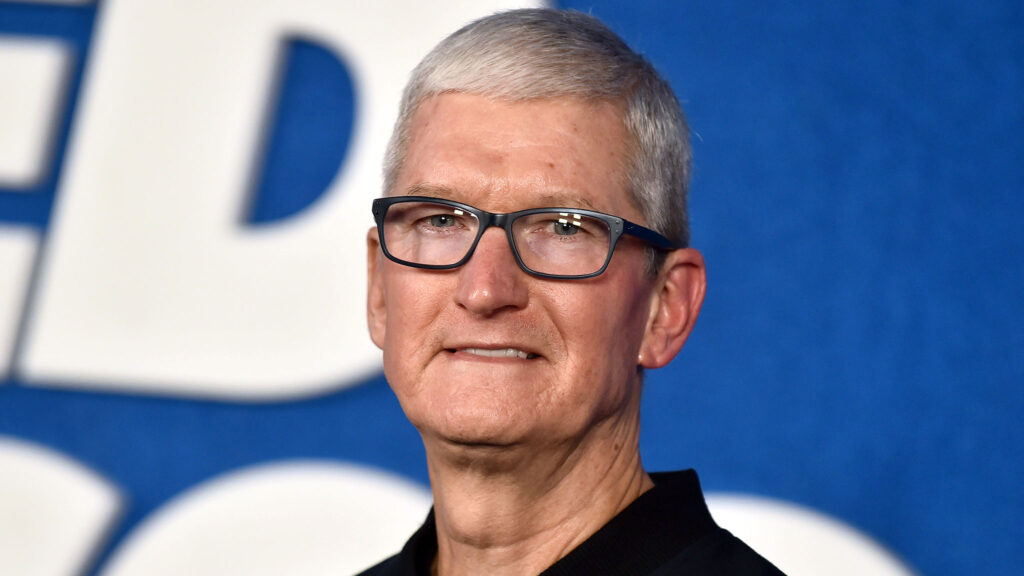
From September 1, the company will be led by John Ternus, 51-year-old head of hardware engineering, who since 2001 has risen through the ranks at Apple from a VR headset designer to the person responsible for every iPhone, Mac, and Apple Watch that has rolled off the assembly line in the last decade. Cook is not leaving the company — he will remain executive chairman of the board. But he is handing over command to an engineer at a time when Apple is, for the first time in years, genuinely behind in the artificial intelligence race.
What changes on September 1
Cook finishes his work as CEO on the last day of August. Ternus starts on September 1 and joins the board. Arthur Levinson, who served as a highly valued chairman for 15 years, becomes the lead independent director.
In the engineering hierarchy, Johny Srouji is rising — he is promoted to Chief Hardware Officer, a new title created specifically for him — as well as Tom Marieb. Both will share Ternus’s previous responsibilities starting today. The decision was approved unanimously — Apple called it a “thoughtful, long-term succession process.” This is the language of a company that has been preparing for this change for years.
Apple shares on the stock market fell by 0.5% to about $271. Which is practically nothing. The market knew.
Who is John Ternus
Born in California, he studied mechanical engineering at the University of Pennsylvania, and swam on the university team. He graduated in 1997. First job: designing virtual reality headsets at a small company, Virtual Research Systems.
He joined Apple in 2001 — in the product design team. In 2013, he became Vice President of Hardware Engineering. In 2021, when Dan Riccio left to work on Vision Pro (a project that — to put it mildly — didn’t quite pan out), Ternus was promoted to Senior Vice President. He was the youngest member of the executive team.
If you’ve held an iPhone in your hand in the last decade, Ternus had a decisive influence on it. If you used an iPad, that’s also his work. AirPods — also. Vision Pro, Apple Watch, all Macs since the transition to Apple silicon — everything went through his desk.
In a statement, he wrote: “I’ve spent almost my entire career at Apple. I was fortunate to work under Steve Jobs and have Tim Cook as a mentor.”
What Cook leaves behind
When Cook took over the company in 2011, Apple was worth less than $350 billion. Today — about $4 trillion. It is the most valuable company in the world.
During Cook’s tenure, the market saw: every iPhone from the 4S model, Apple Watch, AirPods, Apple Pay, Vision Pro, and Macs also transitioned from Intel processors to proprietary Apple Silicon chips. The App Store exploded, Apple Music launched, and Apple TV+ entered the mainstream.
Cook was not Jobs. He didn’t deliver spectacular keynotes like a prophet or invent product categories that changed the world. However, he built something different — an operational machine that any factory manager would envy.
In the 90s, Apple was a chaotic company with a terribly managed supply chain. Cook fixed that. He closed warehouses, consolidated suppliers, and made Apple the best-oiled production machine in Silicon Valley. For 15 years, his “vibe” was quiet, systematic improvement. No drama, no spectacular Twitter blunders. As “Fortune” wrote: “Cook’s controversies can be counted on one hand.”
Why now
Officially — because Cook is 65 and has long planned to leave. Unofficially — Apple is losing the AI race. And everyone knows it.
At the end of 2025, Apple did something that would have seemed unthinkable five years ago: it signed an agreement with Google for Google’s AI to power Siri and other iPhone features. Apple had its own AI strategy — Apple Intelligence, announced in 2024 — but it failed to deliver. The models were weaker than those from OpenAI or Anthropic. Delays were regular. Promises were not met.
And yesterday, Amazon announced $25 billion in investment in Anthropic and $100 billion in commitments for AWS Trainium infrastructure. Google has Gemini, Microsoft has OpenAI, Meta has Llama, Amazon has Anthropic. Apple has… an agreement with Google.
Added to this are China. Under Cook’s leadership, Apple became deeply dependent on Chinese manufacturing. In a world where US-China tensions are rising, and tariffs are returning as a policy tool, this is a position from which it is difficult to retreat — but necessary. Foxconn is opening factories in India, plants in Vietnam are growing, but most of the value is still created in Shenzhen. Someone has to dismantle this. Cook started it. Ternus will have to finish it.
What this means for the Polish diaspora
Directly — not much. Apple is Apple. iPhones will still cost what they cost.
But indirectly — a lot.
Firstly, if Ternus manages to put Apple back in the AI fight, Siri will finally start to understand Polish better than “communication with an alien creature” (which sounds like a joke today, but it’s not).
Secondly, the tech job market in America reacts to such changes. Apple has thousands of employees in engineering departments — Poles on H-1B visas, Polish PhD students in Cupertino, Polish programmers in product teams. New CEO, new strategy, new budget. There will be movement.
Thirdly — a reminder of what good succession looks like. Cook had been preparing Ternus for years. When the moment came, the market didn’t even blink. Apple showed something that OpenAI failed to show at the end of 2023 when the board tried to fire Sam Altman and the company imploded within a week. Or Microsoft during Steve Ballmer’s time. A good company is one that can be passed on — without confusion, without crisis, without a collapse in stock price. Apple can do that. Not every company can.
Ternus won’t be Jobs. But Cook wasn’t either. And yet it worked out well.
Arthur Skok, poland.us
Fact Sheet
Apple — CEO Succession 2026
Announcement: April 20, 2026
Tim Cook — Last day as CEO: August 31, 2026
John Ternus — CEO from: September 1, 2026
Cook remains: Executive Chairman of the Board
Apple’s Value: ~4 trillion USD (from ~350 billion in 2011)
Ternus: 51 years old, at Apple since 2001, former SVP Hardware Engineering
Based on Apple Newsroom announcement and reports from TechCrunch, NPR, Fortune, 9to5Mac, and Deadline (April 20, 2026)