
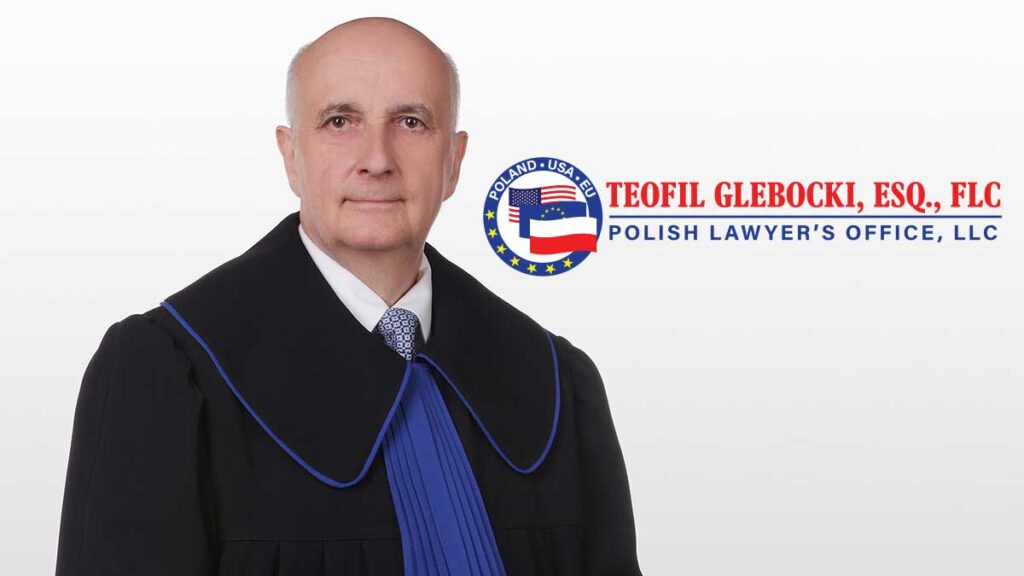
Attorney – Legal Counsel, Teofil Głębocki is authorized by the judicial authorities of the State of NJ to practice law in the USA in the field of Polish and European Union law – he also has his own law firm in Poland and cooperates with lawyers throughout the country
Power of Attorney
General characteristics
Power of Attorney – sometimes called authorization – is one of the forms of representation and consists of empowering someone to act on another’s behalf, with direct legal effect for the represented party. This means that a person residing in the USA (or a legal entity), in order to effectively perform legal actions in Poland, should authorize a natural person in Poland in writing (sometimes orally is also possible) to perform actions on their behalf and for their benefit. The signature on the power of attorney should be made in the presence of a Public Notary, and sometimes confirmed by attaching an “Apostille”, as described below.
The content of the power of attorney is very important; the attorney-in-fact can only act within the scope of the authorization. From my legal practice, I can assure you that a so-called general power of attorney, which does not specify the exact actions for the attorney-in-fact, causes many subsequent misunderstandings, and even legal disputes regarding its execution. It is possible to include not only the type and content of the authorization in the power of attorney, but also what actions the principal does not consent to, as well as brief statements.
Apostille – cessation of legalization of documents – including powers of attorney – in Consulates as a result of Poland joining the Hague Convention. The Convention Abolishing the Requirement of Legalisation for Foreign Public Documents was drawn up in The Hague on August 5, 1961. This simplifies the legalization of documents for legal transactions in a given country. Currently, over 80 states are parties to the Convention – the USA since October 15, 1981, and Poland since August 14, 2005 (Journal of Laws No. 112, item 939). The Hague Convention does not impose an obligation to legalize all documents by attaching an “Apostille”, even though Polish authorities and various bodies demand this type of legalization.
The US government has delegated the obligation of legalization to state governments. In the State of New Jersey, an “Apostille” can be obtained by sending the document to the address:
New Jersey Division of Revenue, Notary Unit
P.O. Box 452, Trenton, NJ 08646
The processing time for this service should be approximately 10 days. In practice, it is up to 2 weeks. It is advisable to include a self-addressed, stamped envelope. Expedited service is available for an additional fee, via overnight courier paid both ways to the address: New Jersey Division of Revenue, Attention – Notary Unit, 33 West State, 5th Floor, Trenton, NJ 08646-1001. The processing time for this service should be 8½ hours (in practice, including shipping, 3-4 days). USPS mail is not accepted.
A power of attorney may be revoked at any time, from the day on which the notice of its revocation reached the attorney-in-fact or the authority before which the attorney-in-fact is to act, with the exception of procedural matters.
Polish courts do not require the legalization of procedural powers of attorney, powers of attorney authorizing non-property matters, or matters that do not cause a change in ownership relations. Legalization is not required for powers of attorney authorizing me to represent clients before courts of all instances in Poland (District, Regional, Appellate, Supreme), before the European Court of Human Rights, and other European Union institutions.
Is the help of a lawyer always necessary? It is not essential, but I would advise extreme caution, especially in property matters, compensation claims, company registrations, and matters where the content of the power of attorney may affect the course, deadlines, and legal decisions.
If you have any questions – I am at your disposal.