How does the asylum procedure actually work in the USA? Who can apply? In 2026, after a series of presidential decrees by Donald Trump, is this path even realistic? Below is a practical overview of the procedure — without politics, focusing on what Polish-American readers should know if the question of asylum arises in their own family or circle of friends.
What asylum in the USA is NOT
The most common misunderstanding: political asylum in the USA is not a visa or an entry permit. You cannot “get asylum” before entering the United States. The asylum procedure is available only to individuals who are physically present in the USA or are arriving in the USA (including at a port of entry, i.e., an official border crossing) — regardless of whether they entered legally or without documents. Zbigniew Ziobro himself, according to his lawyer Bartosz Lewandowski, flew to the USA on a regular visa and used a Hungarian Geneva Travel Document. Whether he intends to apply for asylum in the USA is not officially known.
Two paths: affirmative and defensive
The asylum procedure in the USA is divided into two paths. The first, called affirmative asylum, applies to individuals who voluntarily file an application with the USCIS immigration office — before being placed in any deportation proceedings. The second, called “defensive asylum,” is filed in immigration court as a defense against deportation. In many cases, if USCIS does not grant asylum and the person does not have legal status, their case may be referred to immigration court — and proceed there as a defensive case.
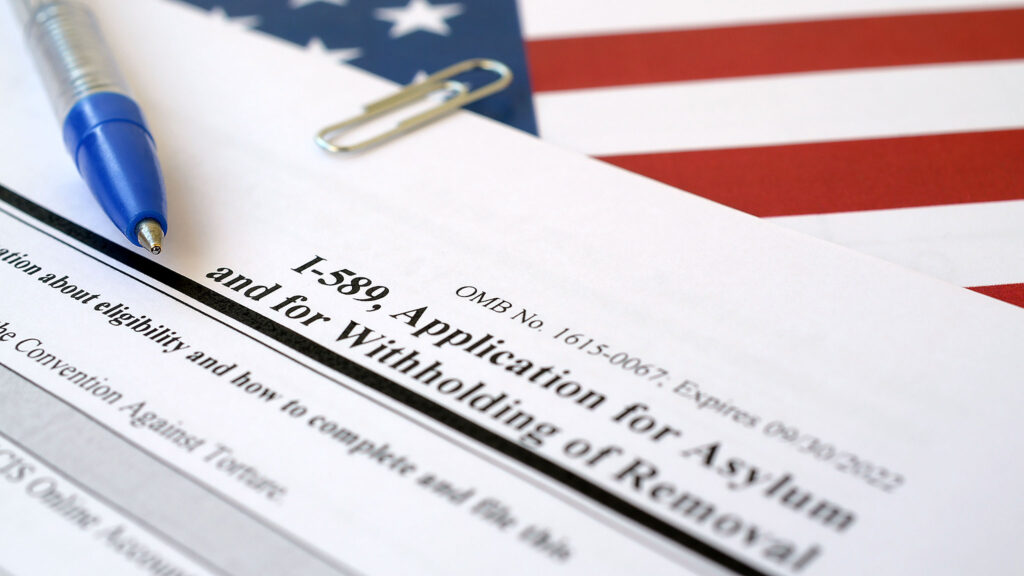
The basic document in both cases is Form I-589 — Application for Asylum and for Withholding of Removal. It can be downloaded from uscis.gov. Following legislative changes introduced as part of H.R. 1, new fees apply for filing the application and for maintaining a pending case (Annual Asylum Fee). The current amount of fees and their payment deadlines should always be checked directly on uscis.gov, as the regulations in this regard were modified several times in 2026.
Affirmative procedure step by step
The applicant fills out Form I-589 and sends it to USCIS within 1 year of their last arrival in the USA. This one-year deadline is an absolute limitation — rare exceptions include a change in country conditions, serious illness, or exceptional life circumstances. After filing the application, USCIS usually sends an acknowledgment of receipt within two to four weeks. The applicant then receives a summons for biometrics at one of the local Application Support Centers, where fingerprints and a photo are taken for security verification purposes. The next stage — an interview with an asylum officer — is the most variable in terms of duration. In 2026, depending on the USCIS office and country of origin, the waiting time for an interview ranges from several months to several years. After the interview, a decision usually comes within two to three months, although longer waits also occur.
According to current discussions by immigration practitioners, after the changes in March 2026, significantly shorter deadlines for submitting evidence appeared in some cases. Therefore, it is advisable to prepare all evidence — statements, country condition reports, medical and psychological documents, affidavits — even before sending Form I-589.
Work during the procedure
An asylum applicant can apply for an Employment Authorization Document (EAD) only after 150 days have passed since filing Form I-589, and the permit itself will not be issued earlier than after 180 days. This is the so-called “180-day asylum EAD clock.” In practice, in 2026, the processing time for I-765 can vary greatly — current processing times are best checked directly on uscis.gov. Since December 2025, USCIS has also shortened the validity of most new work permits from five years to eighteen months — to allow for more frequent security verification.
List of 39 high-risk countries — Poland is not on it
The most important change of 2026 for Polish-American applicants: Poland is not on the list of 39 countries subject to a full or partial travel ban, which is accompanied by a freeze on USCIS decisions. The full list of high-risk countries includes states mainly from Africa, the Middle East, Central Asia, and selected countries in Latin America and the Pacific. The current list and scope of restrictions should be verified directly in announcements from the Department of State (state.gov) and USCIS (uscis.gov), as they were expanded in December 2025 and January 2026.
After a period of suspension of some decisions, USCIS resumed processing asylum cases for individuals from countries not deemed high-risk on March 30, 2026 — while maintaining enhanced vetting, which may include analysis of publicly available information, including the applicant’s online activity and social media. For citizens of countries on the high-risk list, asylum applications remain practically frozen, with no announced resolution date.
After a positive decision
A person granted asylum by USCIS or an immigration court receives asylee status and automatic right to work in the USA. One year after the date asylum is granted, an application for a green card (Form I-485) can be filed. Naturalization generally requires five years as a lawful permanent resident, but since the asylee’s permanent residency date can be backdated by one year, in practice, the possibility of applying for citizenship may arise approximately four years after obtaining a green card — provided all other requirements are met. The path from filing I-589 to obtaining a US passport usually takes six to ten years, sometimes much longer.
Will Ziobro’s case change anything for the Polish diaspora
Most likely not. Poles in the USA who are considering political asylum are a very narrow group today — Poland is a democratic state, a member of NATO and the European Union, and the asylum grant rate for citizens of democratic states is historically very low. The Polish diaspora seeking status legalization in the USA more often uses other paths: family sponsorship, H-1B work visa, visa program for spouses of US citizens, or regular professional immigration. The mere fact that a former Polish minister found himself in the USA with a Hungarian protective document does not create a precedent for an ordinary Polish-American applicant — neither legal nor practical. Each asylum application is assessed individually, based on documented persecution in the country of origin due to race, religion, nationality, membership in a social group, or political opinion.
The asylum procedure has never been a simple path — and in 2026, after a series of Trump administration decrees, it became even more difficult and unpredictable. Individuals considering filing an application should consult with a licensed US immigration attorney before taking any steps. Form I-589 itself looks technical — in practice, every part of it determines the fate of the case.
Key facts 2026
Procedure
- Form: I-589, available at uscis.gov; after H.R. 1 changes, new fees apply for filing and maintaining a pending asylum application
- Filing deadline: 1 year from last arrival in the USA (possible exceptions)
- Evidence: should be prepared before filing I-589; in 2026, practitioners indicate significantly shorter deadlines for supplementing evidence in some cases
- Work: EAD after 180 days from I-589 (Form I-765 can be filed after 150 days)
- Green card: 1 year after asylum is granted (Form I-485)
- Citizenship: in practice, approx. 4 years after obtaining a green card (asylee’s permanent residency date may be backdated by one year)
Changes 2026 (Trump administration)
- New fees: filing fee and Annual Asylum Fee (current rates on uscis.gov)
- Shortening the validity of most new EADs to 18 months (from December 2025)
- Enhanced vetting — may include analysis of publicly available information, including social media
- High-risk/travel-ban countries: Poland is NOT on the list; the current list should be verified in Department of State and USCIS announcements
- Partial resumption of USCIS decisions from March 30, 2026, for applicants from countries not deemed high-risk
Bartosz Karczmarski — the above text is for informational purposes only and does not constitute legal advice. Each asylum case requires individual consultation with a licensed immigration attorney in the United States. Polish-American directory of experts and law firms: PolishPages.com.
📱 Download the PolishPages app:
App Store (iPhone) | Google Play (Android)