Krzysztof Bronk – Vatican
Leo XIV recalls John Paul II
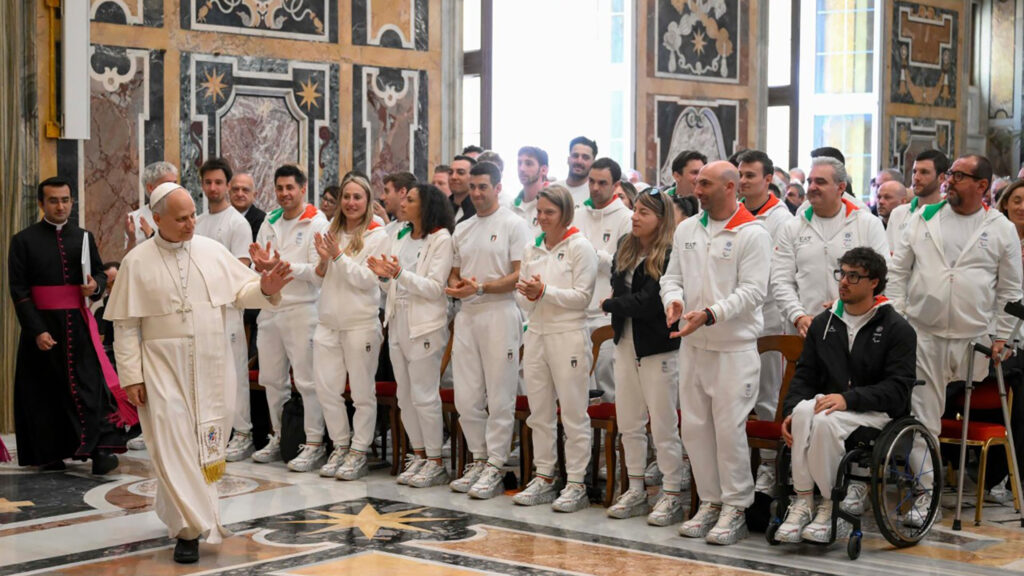
The Pope referred to the words of St. John Paul II, who called Jesus “the true athlete of God”. I pray that He will inspire you to take on increasingly noble challenges – said Leo XIV.
Harmony of spirit and body
The Holy Father pointed to the need to cultivate within oneself a harmony between body and spirit. Only in this way can one achieve the “life in abundance” of which the Gospel speaks and which Leo XIV chose as the title of his letter for the opening of the Olympics. He admitted that sport can build character in us, but it requires a solid spiritual life. Thanks to this, it becomes an effective form of education. “Through sport, we learn to know our own body, without worshipping it as an idol, to control emotions, to compete without losing the sense of brotherhood, to accept defeat without despair, and victory without arrogance.”
The original vocation of sport
“By developing the mind along with the body – the Pope continued – sport is authentic when it remains human, that is, faithful to its original vocation: to be a school of life and talent. A school where we learn that true success is measured by the quality of relationships: not by the number of awards, but by mutual respect, shared joy in the game.”
Sport in times of war
The Holy Father pointed to the particular importance of sport understood in this way in our times, “marked by polarization, rivalry, and conflicts that turn into devastating wars.” It can become a true space for encounter, not a display of strength, but the cultivation of relationships.
One can compete without hatred
The Pope noted that the Winter Games showed “that one can compete without hatred. That one can win without humiliating. That one can lose without losing oneself. And this applies not only to sport. It applies to social life, politics, relations between nations. Because sport, if lived well, becomes a laboratory of reconciled humanity, where diversity is not a threat, but a richness.”
Your testimony inspires people
Leo XIV also pointed to the importance of the personal testimony of athletes, a testimony of an honest and beautiful lifestyle. Their struggles in Milan and Cortina were “a story composed of gestures, effort, expectations, falls, and new beginnings. During the Games, we saw not only bodies in motion, but stories: stories of sacrifice, discipline, perseverance. In particular, during the Paralympic competitions, we observed how limitation can become a place of revelation: not something that hinders a person, but something that can be transformed, and even turned into new advantages. You, athletes, have become biographies that inspire many people.”