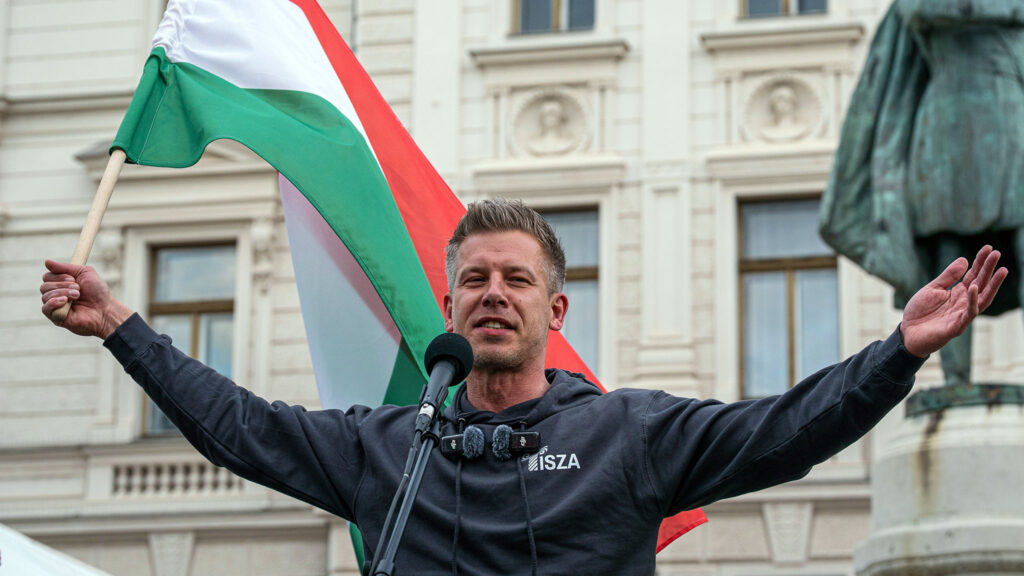
“I congratulated the winning party,” he told his supporters in Budapest. “We will serve the Hungarian nation from the opposition.” After sixteen years of uninterrupted power, four consecutive election victories, and the systematic dismantling of democratic institutions — Orbán is leaving. Hungary is changing course. And Europe — from Brussels to Warsaw — breathed a sigh of relief.
Who Won and How
Péter Magyar and his center-right Tisza party are heading for a supermajority in the 199-member Hungarian parliament. With 45% of votes counted, Tisza leads with 51% to 40% for the ruling Fidesz. According to exit polls published after the polling stations closed, Tisza could win between 132 and 135 seats — with the threshold of 133 seats providing a constitutional majority, allowing for changes to the constitution and key laws.
Voter turnout exceeded 77% — a record in the history of post-communist Hungary. At 6:30 PM, two hours before the polls closed, 140,000 more people had already voted than in the entire 2022 election. Hungarians came out in droves — and voted for change.
Magyar, a lawyer in his forties and a former Fidesz member, built his campaign on Hungarians’ growing frustration with the cost of living, corruption surrounding Orbán, and deteriorating healthcare. “This was a choice between East and West, propaganda and honest debate, corruption and clean public life,” he said after casting his vote.
Why Orbán Lost
Orbán has governed since 2010 — sixteen years in which Hungary transformed from a parliamentary democracy into what Orbán himself called an “illiberal state.” He changed the constitution, subjugated the judiciary, took control of the media, funneled public money to oligarchs in his circle, and systematically blocked European Union actions — from aid to Ukraine to common migration policy. Freedom House, an American organization monitoring democracy since 1941, now classifies Hungary as a “partially free” country. Transparency International considers it the most corrupt state in the European Union.
But it wasn’t Brussels that removed Orbán from power — it was the Hungarians. Three years of economic stagnation, rising prices, oligarchs enriching themselves before the public’s eyes, deteriorating healthcare and education — these were the issues that dominated Magyar’s campaign. Orbán tried to divert attention with foreign policy — attacks on Zelensky, accusations of Ukrainian sabotage, and threats against the EU — but this time he failed.
In the final days of the campaign, recordings of conversations between Foreign Minister Péter Szijjártó and Russian officials were revealed, in which he coordinated with Moscow to weaken sanctions and shared information about Ukraine’s EU accession process. The leak — published 72 hours before the election — became a central theme of the opposition’s final campaign push.
Trump and Vance Tried to Save Orbán
Orbán has been one of Trump’s closest international allies since 2016. He himself boasted that he participated in “writing the program” for Trump’s policy. Since 2022, the annual CPAC conference — a flagship event of the American right — has had its satellite edition in Budapest. In the final days before the election, Vice President JD Vance flew to Budapest to personally support Orbán — an unprecedented step that did not help.
Orbán’s defeat is a blow to Trump and to the global nationalist right-wing movement that treated Hungary as a model to emulate. Macron, Mertz, the prime ministers of Estonia and Sweden congratulated Magyar — each emphasizing that Hungary is “returning to Europe.”
What This Means for Poland
Poland and Hungary are countries whose fates in the European Union intertwined a decade ago — when both governments (PiS in Warsaw, Fidesz in Budapest) mutually blocked EU disciplinary procedures and jointly built a vision of “a different Europe.” Since the change of power in Poland in 2023, the alliance has broken down, but Orbán continued to block EU aid to Ukraine, which Poland could not accept.
Magyar’s victory means that Poland loses its last reason for diplomatic compromises with Budapest — and gains a potential ally in Central Europe who speaks the same language about Ukraine, NATO, and the rule of law. For Prime Minister Nawrocki, this is good news: the frozen package of 90 billion euros in EU loans for Ukraine, which Orbán had blocked, can finally move forward. And frozen EU funds for Hungary itself may be unblocked, which will stabilize the economy of Poland’s closest neighbor.
For the Polish diaspora in America — Orbán was a polarizing figure. Part of the Polish diaspora admired him for defending traditional values and resisting Brussels. Part considered him a tool of Moscow that weakened Poland’s position in Europe. Regardless of which side you stand on — one thing is certain: Hungary after Orbán will be a different country. Europe after Orbán will be different.
On the Danube in Budapest — on the right bank, below the Tisza party headquarters — people are celebrating with champagne, tears, and Hungarian flags. András Petőcz, a writer and poet, told CNN that the feeling reminds him of 1989 — “when the communist regime fell.” Sixteen years have ended. A new chapter begins.
Kamil Brzozowski, poland.us
Hungarian Elections 2026 | April 12, 2026 | Turnout: 77%+ (record) | Tisza (Magyar): ~51% | Fidesz (Orbán): ~40% | Seat Projection: Tisza ~135 / 199 (supermajority)
Read more at poland.us. Looking for a Polish business in the USA? PolishPages.com.