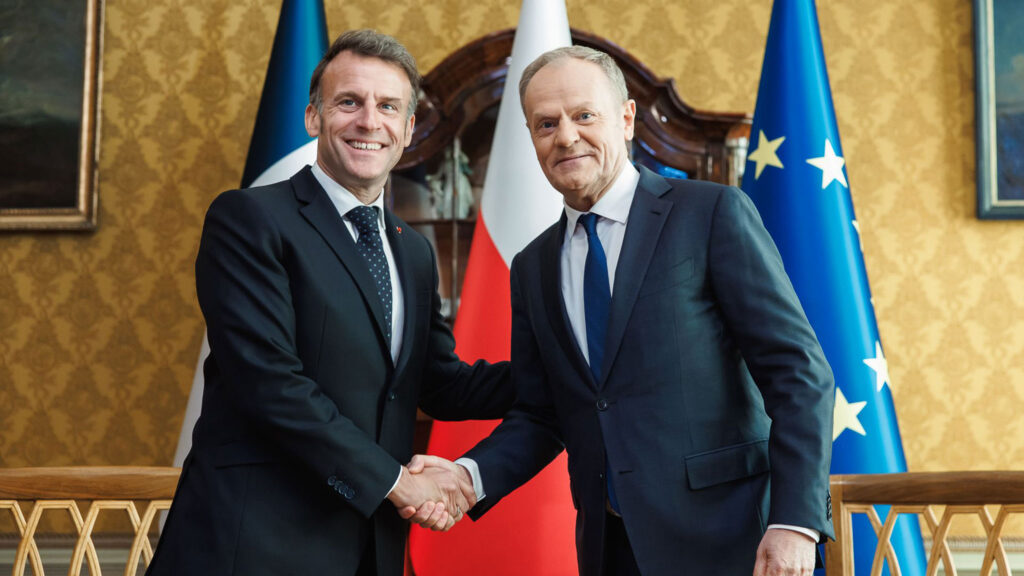
Three documents were signed: a joint declaration on energy, a letter of intent on satellite telecommunications, and an agreement on organizing the France-Poland 2027 Season. Macron announced that France wants to include Poland in its nuclear deterrence doctrine. Tusk announced joint Dragon 2027 maneuvers. And finally, during the Bronisław Geremek Award ceremony, actor Andrzej Seweryn was honored for his contribution to strengthening Polish-French relations. In the background of the entire visit, one question hung, which no one officially asked: what will Poland do if Trump’s America ceases to be a reliable ally?
What happened in Gdańsk
Macron arrived accompanied by four ministers. This speaks more than diplomatic protocol – France treated this visit as a serious strategic event, not a courtesy meeting. The official backdrop was the first Polish-French Friendship Day, patronized by Maria Skłodowska-Curie. But beneath this veneer of politeness, discussions about much more serious matters were taking place.
Three specific documents were signed during the summit. The first – a joint declaration on energy. The second – a letter of intent concerning cooperation in satellite telecommunications, crucial for military security in times of Russian provocations in space. The third – an agreement between the French Institute, the Adam Mickiewicz Institute, and the Polish Institute in Paris on organizing the France-Poland 2027 Season, a major cultural event for artistic exchange between the two countries.
The most important topics of discussion: France’s nuclear deterrence, joint military exercises, nuclear energy, support for Ukraine, and the protection of children and youth from internet addiction. Macron confirmed that France wants to involve eight European countries, including Poland, in its nuclear deterrence doctrine – on the principles of a common defense bloc, with the proviso that the decision to use nuclear weapons will always remain in Paris’s hands. Tusk jokingly replied that he would not want to see French Rafales with nuclear bombs over Poland – but added that Poland is one of the countries interested in this initiative. The joke covered the seriousness: for the first time in decades, Europe is seriously discussing a nuclear umbrella that is not American.
The second pillar: nuclear energy. France had previously signed an agreement to supply turbines for a Polish nuclear power plant, and now both countries want to build, as Macron put it, a “global, integrated partnership in the field of civilian nuclear energy.” For Poland, this is an opportunity to become independent from Russian gas and American technology simultaneously.
Tusk recalled the event from September 2025, when Russian drones intruded into Polish airspace. France reacted instantly. “In this uncertain moment, France’s swift reaction was unequivocal and confirmed that NATO is something very concrete and that in difficult times, one can count on European allies,” the prime minister said. This part of the speech had a double meaning: if Trump’s America increasingly hesitates whether Article 5 of the Atlantic Treaty is truly binding, France showed that for it – it is.
Why Gdańsk, not Warsaw
The choice of city was not accidental – and the French noticed it. Commentators in Paris noted that Gdańsk is not only Tusk’s hometown and the cradle of Solidarity, but also a center located about 100 kilometers from Kaliningrad, a Russian outpost in the European Union. Macron visited the French military cemetery in Gdańsk – the largest necropolis of its kind outside France. He met with Lech Wałęsa at the European Solidarity Centre. He was the fifth French president to visit Gdańsk – after de Gaulle, Giscard d’Estaing, Mitterrand, and Sarkozy.
But the choice of Gdańsk also had a double meaning, which French and Polish media wrote about openly. The official program did not include a meeting between Macron and President Karol Nawrocki. Rafał Leśkiewicz, spokesman for the Presidential Palace, stated that the Chancellery sought such a meeting – which is standard for visits by heads of state – but the government blocked it. “Prime Minister Tusk was very keen that President Nawrocki and Macron should not meet. That is why he insisted that the visit take place in Gdańsk, not in Warsaw,” said Leśkiewicz, quoted by Polsat News, Onet, and other media. Deputy Minister Marcin Bosacki, in turn, claimed it was the French side’s decision. The Ministry of Foreign Affairs did not send a formal invitation to the Presidential Palace. Leszek Miller of the SLD called the situation “crude.” PiS sympathizers used stronger words.
This is the Polish cohabitation theater, which the Polish diaspora in America knows from the years 2007–2015, when Tusk was prime minister and Kaczyński was president. It has returned. In full glory, with a new cycle of contempt for old actors.
What’s really playing in the background
Macron and Tusk spoke, ostensibly, about Russia, Ukraine, and European security. But one thing hung in the air and was spoken in half-words: Trump’s America has ceased to be a reliable ally. Tusk explicitly stated at the conference that “the world has undergone a permanent change” and Europe “urgently needs unity.” French commentators put it more unequivocally: the entire visit aimed to strengthen Franco-Polish cooperation in the face of actions by both Russia and the United States.
For Poland, this is a cautious mental revolution. For twenty years, Warsaw built its security policy around one axiom – that America would always come to its aid. Today, a president sits in the White House who has publicly suggested that NATO’s Article 5 might be “negotiable.” Trade wars are ongoing between Washington and European allies. The American team is negotiating with Iran in Islamabad, while Europe sits on the sidelines. In this world, Poland is beginning to look for a Plan B. The closest Plan B after Washington is Paris.
This does not mean that Warsaw is giving up on America. American bases in Poland remain. Military equipment from the USA is still being purchased. But something has changed in the language of Polish politicians – even the pro-American ones. French commentators noticed this nuance and were clearly pleased.
Andrzej Seweryn receives the Geremek Award
The visit concluded with the Bronisław Geremek Award ceremony for contributions to strengthening Polish-French relations. The laureate was Andrzej Seweryn – a theater and film actor, for years the director of the Polish Theater in Warsaw, and also a member of the French Comédie-Française, whose career has spanned decades between Warsaw and Paris. Seweryn is a figure who symbolically connects both countries better than most documents signed by politicians.
The choice was not accidental. Geremek – a historian, opposition activist, and foreign minister of the Third Polish Republic – was one of the architects of Poland’s path to Europe and had close, personal relations with the French intelligentsia. The award in his name, presented to Seweryn in Gdańsk, in the presence of the French president, is a cultural gesture, but also a political one – showing that Polish-French friendship does not begin in 2026, but has deep roots in the Polish intelligentsia and its long-standing ties with Paris.
For the Polish diaspora in the USA, Seweryn is a well-known name – he has acted in films by Spielberg, Wajda, and Polański, and has been the voice of Polish culture in Western media for decades. The distinction in Gdańsk is a Polish bow to an artist who for years has shown the French and Americans that Polish culture does not begin with Chopin and does not end with pierogi.
What this means for the Polish diaspora
From a Polish diaspora perspective, this visit might look like another political spectacle in a distant country – but in reality, it touches on issues that could impact the daily lives of Poles in America. Firstly: if Europe truly builds its own defense umbrella, the pressure to maintain a large American presence on NATO’s eastern flank will decrease. American taxpayers – including Poles with dual citizenship – will stop financing this presence at the current level.
Secondly: the Polish-French economic partnership opens new business channels for Polish diaspora companies in the USA that trade with Poland. On April 22, the Polish-French Economic Forum, part of the European Economic Congress, will take place in Katowice. Polish companies will be looking for French partners – and Polish diaspora exporters can mediate in the USA – Poland – France triangle.
Thirdly, and perhaps most importantly: the Polish prime minister publicly announces the building of a “Plan B” in case America ceases to be a reliable partner. For the Polish diaspora, which for decades treated American citizenship as a guarantee of security, this is a signal – from Warsaw, from a pro-American government – that the world is changing faster than many would like to notice.
Macron returns to Paris with a package of agreements and promises. Tusk remains in Poland with the question of whether Nawrocki will not take this success away from him in the coming weeks. And Gdańsk, which 45 years ago was the cradle of Solidarity, today once again becomes a place from which Poland tries to say something important to Europe. Only this time it is no longer shouting – it is talking to ministers at the table.
Kamil Brzozowski, poland.us
Polish-French summit in Gdańsk – April 20, 2026 | Locations: Uphagen House, Artus Court, European Solidarity Centre | Discussion time: over 2 hours + plenary meeting with ministers | French delegation: Macron + 4 ministers | Documents signed: joint declaration on energy, letter of intent on satellite telecommunications, agreement on France-Poland 2027 Season | Topics: nuclear deterrence, nuclear energy, support for Ukraine, Dragon 2027 maneuvers, protection of children on the internet | Meeting with Nawrocki: did not take place | Bronisław Geremek Award laureate: Andrzej Seweryn | April 22: Polish-French Economic Forum in Katowice | Based on the official communiqué of the Chancellery of the Prime Minister (gov.pl/web/premier), materials from Rzeczpospolita, Defence24, gdansk.pl
Read also: Magyar forms government in Hungary and travels to Warsaw
Read more at Poland.us.