Fr. Łukasz Bankowski – Vatican
Memory of the Witnesses of Faith
In his greeting addressed to Poles, the Pope recalled that in Poland, this day is celebrated as the Day of Martyrdom of the Polish Clergy during World War II. He encouraged the faithful not to forget those who gave their lives during the times of totalitarianism. “Invoke the intercession of bishops, priests, and seminarians – martyrs of 20th-century totalitarianisms,” he said. He emphasized that their testimony can today be a source of spiritual strength and an inspiration to faithfulness to the Gospel.
Full text of the Pope’s greeting:
“I cordially greet the Poles. Today, on the anniversary of the liberation of the German Nazi camp in Dachau, you celebrate the Day of Martyrdom of the Polish Clergy during World War II. Invoke the intercession of bishops, priests, and seminarians – martyrs of 20th-century totalitarianisms. May they intercede especially for young people, so that they may courageously respond to God’s call. I bless you all!”
Dachau – a place of special testimony
The Dachau concentration camp, established in 1933, was one of the first Nazi camps and became a place of particular persecution for the clergy. Over 2,700 priests were sent there, the vast majority of whom were Poles. Many of them died from hunger, disease, medical experiments, and inhumane treatment. For the Church in Poland, Dachau remains a symbol of martyrdom and faithfulness to the very end.
Crowds of Poles at the audience
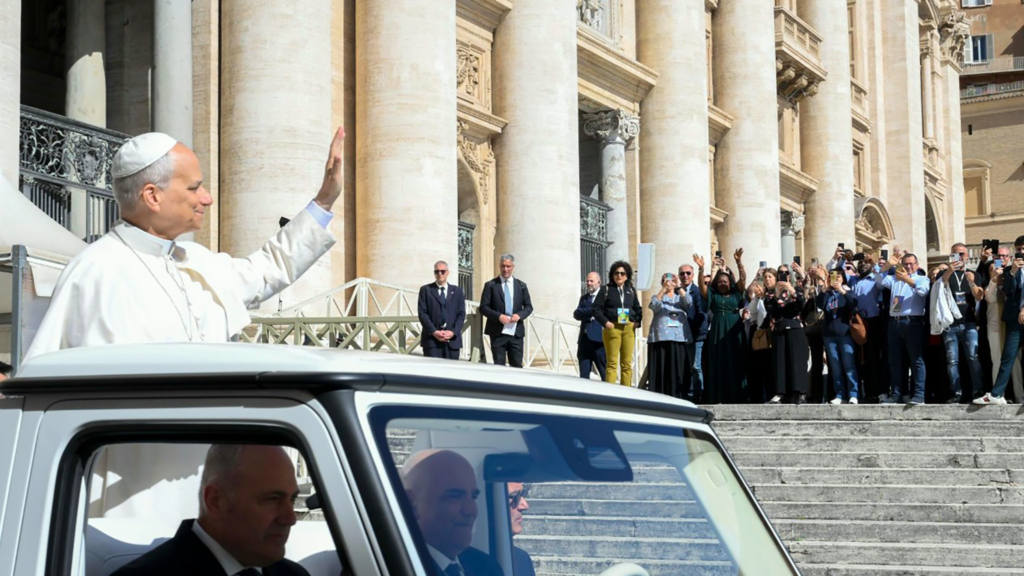
Approximately one thousand registered pilgrims from Poland participated in the papal audience, arriving in organized groups, including from Gniezno, Sieradz, and various towns in the Archdiocese of Katowice. Parishioners from Włocławek, Tarnobrzeg, Lanckorona, Łagów, Radom, Pewel Wielka, and Szczecin were present, as well as the Sisters of Mercy of St. Charles Borromeo from Trzebnica.
The meeting also included representatives of the Foster Families Association, wards of the St. Stanisław Kostka Special Educational Center “Home for Boys” in Częstochowa, youth from Bodzanów near Wieliczka, and officers from Prison No. 1 in Wrocław.
Poland was also represented by ensembles and choirs, including the “Rzeszowiacy” Song and Dance Ensemble from Mielec and the “St. Wojciech Choir” from the Parish of Christ the King and the Annunciation of the Blessed Virgin Mary in Rawicz, as well as numerous individual pilgrims from home and abroad.