
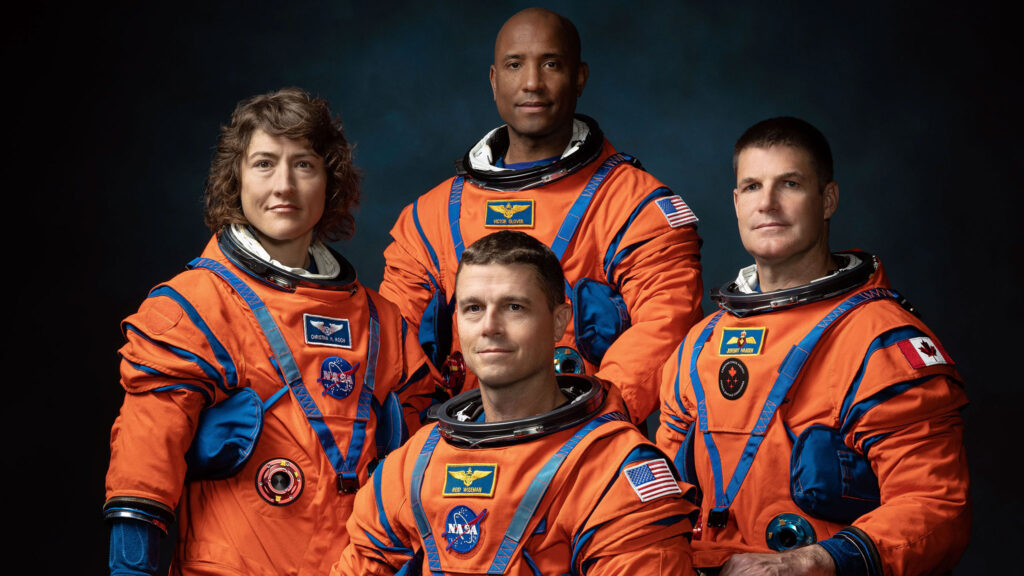
On board — four astronauts: Reid Wiseman, Victor Glover, Christina Koch, and Canadian Jeremy Hansen. This is the first crewed mission to the Moon since Apollo 17 in December 1972 — a fifty-three-year break. Orion is currently flying towards the Moon and today broke the record for the farthest distance a human has ever traveled from Earth: 252 thousand miles. Farther than anyone before.
What this mission is about
Artemis II is a ten-day test flight — astronauts will not land on the Moon or enter lunar orbit. Instead, they will circle it from the side invisible from Earth, see the entire far side of the Moon in one view — something even Apollo astronauts never saw from such a perspective — and return to Earth. Landing in the Pacific Ocean is scheduled for April 10.
The mission tests all Orion capsule systems with humans on board for the first time: life support systems, deep space navigation, communication, and the heat shield for atmospheric re-entry. If Artemis II succeeds, the next mission — Artemis III, planned for 2028 — will land humans on the Moon’s surface for the first time in half a century.
Record farther than Apollo 13
According to NASA’s calculations, Artemis II will reach a maximum distance of 252,021 miles from Earth — breaking the record of Apollo 13, which in 1970 was 248,655 miles from our planet (though not by choice then, but after an onboard malfunction). For Artemis II, this distance is planned and controlled. Four people will be farther from home than anyone in human history.
The crew making history
The Artemis II crew is history in a single sentence. The first Black astronaut to fly towards the Moon. The first woman on a lunar mission. The first Canadian — and the first astronaut from outside the USA and USSR/Russia — to leave low Earth orbit. And a commander who led record-breaking research on the International Space Station.
Reid Wiseman — Commander. Hails from Baltimore, Maryland. In 2014, he spent 165 days on the International Space Station as a flight engineer for Expedition 41. Together with the crew, he conducted over 300 scientific experiments and set a station record — 82 hours of research in one week. From 2020–2022, he served as Chief of the NASA Astronaut Office. Now he commands the first crewed lunar mission in half a century.
Victor Glover — Pilot. Hails from California. A naval aviator, test pilot for F/A-18 Hornet, Super Hornet, and EA-18G Growler fighter jets. Selected as an astronaut in 2013 while working as a legislative fellow in the U.S. Senate. He flew to the International Space Station as pilot of the Dragon capsule on the Crew-1 mission and was a flight engineer for Expedition 64/65. On Artemis II, he is the first Black astronaut to fly towards the Moon.
Christina Koch — Mission Specialist. Engineer and researcher, NASA astronaut since 2013. In 2019, she spent 328 consecutive days on the International Space Station — one of the longest continuous stays in history. She participated in the first all-female spacewalks. Before becoming an astronaut, she worked on building scientific instruments for space missions and conducted polar research in Antarctica and the Arctic. On Artemis II, she is the first woman on a lunar mission.
Jeremy Hansen — Mission Specialist (Canadian Space Agency). Born in London, Ontario. A colonel in the Canadian Armed Forces, former fighter pilot. Selected as an astronaut in 2009. He worked as CAPCOM at NASA’s Mission Control Center in Houston, participated in the NEEMO 19 underwater mission (simulating space conditions), ESA’s CAVES cave program, and geological expeditions in the Canadian Arctic. In 2017, he became the first Canadian to lead a NASA astronaut class. On Artemis II, he is the first astronaut from outside the USA and Russia to leave low Earth orbit.
The launch was dramatic — an hour before the planned ignition, the Flight Termination System showed a “No-Go” status. Engineers used equipment from the space shuttle era to verify the system and avoid a delay. The weather also threatened postponement — thick clouds and a risk of lightning. But at 6:35 PM, the rocket launched — with the force of 8.8 million pounds of thrust, shaking the Florida coast.
“It was surprising,” said pilot Victor Glover from orbit the day after launch. “You prepare, having no expectations — but somewhere in the back of your mind, you hope you’ll fly.”
What this means for the Polish diaspora
Artemis II is an American mission — and as Poles living in America, we can look at it with pride. It’s a rocket with a Florida zip code, but with the ambition of all humanity. The next Artemis missions are not only meant to land on the Moon — they are meant to build a base there and prepare the way for Mars.
Poland has its own moment in space — the MikroSAR spy satellite launched from Vandenberg, California, just a week ago. America flies to the Moon, Poland watches from orbit. Two countries, a shared fascination with what lies beyond.
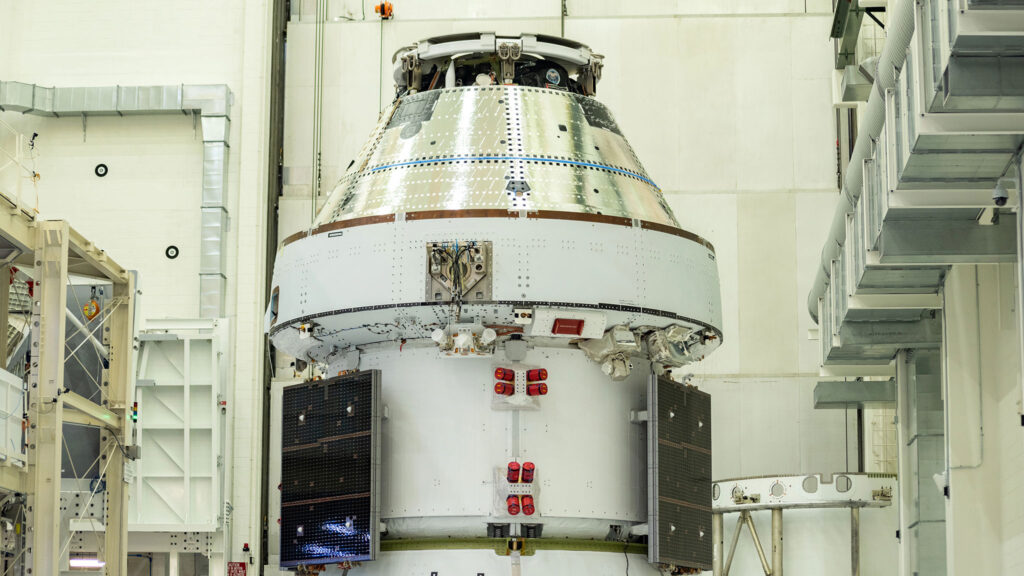
Orion “Integrity” is now flying somewhere between Earth and the Moon. Soon, four people will see the far side of the Moon with their own eyes. And on April 10 — if all goes well — they will land in the Pacific. We’re keeping our fingers crossed.
Arthur Skok, poland.us
Artemis II | Launch: April 1, 2026, 6:35 PM ET, Kennedy Space Center, Florida | Landing: ~April 10, 2026, Pacific Ocean | Crew: Reid Wiseman (Commander), Victor Glover (Pilot), Christina Koch (Mission Specialist), Jeremy Hansen (CSA, Mission Specialist) | Distance Record: ~252,000 miles from Earth
Read also: Polish MikroSAR satellite in orbit
Read more at poland.us. Follow space and technology on poland.us from the perspective of the Polish diaspora.