
So, a kurna chata (smokehouse), as we know, is a type of primitive dwelling, which, of course, lacked a chimney, and yet its inhabitants were glad that the smoke in this hut killed the insects bothering them.
“Kurna Maiden”
As is known, there was no built-in stove in the mentioned hut, only an open hearth located in the central part of the living area. The smoke emanating from this hearth escaped the house only in windy weather, through an opening placed at the highest point of the roof, commonly called a “smoke vent” or “air vent”. In a kurna chata, everything and everyone was, as one might easily guess, sooty, and maidens “smelling” of smoke were colloquially called “kurniakówki”. It was difficult for them to find a suitor, unless he also lived in a kurna chata.
In the 19th Century
Such primitive dwellings were still built in some parts of old Poland at the end of the 19th century. They were sporadically inhabited even in the interwar period. However, these huts were already rather rare, because everyone by then knew that the smoke filling the interior of such a hut had a harmful effect on the health of its inhabitants. It is worth remembering that some inhabitants of kurna chatas considered smoke to be very beneficial. For example, lice and fleas did not breed in such a hut, and less fuel was used for heating during winter in such huts than in houses with chimneys.
Unnecessary Stoves
Stoves, as is known, were considered a kind of technical novelty at the beginning of their existence. In more modern, often two-room huts, the interior was divided into a black room with an open hearth and a representative white room. In the white room, people slept and received guests. The open hearth, despite everything, was a source of heat and, of course, light throughout the house. This way, they saved on buying candles.
Thatched Roofs
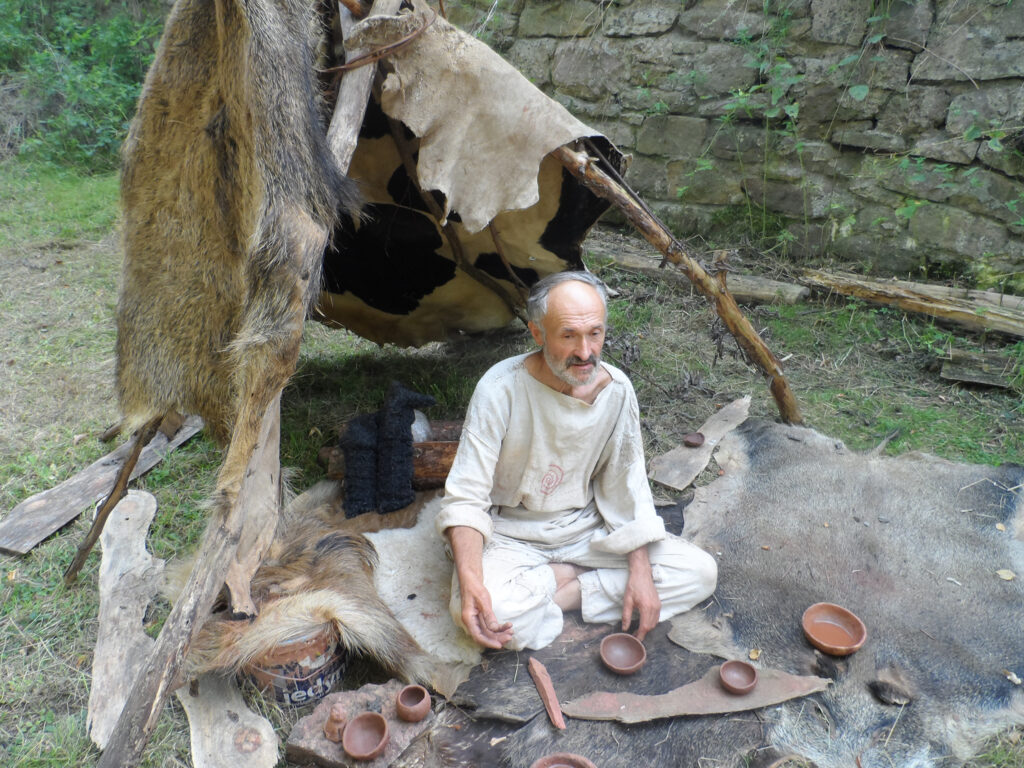
From the earliest times, the roofs of kurna chatas were made of thatch. Later, such roofs were covered with wooden shingles. The walls of kurna chatas were often built from wooden beams arranged in a so-called “sumikowa” construction. However, it should be remembered that the first kurna chatas were made entirely of animal skin.
Floor in the Kurna Chata
The floor of the kurna chata was simply a clay threshing floor; over time, it was made of wood. The ceiling was covered with a so-called “polepa”, whose basic ingredient was, of course, dried reed, and sometimes straw. Such huts were always built facing the main road. As a rule, these huts had one window and one door, commonly called an “entrance”.
The editorial staff of “Dziennik Polonijny” had the opportunity to see a reconstructed primitive kurna chata in Skarżysko-Kamienna, Świętokrzyskie Voivodeship.