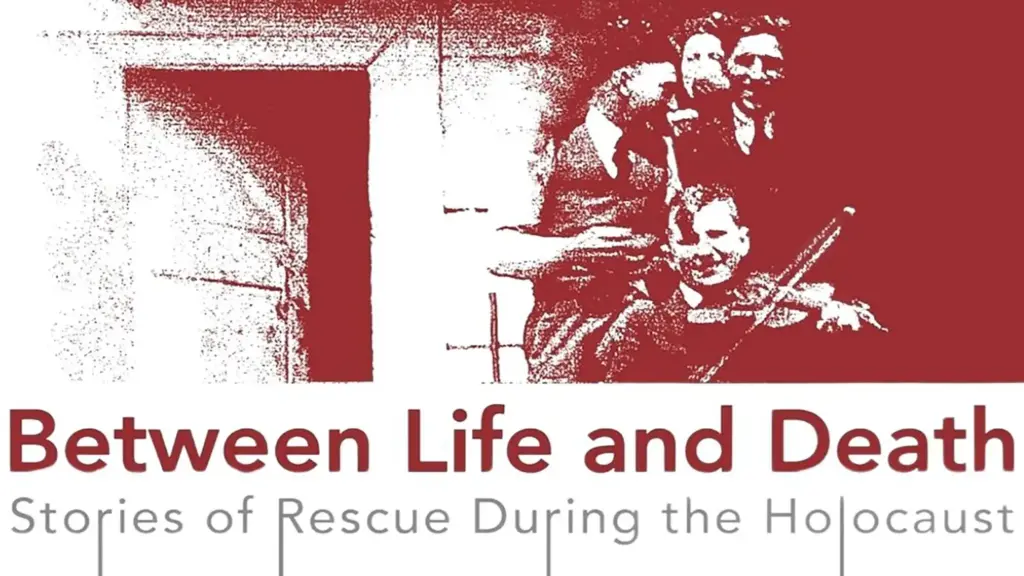
The Pilecki Institute in New York and the European Network Remembrance and Solidarity invite you from August 25 to October 29 to the exhibition “Between Life and Death: Stories of Rescue during the Holocaust”, an academic seminar on September 9, and a meeting with Holocaust survivor Eva Paddock on September 10. Admission is free.
A journey that has lasted eight years
In January 2018, the exhibition “Between Life and Death” premiered at the European Commission headquarters in Brussels. Its goal was to remind people that alongside the history of the Holocaust, there is also a lesser-known history of assistance—of people who, faced with occupation, chose not to look away, even though it risked death, deportation, or imprisonment.
Eight years have passed since that premiere, and the exhibition has visited more than thirty locations in Europe, Asia, and North America—from Amsterdam, Dresden, Bern, and Strasbourg to Osaka, Yokohama, and Gifu in Japan. Few historical exhibitions enjoy such a long life on the road. ENRS treats it almost as a living project that gains a new local context each time because, as the curators emphasize, the history of rescue looks different in every city it reaches.
The third New York stop this year
The Pilecki Institute on Greenwich Street is not New York’s first encounter with this exhibition this year. In January 2026, the panels of “Between Life and Death” were displayed at the UN Headquarters in Manhattan. The opening was attended by, among others, Poland’s Ambassador and Permanent Representative to the UN Krzysztof Szczerski and Minister of Culture and National Heritage Marta Cienkowska, and the speakers included Elżbieta Ficowska, one of the exhibition’s protagonists. A few weeks later, the exhibition was hosted by yet another New York institution.
The August–October presentation at the Pilecki Institute is thus the third one this year and one of the longest in the exhibition’s entire eight-year tour—it will last over two months instead of the typical few weeks. For the New York Polish community, this is a rare opportunity to see the exhibition without having to travel to the UN headquarters or happen to catch a shorter, earlier showing.
Fifteen countries and one rule
The exhibition’s curators—Dr. Martyna Grądzka-Rejak from ENRS and Klara Jackl from the POLIN Museum of the History of Polish Jews—gathered stories from fifteen countries: Croatia, Denmark, Estonia, France, Germany, Hungary, Ireland, Italy, Lithuania, the Netherlands, Poland, Romania, Slovakia, Ukraine, and the United Kingdom. Each story has two sides—the rescuer and the rescued—as well as its own historical context. The organizers emphasize that the situation of someone hiding a neighbor in Warsaw differed fundamentally from that of someone doing the same in Paris.
A separate panel is dedicated to diplomats from Poland, Japan, the United Kingdom, Portugal, Switzerland, Sweden, and Denmark who—often against the instructions of their own governments—issued life-saving visas and documents in Germany, France, Hungary, Lithuania, and Switzerland. This is a thread that is discussed less frequently than the Holocaust itself: a handful of officials who at a decisive moment placed conscience above procedure.
The little girl from the wooden crate
One of the exhibition’s protagonists is Elżbieta Ficowska—now an activist with the “Children of the Holocaust” association, and in 1942 a six-month-old infant. She was smuggled out of the Warsaw ghetto hidden in a wooden crate on a brick cart as part of a rescue network organized by Irena Sendler. The only trace of the girl’s true identity was a silver spoon engraved with the name “Elżunia” and her date of birth—her parents and grandparents perished in the ghetto shortly afterward.
Ficowska was one of approximately two and a half thousand children rescued by Sendler’s network. Her story, documented among others by the POLIN Museum—the exhibition’s partner—shows that acts of assistance took place not only on a grand diplomatic scale, but also on the scale of a single family, a single neighbor, and a single decision made within a few minutes.
The last train from Prague
The second part of the New York program will feature a meeting with Eva Paddock on September 10, the day after the academic seminar. Paddock was three and a half years old when, in July 1939, she and her sister boarded one of the last Kindertransport trains from Prague to England, organized by Sir Nicholas Winton. Winton, then a young London stockbroker, organized eight such transports and saved a total of 669 children—although the world only learned about this in the late 1980s when his wife found an album with photos and a list of names in the attic. Today, Winton is called the “British Schindler”.
During the meeting at the Pilecki Institute, Paddock, a teacher and former school principal by profession, will talk not only about her escape itself, but also about how she rebuilt her life in a foreign country—and how, in her opinion, to teach about the Holocaust with sensitivity rather than turning it into a dry history lesson. The evening will be complemented by a presentation of “Sound in the Silence”, an ENRS educational program, introduced by its artistic director Dan Wolf. The day before, on September 9, researchers from five countries—including Prof. Daniel Blatman from Israel and Prof. Piotr Trojański from Poland—will take part in the seminar “Memory in Transition: A Transatlantic Perspective on Holocaust Education” to compare how the Holocaust is taught today on both sides of the Atlantic.
How to visit
The exhibition is open from August 25 to October 29 at 92 Greenwich Street in Manhattan. Admission to all three events—the exhibition, the seminar, and the meeting with Eva Paddock—is free.
- Tuesday–Thursday: 12:00 PM–6:00 PM
- Friday: 12:00 PM–8:00 PM
- Saturday: 12:00 PM–7:00 PM
The gallery is closed on Mondays, Sundays, and federal holidays. More information about the exhibition and the full list of cities that have already hosted it is available on the European Network Remembrance and Solidarity website.